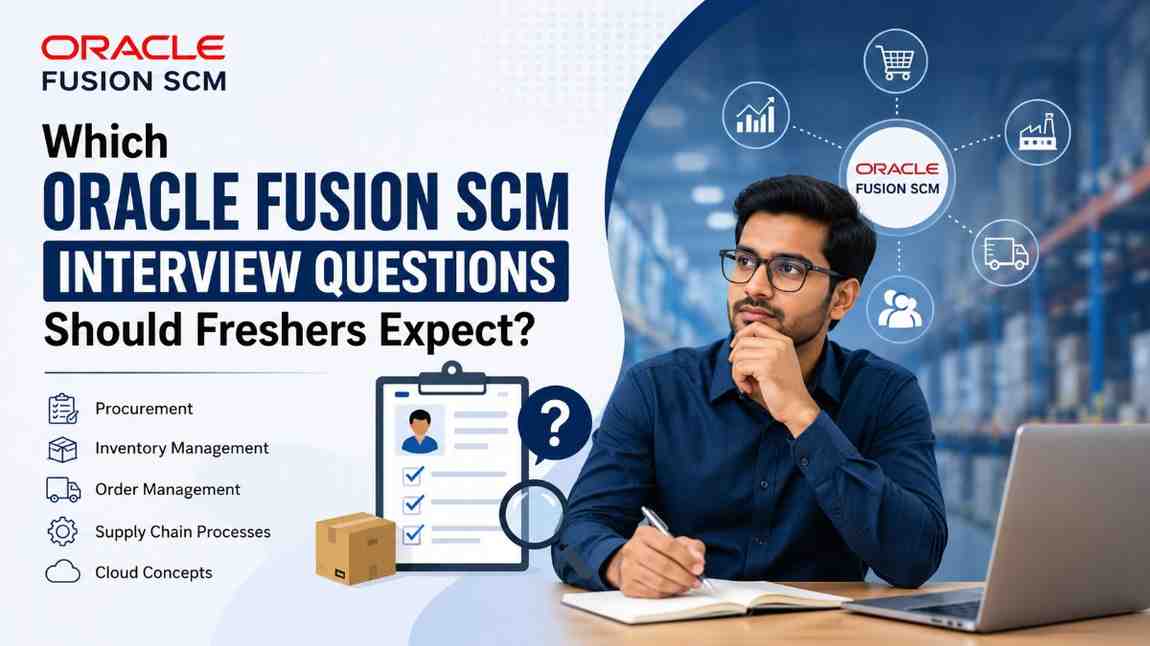
Which Oracle Fusion SCM Interview Questions Should Freshers Expect?
-

- Published Updated
- 5,699 views
Introduction
The demand for Oracle Fusion Supply Chain Management (SCM) professionals is steadily increasing as organizations continue to adopt cloud-based business applications. Companies are looking for candidates who understand supply chain processes and can work with Oracle Fusion SCM applications effectively. Soft Online Training offers industry-oriented learning programs that help freshers gain practical knowledge and prepare for real-world job opportunities.
If you are planning to attend an Oracle Fusion SCM interview as a fresher, it is important to understand the types of questions recruiters commonly ask. Interviewers generally focus on fundamental supply chain concepts, Oracle Fusion SCM modules, business processes, and basic cloud application knowledge. Preparing for these questions can significantly improve your confidence and chances of getting selected.
In this blog, we will explore the most common Oracle Fusion SCM interview questions that freshers should expect and how they can prepare effectively.
Why Companies Hire Freshers in Oracle Fusion SCM
Organizations implementing Oracle Fusion SCM often require enthusiastic candidates who can learn quickly and adapt to cloud technologies. Freshers who complete an Oracle Fusion SCM training and possess a strong understanding of supply chain processes are often considered for entry-level positions such as:
Oracle Fusion SCM Associate Consultant
SCM Functional Analyst
Procurement Analyst
Inventory Coordinator
Supply Chain Support Executive
Oracle Cloud SCM Trainee
Employers generally assess both technical knowledge and business process understanding during interviews.
Basic Oracle Fusion SCM Interview Questions for Freshers
1. What is Oracle Fusion SCM?
Sample Answer:
Oracle Fusion SCM is a cloud-based supply chain management solution that helps organizations manage procurement, inventory, manufacturing, order management, logistics, and product lifecycle management through a unified platform.
2. What are the key modules in Oracle Fusion SCM?
Sample Answer:
The major Oracle Fusion SCM modules include:
Procurement
Inventory Management
Order Management
Product Management
Manufacturing
Supply Planning
Cost Management
Logistics Management
Supplier Portal
Interviewers frequently ask this question to evaluate your understanding of the overall SCM ecosystem.
3. What is Supply Chain Management?
Sample Answer:
Supply Chain Management is the process of planning, sourcing, manufacturing, delivering, and managing goods and services from suppliers to customers while maximizing efficiency and reducing costs.
4. What are the benefits of Oracle Fusion SCM?
Sample Answer:
Benefits include:
Cloud-based accessibility
Real-time data visibility
Improved inventory management
Better supplier collaboration
Automated procurement processes
Enhanced forecasting and planning
Scalability and flexibility
Oracle Fusion Procurement Interview Questions
5. What is Oracle Fusion Procurement?
Oracle Fusion Procurement is a module that helps organizations automate purchasing activities, manage suppliers, create purchase orders, and control procurement processes efficiently.
6. What is a Purchase Requisition?
A Purchase Requisition is an internal request raised by employees or departments to procure goods or services.
7. What is a Purchase Order (PO)?
A Purchase Order is an official document sent to suppliers specifying products, quantities, pricing, and delivery details.
8. What is the difference between a Purchase Requisition and a Purchase Order?
Purchase Requisition |
Purchase Order |
Internal request |
External document |
Raised by employees |
Sent to suppliers |
Requires approval |
Acts as a purchasing contract |
Oracle Fusion Inventory Management Questions
9. What is Inventory Management?
Inventory Management involves tracking, storing, controlling, and maintaining stock levels to ensure smooth business operations.
10. What are inventory organizations in Oracle Fusion?
Inventory Organizations are business units used to manage inventory transactions, storage locations, and inventory control processes.
11. What is a Subinventory?
A Subinventory is a physical or logical grouping within an inventory organization used to store inventory items.
12. What is a Locator?
A Locator identifies the exact storage location of an item within a warehouse or subinventory.
Oracle Fusion Order Management Questions
13. What is Order Management?
Order Management is the process of capturing, processing, fulfilling, and tracking customer orders from creation to delivery.
14. What is an Order Lifecycle?
The order lifecycle generally includes:
Order Creation
Order Validation
Scheduling
Shipping
Billing
Completion
15. What is Order Fulfillment?
Order Fulfillment refers to the process of delivering products or services to customers after receiving an order.
Oracle Fusion Cloud Concepts Questions
16. What is Oracle Fusion Cloud?
Oracle Fusion Cloud is Oracle’s integrated suite of cloud applications designed to manage enterprise business functions such as finance, human resources, customer experience, and supply chain management.
17. Why is Oracle Fusion SCM considered a cloud application?
Oracle Fusion SCM operates on Oracle Cloud infrastructure, allowing users to access applications through the internet without maintaining on-premise hardware.
18. What are the advantages of cloud-based SCM systems?
Advantages include:
Lower infrastructure costs
Automatic updates
Enhanced security
Remote accessibility
Faster implementation
Business Process-Based Questions
19. Explain the Procure-to-Pay (P2P) Process.
The Procure-to-Pay process includes:
Creating Purchase Requisition
Approval Workflow
Purchase Order Creation
Goods Receipt
Invoice Processing
Payment to Supplier
20. Explain the Order-to-Cash (O2C) Process.
The Order-to-Cash process includes:
Customer Order Creation
Order Processing
Product Shipment
Invoice Generation
Payment Collection
These process-oriented questions are commonly asked during fresher interviews.
Scenario-Based Interview Questions
21. What would you do if inventory stock is unavailable?
You would:
Verify inventory levels
Check alternative warehouses
Coordinate with procurement teams
Initiate replenishment requests
22. How would you handle delayed supplier deliveries?
You would:
Contact the supplier
Identify the reason for delay
Update stakeholders
Explore alternate sourcing options if necessary
23. Why is supplier management important?
Supplier management helps ensure:
Timely deliveries
Quality products
Cost control
Strong supplier relationships
Business continuity
Functional Knowledge Questions
24. What is a Business Unit in Oracle Fusion?
A Business Unit represents an operational division responsible for conducting business transactions.
25. What is a Legal Entity?
A Legal Entity represents a legally registered organization that can enter contracts and comply with regulatory requirements.
26. What is a Supplier in Oracle Fusion SCM?
A Supplier is an external organization or individual providing goods or services to the company.
27. What is Item Master?
Item Master is a centralized repository that stores item-related information used across various SCM modules.
Behavioral Interview Questions for Freshers
28. Why do you want to build a career in Oracle Fusion SCM?
Employers expect candidates to discuss:
Interest in cloud technologies
Supply chain management opportunities
Career growth potential
Enterprise application expertise
29. How do you handle learning new technologies?
Discuss:
Continuous learning
Online courses
Hands-on practice
Certification preparation
30. What are your strengths?
Examples:
Quick learner
Problem-solving ability
Team collaboration
Analytical thinking
Tips to Crack Oracle Fusion SCM Interviews
Learn Core SCM Concepts
Understand procurement, inventory, logistics, planning, and order management processes thoroughly.
Gain Hands-On Practice
Practical exposure helps you answer scenario-based questions confidently.
Complete Professional Training
Enrolling in an Oracle Fusion SCM Training program helps you understand real-world implementations, workflows, and business scenarios.
Practice Mock Interviews
Regular mock interviews improve communication skills and confidence.
Understand End-to-End Business Processes
Recruiters often evaluate candidates on Procure-to-Pay and Order-to-Cash cycles.
Conclusion
Freshers preparing for Oracle Fusion SCM interviews should focus on both supply chain fundamentals and Oracle Fusion application concepts. Most interviewers assess your understanding of procurement, inventory management, order management, cloud technology, and business processes rather than expecting deep implementation experience.
A structured Oracle Fusion SCM Course can provide the foundational knowledge required to answer interview questions effectively. Combined with practical exercises and Oracle Fusion SCM Training, freshers can develop the confidence needed to secure entry-level roles in Oracle Cloud SCM implementations.
As organizations continue adopting cloud-based supply chain solutions, Oracle Fusion SCM remains one of the most promising career paths for aspiring supply chain and ERP professionals.