Fast, Secure Italy Certificate Attestation in the UAE — Step-by-Step Guide
-

- March 06th, 2026
- 134 views

Get a free topical map and start building content authority today.
Quick introduction
Intent: Transactional
This guide explains how to get Italy certificate attestation UAE for Italian diplomas, birth certificates, marriage certificates, and other official documents. It covers the full practical path—notarization, ministry stamps or apostille where applicable, translation, consular legalization, timing estimates, costs, and secure service options—so that documents issued in Italy are accepted by UAE authorities and employers.
- Primary need: Authenticate Italian documents so UAE bodies accept them.
- Core steps: certify/notarize in Italy → apostille or ministry legalization → UAE Ministry/consular steps → certified translation (if required).
- Use the FAST Attestation Checklist below and expect 3–20 working days depending on route and translation needs.
Italy certificate attestation UAE: quick, secure steps
Start with the document type and issuing authority. Certificates issued by Italian public authorities normally require a notarized copy and an apostille (for Hague Convention countries) or legalization through Italian Ministries and the UAE embassy/consulate if apostille is not accepted. The exact combination depends on whether both countries accept apostille or require diplomatic legalization. For background on the apostille system and convention status, consult the Hague Conference status table: Hague Conference Apostille Convention status.
When to use apostille vs consular legalization
Key distinction
Apostille is a one-step authentication for documents exchanged between countries that are both parties to the Hague Apostille Convention. If either country is not a member, or if a specific UAE authority requires embassy legalization, use the consular legalization route.
Fast Attestation Checklist (FAST)
Use the FAST Attestation Checklist to avoid missed steps and delays.
- F — Format & Originals: Confirm the required original document, certified copy, or notarized copy.
- A — Authenticate: Notary public and/or municipal authentication in Italy.
- S — Stamp & Seal: Obtain apostille or ministry/consular legalization as required.
- T — Translate & Test: Get a certified Arabic/English translation and verify acceptance with the target UAE authority.
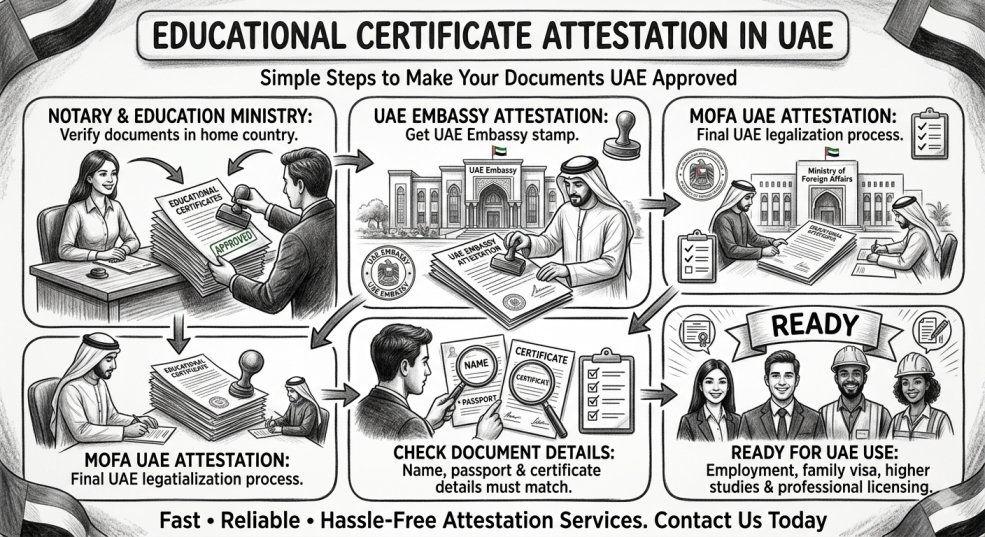
Step-by-step process
1. Identify document category and recipient
Confirm whether the receiving UAE authority (immigration, employer, university, or licensing body) requires an apostille, UAE Ministry of Foreign Affairs (MoFA) attestation, or consular/legalization. Also verify translation language and whether the translation must be certified by a licensed translator in the UAE.
2. Notarization in Italy (if required)
For many private documents, a notarized copy is the first step. Public records (e.g., birth or university diplomas) may be processed directly by the issuing authority for apostille or legalization.
3. Apostille or Ministry legalization
If both countries accept apostille, obtain the apostille from the competent Italian authority. If apostille is not applicable, obtain the required ministry certifications and the UAE consular stamp in Italy or in the UAE according to instructions from the receiving party.
4. UAE Ministry of Foreign Affairs (MoFA) or embassy steps
Some documents will need final attestation by the UAE MoFA once in the UAE. Confirm whether this step is required and whether a certified translation must be submitted at this stage.
5. Certified translation and submission
Translate the attested documents into Arabic or English, using a certified translator if required. Submit to the receiving organization and keep certified copies for records.
Real-world example
Scenario: A professional moving to Abu Dhabi needs an Italian university degree attested for an employment visa. Steps followed: obtain an official copy of the diploma from the issuing Italian university; secure apostille from the competent Italian authority; translate the diploma into English and Arabic by a certified translator; submit the apostilled diploma and translations to the UAE employer and then to the UAE Ministry of Foreign Affairs for final verification as required. Total time: typically 7–14 working days if apostille route is available; longer if consular legalization or extra translations are needed.
Practical tips for speed and security
- Prepare originals and certified copies in a single visit to avoid repeat notarizations.
- Confirm the exact receiving authority requirements in the UAE before starting to avoid rework.
- Use tracked shipping and registered courier services for cross-border document movement.
- Request priority or express apostille services where available in Italy to shorten processing time.
Common mistakes and trade-offs
Common mistakes
- Assuming apostille is always accepted—some UAE procedures still ask for consular legalization.
- Skipping certified translations or using uncertified translators, which can lead to rejection.
- Not confirming whether copies or originals are required for a particular authority.
Trade-offs
Faster routes (express apostille, courier) cost more but reduce downtime. Full consular legalization can be slower but sometimes unavoidable when apostille is not recognized for that document type. Outsourcing to an attestation service saves time at a premium; doing all steps independently is cheaper but requires more coordination and travel.
Costs and timing overview
Typical timelines: apostille processing in Italy can take 1–10 working days depending on backlog and whether an expedited service exists; UAE MoFA steps usually take a few working days once documents are in the UAE. Budget for certified translations (per page), courier fees, and any consular or ministry fees. Exact fees fluctuate by provider and location—verify current rates with the issuing offices.
Secure handling and tracking
Use tamper-evident packaging, photographed records of each stamped stage, and tracked courier services for international transfers. Keep both digital scans and physical copies of every attested document.
Core cluster questions
- How long does apostille on an Italian diploma take for UAE use?
- Does the UAE accept apostille from Italy for birth certificates?
- What translations are accepted for attested Italian documents in the UAE?
- When is consular legalization required instead of apostille for UAE authorities?
- How to check if an Italian certificate needs additional UAE Ministry attestation?
Practical checklist before submission
- Confirm receiving UAE authority and its exact attestation requirements.
- Obtain original or notarized copy from Italian issuer.
- Secure apostille or ministry/consular stamps as required.
- Get certified translation to the required language(s).
- Use tracked shipping and retain digital backups.
Final notes
Following the FAST Attestation Checklist and confirming requirements with the target UAE authority prevents common delays. When in doubt, verify with the issuing Italian authority and the UAE recipient before starting. The Hague Conference link above provides definitive details on apostille applicability and country status.
FAQ
Italy certificate attestation UAE: typical processing time?
Processing time depends on route: apostille can take 1–10 working days in Italy plus transit; consular/legalization usually takes longer (10–20 working days) because multiple offices and translations may be required. Expedited services reduce timelines at additional cost.
Is an apostille enough for UAE visa purposes?
Often yes for countries where apostille is accepted, but some UAE departments or specific document types may still require consular legalization or UAE MoFA attestation. Always confirm with the visa sponsor or licensing authority.
Can translations be done in the UAE after attestation?
Yes. Certified translations by a licensed translator in the UAE are commonly accepted; verify if the receiving agency requires translation before or after attestation.
What documents typically need attestation?
Common documents include university diplomas/transcripts, professional certificates, birth and marriage certificates, police clearances, and powers of attorney. Each has slightly different issuance and attestation steps.
Where to verify official apostille and legalization rules?
Consult official government sites and international conventions for definitive guidance. For apostille convention status and member country details, see the Hague Conference status table linked above.