Complete Guide to UAE Marriage Certificate Attestation: Steps, Checklist & Costs
-

- March 01st, 2026
- 296 views

Get a free topical map and start building content authority today.
The process of UAE marriage certificate attestation is essential when submitting a foreign marriage certificate for legal use in the United Arab Emirates—for residency sponsorship, government records, or family-related services. This guide compares common routes, clarifies required documents, and provides a practical checklist so decisions are efficient and low-risk.
- Detected intent: Commercial Investigation
- Primary focus: UAE marriage certificate attestation process, requirements, timelines
- Includes: ATTEST Checklist, real-world example, practical tips, trade-offs and common mistakes
UAE marriage certificate attestation: overview and when it is required
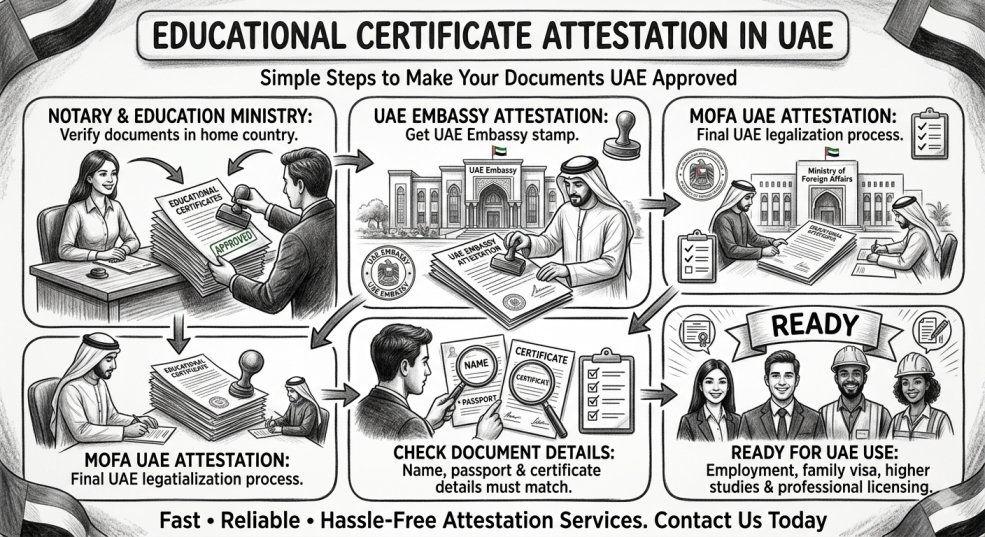
Attesting a marriage certificate means confirming the document's authenticity through a sequence of verifications—local authentication, translation (if required), embassy or consular legalization, and final endorsement by the UAE Ministry of Foreign Affairs. Typical reasons to complete attestation are spouse visa applications, family sponsorship, or official registration with UAE authorities.
How attestation routes differ: embassy vs. MOFA paths
Two common options exist: (1) consular/legalization via the issuing country's embassy to the UAE and (2) multistep verification culminating in endorsement by the UAE Ministry of Foreign Affairs. Each approach requires slightly different documents and timelines.
Key stages in most attestation workflows
- Local authentication (issuing authority, e.g., civil registry)
- Certified translation if the document is not in Arabic or English
- Notary or state-level validation (depends on country)
- Embassy/consulate legalization for UAE (or apostille where applicable)
- Final attestation by the UAE Ministry of Foreign Affairs
attestation for marriage certificate UAE: documents, translation and formats
Documents vary by issuing country. At minimum, expect to provide the original marriage certificate, a government-issued ID copy (passport), and any translation certificates. If the issuing country participates in the Hague Apostille Convention, an apostille can replace certain embassy steps. Otherwise, embassy legalization followed by MOFA endorsement is required.
Commonly required documents
- Original marriage certificate (issued by civil authority)
- Certified translation into English or Arabic, if needed
- Copies of passports or national IDs of both spouses
- Proof of previous authentications (notary, apostille, or state stamp)
- Power of attorney if using an agent
ATTEST Checklist: a named framework for consistent processing
Use the ATTEST Checklist to track progress and reduce rework. ATTEST expands to Authenticate, Translate, Test (verify local stamps), Embassy/legalize, Submit to MOFA, Track.
- Authenticate — Obtain certified copies and local validation from the issuing authority.
- Translate — Use an accredited translator and attach translation certificates where required.
- Test — Confirm whether apostille or embassy legalization is required for the issuing country.
- Embassy/legalize — Get the document legalized by the UAE embassy or consulate if no apostille.
- Submit to MOFA — Final attestation by the UAE Ministry of Foreign Affairs.
- Track — Keep tracking numbers and digital copies until the attested original is returned.
Typical timelines, costs and trade-offs
Processing time ranges from a few days to several weeks depending on country of issue, need for translation, and whether an apostille is available. Costs vary by country and service (translation, notary, embassy fees, MOFA fees, courier). Using a commercial service can be faster but costs more; self-processing is cheaper but requires more time and familiarity with government procedures.
Trade-offs / common mistakes
- Using an apostille (when available) shortens steps but only applies to Hague Convention countries.
- Skipping certified translation requests can cause rejection at MOFA or the embassy.
- Relying on non-accredited translators or unverified agents increases risk of delays or rejections.
Real-world example: sponsoring a spouse in Dubai
Scenario: A UAE resident needs to sponsor a spouse whose marriage certificate was issued in Country X. Country X requires a state-level stamp and embassy legalization (no apostille). Steps taken: obtain a certified copy from the civil registry, commission an accredited translation into English, get notary and state validation, legalize at the UAE embassy in Country X, and finally submit to the UAE Ministry of Foreign Affairs for final attestation. Expected timeline: 2–6 weeks depending on appointment availability and courier times. Practical outcome: an attested original accepted by the General Directorate of Residency and Foreigners Affairs for visa processing.
Practical tips for smoother attestation
- Start early: begin the authentication process before visa or government deadlines—allow 3–6 weeks when in doubt.
- Verify requirements with the issuing authority and the UAE embassy in that country; requirements change by jurisdiction.
- Use certified translators and keep copies of every submission and tracking number.
- Confirm whether a Hague apostille is accepted for your country to skip embassy legalization steps.
- Consider a local agent only if the documentation process is unclear or if remote pickup is needed; always request itemized receipts.
Where to check official rules and updates
For official MOFA validation rules and current procedures, consult the UAE Ministry of Foreign Affairs and International Cooperation website: Ministry of Foreign Affairs UAE. For embassy-specific steps, contact the UAE embassy or consulate in the certificate’s issuing country.
Core cluster questions for related articles and internal linking
- How long does attestation of a foreign marriage certificate for the UAE usually take?
- When is an apostille accepted instead of embassy legalization for UAE use?
- What documents are required to sponsor a spouse in the UAE with a foreign marriage certificate?
- How to get a certified translation accepted by UAE authorities?
- What are the embassy and MOFA fees for marriage certificate attestation?
Common mistakes to avoid
- Assuming apostille covers all countries—confirm country status under the Hague Convention.
- Submitting incomplete sets (missing IDs or translation certificates) that trigger rejections.
- Using informal courier services without tracking for returning original documents.
Next steps and decision guide
Decide whether to self-process or use a service based on time sensitivity and familiarity with embassy procedures. If deadlines are tight or the issuing country’s bureaucracy is complex, paying for an experienced agent could reduce risk. If cost is the priority and timelines are flexible, self-processing should be viable with careful follow-up.
Final checklist before submission
- Original marriage certificate and certified copies
- Certified translation (where required)
- Proof of notary/state-level validation or apostille
- Embassy legalization stamp or MOFA pre-requirements
- Return envelope and courier tracking
FAQ
How long does UAE marriage certificate attestation take?
Typical processing ranges from 2–6 weeks depending on country-specific steps, availability of appointments, translation needs, and whether an apostille applies. Use the ATTEST Checklist and allow buffer time for re-submissions.
Is an apostille enough for use in the UAE?
An apostille is accepted only from countries that are part of the Hague Apostille Convention. Where an apostille is not available, embassy or consular legalization is required before MOFA endorsement.
Can a certified translator in the home country be used for UAE procedures?
Yes—use accredited or court-approved translators. Confirm acceptance with the embassy or consulate handling the legalization step to ensure the translation format and seals meet requirements.
What are the common fees involved in attestation?
Fees commonly include translation costs, notary/state validation fees, embassy/legalization fees, MOFA fees, and courier charges. Exact amounts vary by country and service provider.
Can an agent process attestation on behalf of applicants?
Yes—agents are commonly used for convenience, especially when the issuing country requires in-person steps. Ensure the agent provides a clear scope of work, itemized fees, and secure handling of originals.