
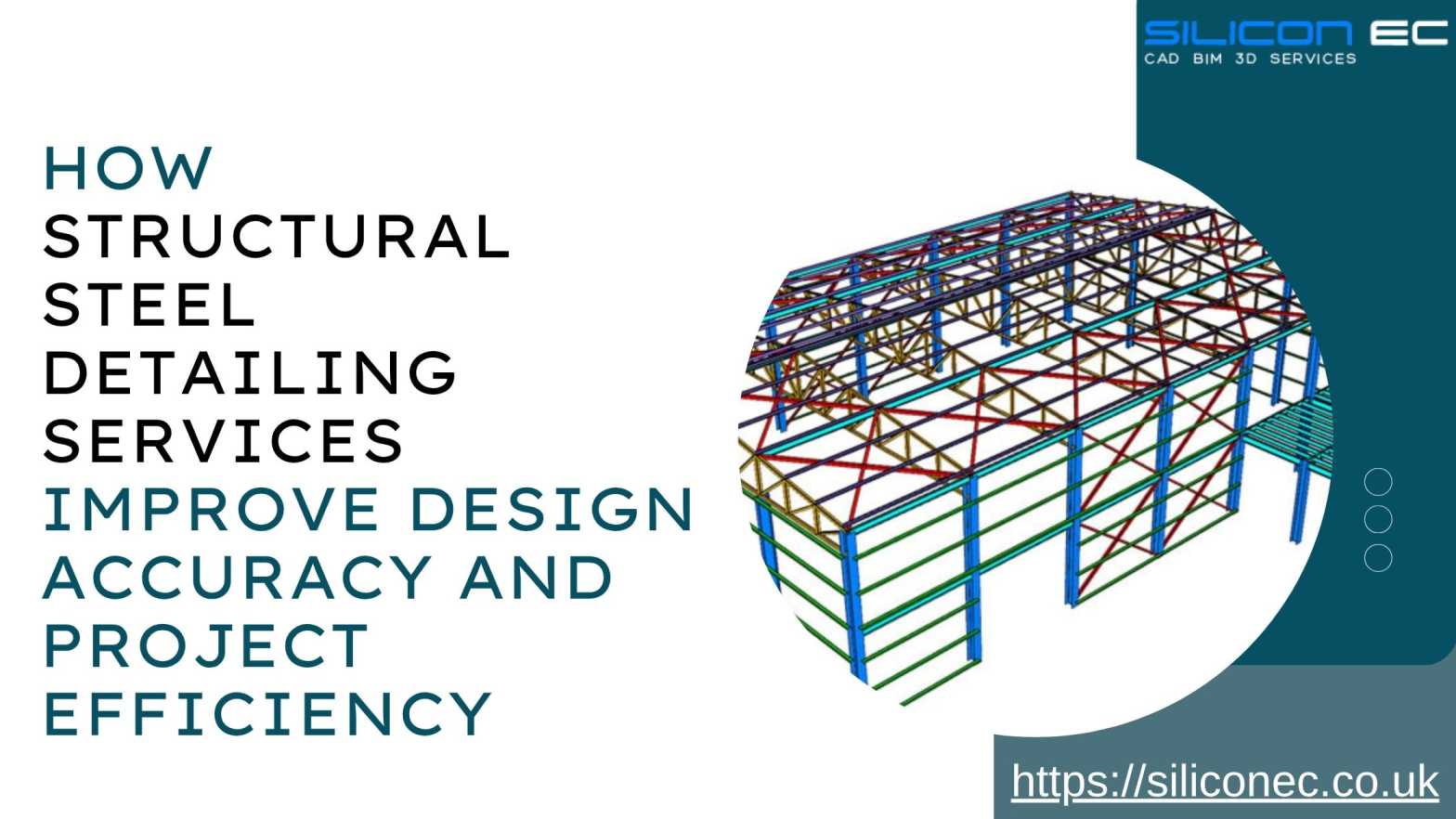
How Structural Steel Detailing Services Improve Design Accuracy and Project Efficiency
-

- September 15th, 2026
- 1,715 views
Introduction
Structural steel plays an important role in many modern building and infrastructure projects. From commercial buildings and industrial facilities to warehouses and complex structures, steel provides strength, flexibility, and durability. However, the performance of a steel structure depends not only on the engineering design but also on how accurately that design is translated into detailed drawings.
This is where Structural Steel Detailing Services become essential. Steel detailing converts structural engineering information into precise drawings and documentation that explain how individual steel components should be fabricated, assembled, and installed. Accurate detailing creates a clear connection between structural design intent and practical project execution.
As projects become more complex, detailing also needs to address coordination, revisions, material information, connections, and constructability. A well-prepared detailing workflow can help reduce errors, minimize unnecessary revisions, improve communication, and support smoother project progress.
This article explains how professional steel detailing contributes to design accuracy and project efficiency, the major types of drawings involved, common challenges, and the importance of selecting the right detailing partner.
What Are Structural Steel Detailing Services?
Structural steel detailing is the process of preparing detailed technical documentation for steel members and their connections. These documents provide the information required to understand the dimensions, locations, materials, connections, and arrangement of structural steel components.
Professional Steel Detailing Services may cover a wide range of requirements, including:
General arrangement drawings
Anchor bolt plans
Fabrication drawings
Assembly drawings
Erection drawings
Connection details
Material lists
Bill of materials
Revision documentation
The level of detail depends on the project's requirements and the stage of development.
The main purpose is to communicate the structural design accurately and clearly so that everyone involved has a consistent understanding of the steelwork.
Why Accuracy Matters in Steel Detailing
Steel structures consist of numerous interconnected components. A small discrepancy in one member can affect several other elements.
Accurate detailing helps ensure that:
Members have the correct dimensions
Connections are properly represented
Components are identified consistently
Openings and penetrations are coordinated
Materials are clearly specified
Assembly information is easy to understand
Errors discovered during later stages can result in additional revisions, material adjustments, or schedule disruptions. Careful detailing at the documentation stage helps reduce these risks.
How Steel Detailing Improves Design Accuracy
1. Converts Engineering Information Into Detailed Documentation
Structural engineering drawings communicate the overall design intent. Detailing develops this information into component-level documentation.
For example, an engineer may specify a beam size and connection concept. A detailed drawing can then communicate the relevant dimensions, connection arrangement, holes, plates, bolts, weld information, and other required details.
This creates a clearer path from engineering design to fabrication and assembly.
2. Provides Precise Dimensions
Steel components must fit together correctly. Detailed drawings provide dimensions and positioning information needed to maintain accuracy.
Consistent dimensional information helps reduce ambiguity and supports better quality control.
3. Improves Connection Documentation
Connections are among the most important aspects of steel detailing. Properly documented connections help communicate how members interact with one another.
Depending on project requirements, drawings may illustrate bolts, plates, welds, stiffeners, brackets, and other connection components.
4. Supports Design Review
Detailed drawings provide an opportunity to review the steel structure before fabrication or installation activities begin.
Potential inconsistencies can be identified and addressed while changes are still manageable.
The Role of Steel Shop Drawings
Steel Shop Drawing documentation provides detailed information about individual steel components and their fabrication requirements.
These drawings may contain:
Member dimensions
Material specifications
Hole locations
Plate details
Connection information
Weld information
Part marks
Assembly references
Clear shop drawings help ensure that steel components are produced according to the approved design information.
When drawings are consistent and well organized, they also make it easier for different project participants to review and understand the steelwork.
Importance of Assembly Drawing Services
Assembly Drawing Services focus on showing how individual steel components come together to form larger assemblies.
An assembly drawing may identify:
Main members
Secondary members
Connection components
Part marks
Bolt arrangements
Assembly relationships
Relevant dimensions
These drawings provide a useful reference for understanding the relationship between individual parts.
Well-prepared assembly documentation can also simplify coordination and reduce confusion when multiple components need to be brought together.
Miscellaneous Steel Detailing Services
Not every steel element belongs to the primary structural framing system. Buildings often contain secondary and supporting steel components that require their own documentation.
Miscellaneous Steel Detailing Services may cover items such as:
Stairs
Handrails
Ladders
Platforms
Brackets
Supports
Canopies
Small structural frames
Although these components may be smaller than primary framing members, inaccurate documentation can still create coordination and installation challenges.
Including miscellaneous steel within a coordinated detailing workflow helps maintain consistency across the project.
How Steel Detailing Improves Project Efficiency
1. Reduces Rework
Accurate drawings can reduce the possibility of errors being discovered after fabrication or during later project stages.
2. Supports Better Material Planning
Detailed documentation provides information that can assist with material identification, ordering, and planning.
3. Improves Communication
Drawings provide a common technical reference for engineers, fabricators, project managers, and other stakeholders.
4. Supports Schedule Management
When documentation is clear and coordinated, downstream activities can progress with fewer interruptions caused by missing or unclear information.
5. Simplifies Revisions
A structured detailing process makes it easier to identify affected components when design changes occur.
Steel Detailing and Project Coordination
Large projects often involve architectural, structural, mechanical, electrical, and other disciplines. Steelwork must coordinate with all of them.
For example, beams may need to accommodate service routes, structural openings may need to align with architectural requirements, and support locations may need to correspond with other building elements.
Coordinated detailing can help identify potential conflicts before steel components are fabricated.
This is especially important for projects with:
Complex geometries
Multiple structural systems
Large numbers of steel members
Tight dimensional constraints
Significant interdisciplinary coordination
Digital Technology in Steel Detailing
Technology has transformed steel detailing from traditional drafting into a more coordinated digital process.
Three-dimensional modeling can provide a better understanding of how individual components relate to the overall structure.
Digital workflows can support:
Model-based coordination
Design visualization
Clash identification
Drawing generation
Material tracking
Revision management
These capabilities can improve consistency between the model and associated documentation.
However, technology alone does not guarantee quality. Experienced professionals are still required to interpret engineering information, review details, identify inconsistencies, and make appropriate technical decisions.
Common Challenges in Structural Steel Detailing
Design Changes
Structural designs can change as a project develops. A revised beam size or connection can affect several related components.
A reliable revision process is therefore essential.
Incomplete Information
Detailers may sometimes receive incomplete architectural or engineering information. Missing data can create uncertainty and should be clarified before proceeding.
Complex Connections
Unusual connections require careful interpretation and documentation.
Coordination Conflicts
Steel members can conflict with openings, equipment, building systems, or architectural elements if coordination is inadequate.
Tight Project Deadlines
Large projects may require hundreds or thousands of drawings within demanding schedules. A structured workflow helps manage these requirements without compromising accuracy.
Choosing the Right Steel Detailing Partner
Selecting a reliable detailing consultancy is an important decision. Several factors should be considered.
Technical Experience
The provider should have experience with different structural systems, project types, and detailing requirements.
Documentation Quality
Drawings should be clear, consistent, and properly organized.
Coordination Capabilities
The team should understand how steelwork interacts with architectural and other engineering disciplines.
Quality Control
A defined checking and review process can help identify errors before documents are issued.
Communication
Clear communication is important when dealing with revisions, technical questions, and project-specific requirements.
Scalability
The provider should be capable of handling both small and large project requirements while maintaining consistent quality.
Silicon Engineering Consultant UK provides professional engineering consultancy and detailing support to help clients address their structural documentation requirements with a coordinated approach.
Case Study: Steel Detailing for a Commercial Development
Project Background
A commercial building project included a multi-level steel framing system with primary beams, columns, secondary framing, stairs, platforms, and several miscellaneous steel components.
The project team needed detailed documentation to support fabrication and maintain coordination between the structural and architectural requirements.
Challenge
The project involved a large number of steel components and several design revisions during development.
Some areas also contained complex connections and limited space for integrating other building systems. The team needed a reliable documentation workflow that could accommodate revisions without creating inconsistencies.
Solution
A structured steel detailing process was implemented.
The workflow included:
Reviewing structural design information
Developing coordinated steel models
Preparing detailed member documentation
Developing connection information
Creating assembly drawings
Preparing miscellaneous steel details
Conducting drawing reviews
Incorporating approved revisions
The drawings were organized using consistent part marks and references to make component identification easier.
Outcome
The coordinated detailing approach helped the project team achieve:
Better understanding of steel components
Improved drawing consistency
More efficient review cycles
Better coordination between disciplines
Reduced risk of fabrication-related misunderstandings
The case demonstrates how professional detailing can contribute to smoother project workflows while supporting the accuracy of structural documentation.
Future Trends in Structural Steel Detailing
Steel detailing is expected to become increasingly connected with digital project delivery.
BIM Integration
Model-based workflows will continue to improve coordination between structural steel and other disciplines.
Automated Documentation
Automation can help generate repetitive documentation more efficiently while allowing professionals to focus on review and technical decisions.
Cloud-Based Collaboration
Cloud platforms enable teams in different locations to access current project information.
Improved Visualization
Advanced 3D environments can provide a clearer understanding of complex structural arrangements.
Data-Driven Workflows
Project data can increasingly support material tracking, revision management, and documentation control.
Conclusion
Structural steel detailing is a critical link between structural engineering design and the practical development of steel components. Accurate detailing provides the information needed to understand member dimensions, connections, assemblies, materials, and other important project requirements.
Professional Structural Steel Detailing Services can improve design accuracy by translating engineering information into precise documentation. At the same time, coordinated Steel Detailing Services can improve project efficiency by reducing ambiguity, supporting material planning, simplifying revisions, and strengthening communication.





![Shree Cement Meghalaya: Complete Guide to the East Jaintia Hills Cement Plant Project [2026]](https://indibloghub.com/public/images/courses/6a6b31280dd624366_1785409832.jpg)
