How Telecom BSS Software Supports Scalable Telecom Service Management
-
- Published Updated
- 96 views
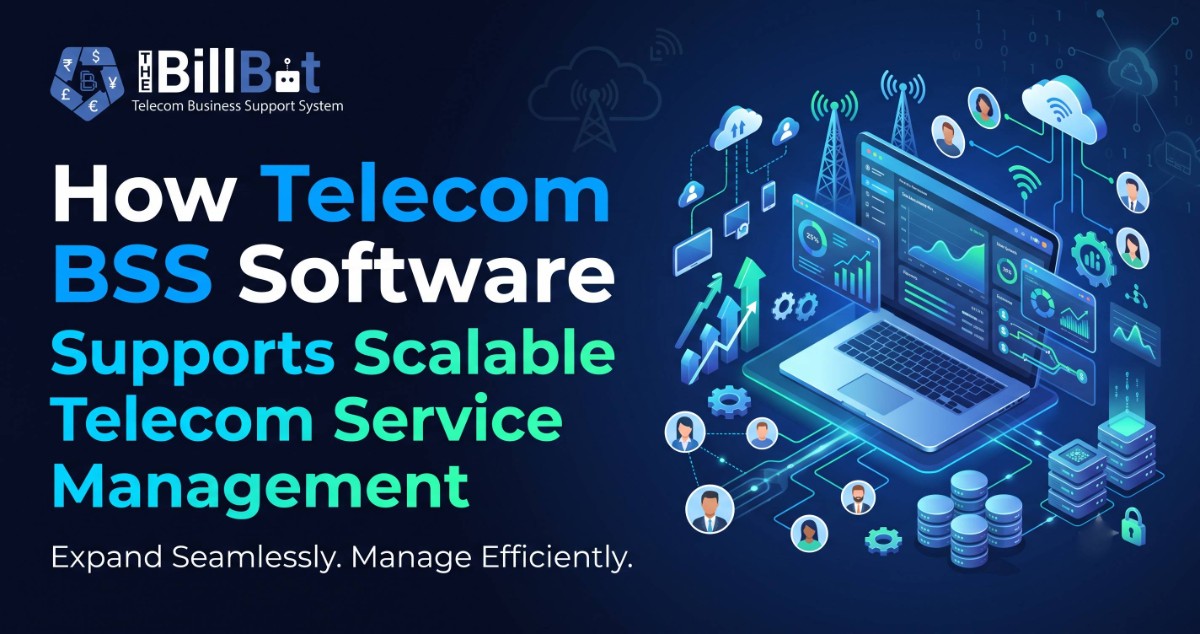
Telecom businesses are constantly evolving. As providers add new customers, launch new services, introduce flexible pricing models, and expand their operations, managing everything manually becomes increasingly difficult. Customer information, service plans, usage data, billing, payments, invoices, and reporting all need to work together efficiently.
This is where Telecom BSS Software becomes an important part of modern telecom operations.
A Business Support System (BSS) provides telecom providers with the tools they need to manage customer-facing and commercial processes from a centralised platform. Instead of relying on disconnected systems and repetitive manual processes, providers can use a BSS platform to bring customer management, product management, billing, invoicing, payments, and reporting into a more connected environment.
For growing ITSPs, VoIP providers, MSPs, and other telecom service providers, this approach can make it easier to manage increasing operational complexity while maintaining accuracy and service quality.
What Is Telecom BSS Software?
Telecom BSS Software is a business management platform designed to support the commercial and customer-facing operations of telecom service providers.
It can help businesses manage different areas of their operations, including:
Customer management
Product and service management
Pricing and packages
Usage and CDR processing
Billing and invoicing
Payment and collection management
Reporting and analytics
Customer onboarding
Business process automation
System integrations
The key advantage is that these processes can operate within a connected business environment rather than being handled through multiple disconnected tools.
This becomes especially valuable as a telecom business grows.
Why Scalability Matters in Telecom Service Management
Growth sounds positive, but it can create operational challenges.
A provider may start with a relatively small customer base and a limited number of services. At that stage, spreadsheets, manual invoicing, and separate tools may appear manageable. However, as customer numbers increase, the volume of data and transactions increases as well.
More customers can mean:
More invoices to generate
More usage data to process
More payments to track
More service plans to manage
More customer records to maintain
More pricing rules to configure
More reports to analyse
More support requests to handle
If the underlying processes are not designed to scale, operational teams can quickly become overloaded.
Telecom BSS Software helps address this challenge by providing automation, centralised data, and structured workflows that can support a growing service operation.
How Telecom BSS Software Supports Scalable Service Management
1. Centralised Customer Management
Customer information is one of the most important assets for any telecom provider.
When customer records are spread across different systems, teams may struggle to find accurate and up-to-date information. This can lead to duplicated data, communication gaps, and unnecessary administrative work.
A centralised BSS environment allows businesses to manage customer information more efficiently.
Teams can have better visibility into customer accounts, services, billing information, and related activities. As the customer base grows, having a structured customer management process becomes increasingly important.
2. Automated Billing Processes
Billing becomes more complicated as a telecom provider grows.
Different customers may have different billing cycles, pricing structures, usage charges, discounts, taxes, recurring services, or custom agreements.
Managing these processes manually can increase the possibility of errors and delays.
Telecom BSS Software can automate many billing activities based on predefined business rules. This can help providers manage recurring billing, usage-based billing, custom pricing, and other billing requirements more consistently.
Automation also reduces the amount of repetitive work required from billing teams.
3. Efficient CDR and Usage Processing
For VoIP and telecom businesses, usage data plays an important role in billing.
Call Detail Records (CDRs) can contain large amounts of information that needs to be processed, rated, and incorporated into billing workflows.
As usage increases, manually handling CDR data becomes increasingly difficult.
A BSS platform can help automate CDR processing and connect usage information with billing processes. This allows providers to handle larger volumes of usage data while reducing dependence on manual processing.
4. Flexible Product and Service Management
Telecom providers rarely offer just one service.
They may manage voice services, broadband, DIDs, extensions, call plans, packages, usage-based services, or other offerings. Each service can have its own pricing and billing requirements.
Telecom BSS Software can provide a structured way to manage products, packages, pricing, and service configurations.
This makes it easier for businesses to introduce new offerings and update existing ones without rebuilding their entire operational process.
A flexible product management structure is particularly valuable when providers want to expand their service portfolio.
5. Faster Customer Onboarding
Customer growth also means more onboarding activity.
Manual onboarding processes can involve repeated data entry, account creation, service configuration, document management, and billing setup.
When these activities are automated and connected, businesses can reduce unnecessary administrative work.
A scalable BSS environment can help create more consistent onboarding workflows, allowing new customers to move from initial setup to active service more efficiently.
6. Streamlined Invoice Management
Invoice management becomes more demanding as customer numbers increase.
Generating invoices, sending them to customers, tracking their status, and following up on unpaid invoices can consume significant amounts of time.
Telecom BSS Software can streamline these processes by connecting billing and invoice management within the same operational environment.
Automated invoice creation and delivery can help businesses maintain more consistent billing cycles while reducing manual intervention.
7. Improved Payment and Collection Management
Growth also means managing more payments.
A telecom provider may need to track successful payments, outstanding balances, overdue invoices, payment reminders, and customer account statuses.
When payment management is disconnected from billing, finance teams may spend considerable time reconciling information across different systems.
A connected BSS platform can bring billing and payment information closer together. This gives teams better visibility into outstanding balances and collection activity.
Automated reminders and structured collection processes can also help providers improve payment follow-up without increasing administrative workload at the same rate as customer growth.
The Role of Automation in Scalable Telecom Operations
Automation is one of the most important elements of scalable service management.
Without automation, business growth often means adding more people to handle additional administrative work. While staffing is necessary in many areas, relying entirely on manual processes can make growth expensive and inefficient.
Telecom BSS Software can automate repetitive processes such as billing, invoice generation, usage processing, payment reminders, reporting, and customer workflows.
This allows employees to spend more time on activities that require human judgement, customer relationships, service improvement, and business development.
The goal is not simply to remove manual work. It is to create an operating model where the business can handle greater volumes without operational complexity increasing at the same rate.
Better Visibility Through Reporting and Analytics
Scalability requires more than automation. Providers also need visibility into how the business is performing.
A BSS platform can bring operational and financial information together through reports and dashboards.
Providers can analyse areas such as:
Revenue
Customer activity
Service usage
Billing performance
Collections
Customer growth
Product performance
Outstanding payments
With better access to business information, management teams can make decisions based on actual operational data rather than relying on assumptions or manually prepared reports.
This becomes increasingly important as the organisation grows and decision-making becomes more complex.
Integrating Telecom BSS Software With Other Business Systems
A scalable telecom environment rarely operates in isolation.
Providers may already use CRM platforms, PBX systems, payment gateways, accounting platforms, carrier systems, or other business applications.
Integration allows information to move between these systems more efficiently.
For example, customer information from a CRM system can support customer management, while usage information from a telecom platform can feed into billing workflows.
By connecting systems instead of creating isolated processes, providers can reduce duplicate data entry and create smoother operational workflows.
Telecom BSS Software and Business Growth
A scalable BSS platform should support the business not only at its current size but also as its requirements evolve.
A provider may begin with a small number of customers and later expand into new markets, add services, introduce new pricing models, or manage significantly higher transaction volumes.
The right Telecom BSS Software can provide the operational foundation needed to support these changes.
Scalability is therefore not simply about handling more customers. It is about creating a business environment that can adapt to changing requirements without constantly replacing or rebuilding core processes.
What to Look for in Telecom BSS Software
When evaluating a BSS platform, telecom providers should consider whether it can support both current and future operational requirements.
Important capabilities may include:
Customer Management
Centralised customer records, account management, service information, and onboarding workflows.
Billing Automation
Support for recurring, usage-based, custom, and flexible billing requirements.
CDR Processing
Efficient processing and management of telecom usage data.
Product and Pricing Management
Flexible management of services, packages, pricing rules, discounts, and related configurations.
Invoice and Payment Management
Automated invoicing, payment tracking, reminders, and collection workflows.
Reporting and Analytics
Clear visibility into revenue, usage, customers, billing, and business performance.
Integrations
The ability to connect with existing telecom, CRM, payment, accounting, and other business systems.
Scalability
The platform should be capable of supporting increasing customers, services, transactions, and operational complexity.
Final Thoughts
Telecom growth brings opportunities, but it also introduces operational complexity. Managing more customers, services, usage records, invoices, payments, and business data through manual processes can quickly become difficult.
Telecom BSS Software provides a more structured approach to managing these challenges.
By combining customer management, billing, CDR processing, product management, invoicing, payments, reporting, and integrations, a BSS platform can help telecom providers create more efficient and scalable operations.
The real value of a scalable BSS solution is not simply managing today's workload. It is building an operational foundation that can support tomorrow's growth.
For telecom providers looking to expand while maintaining efficiency, accuracy, and control, investing in the right Telecom BSS Software can be an important step towards sustainable business growth.
Frequently Asked Questions
1. What is Telecom BSS Software?
Telecom BSS Software is a business support platform that helps telecom providers manage customer operations, services, products, billing, invoicing, payments, usage, reporting, and other commercial processes.
2. How does Telecom BSS Software support scalability?
It supports scalability by automating repetitive processes, centralising business information, improving workflows, and helping providers manage increasing customers, services, transactions, and usage volumes.
3. Can Telecom BSS Software automate telecom billing?
Yes. Depending on the platform, it can support automated recurring billing, usage-based billing, custom pricing, invoice generation, and other billing workflows.
4. Why is CDR processing important for telecom providers?
CDRs contain important usage information, particularly for voice and VoIP services. Efficient CDR processing helps providers accurately process usage and connect it with billing activities.
5. Can a BSS platform manage products and pricing?
Yes. Telecom BSS platforms can provide product and pricing management capabilities, allowing providers to manage services, packages, pricing structures, discounts, and other commercial configurations.
6. Does Telecom BSS Software help with customer management?
Yes. It can centralise customer information and help manage customer accounts, services, onboarding, billing information, and related business activities.
7. How does BSS software improve operational efficiency?
By reducing repetitive manual work, connecting business processes, automating workflows, and providing better access to operational information, BSS software can help teams work more efficiently.
8. Can Telecom BSS Software integrate with other systems?
Many modern BSS platforms support integrations with systems such as CRM platforms, PBX systems, payment gateways, accounting software, and other telecom applications.
9. Is Telecom BSS Software suitable for growing ITSPs and VoIP providers?
Yes. A scalable BSS platform can help ITSPs and VoIP providers manage increasing customers, services, usage, billing, payments, and operational requirements as their businesses grow.
10. What should businesses consider when choosing Telecom BSS Software?
Businesses should evaluate customer management, billing automation, CDR processing, product and pricing management, invoice and payment management, reporting, integrations, flexibility, and scalability before selecting a platform.
Visit the website: https://thebillbot.com/bss