How to Collaborate with an E-Commerce Ads Agency: A Practical Checklist
-

- Published Updated
- 397 views
Effective collaborating with an e-commerce ads agency depends on clear goals, shared data, and a repeatable process that keeps performance measurable. This guide explains what to prepare, how to structure communication, what to expect in reporting, and a practical checklist to get work moving within the first 30–90 days.
- Detected intent: Informational
- Focus: onboarding, communication, reporting, and optimization routines
- Named framework: RACI Collaboration Checklist (below)
- Core cluster questions:
- What should a 30-day onboarding plan with an ads agency include?
- How to set conversion tracking and attribution for ecommerce campaigns?
- Which metrics matter most for ad performance reporting in ecommerce?
- How to manage creative feedback and testing with an agency?
- When should an ecommerce brand change agencies or scale investment?
collaborating with an e-commerce ads agency
Start by aligning on business outcomes (ROAS, AOV, CPA targets), available data (SKU-level SKUs, customer LTV), and the minimum technical setup (pixel, server-side tracking, and ecommerce feed access). Successful collaboration is both strategic (audience and channel mix) and tactical (daily budget pacing, negative keyword lists, and A/B testing cadence).
Prepare before onboarding
Define goals, KPIs, and constraints
Document core KPIs: revenue, return on ad spend (ROAS), cost per acquisition (CPA), average order value (AOV), and lifetime value (LTV) assumptions. Include channel priorities (search, social, display) and any constraints like brand safety, exclusivity, or minimum bid limits.
Data & access checklist
- Grant read/write access to ad platforms, analytics, and storefront (use the principle of least privilege).
- Share product feed, SKU-level margins, and inventory rules.
- Agree on conversion events and validate them against analytics.
RACI Collaboration Checklist
Use the RACI model to make roles explicit during collaboration: Responsible, Accountable, Consulted, Informed. Apply RACI to these items:
- Campaign strategy & channel allocation
- Creative production and review
- Budget adjustments and bid strategies
- Weekly performance reporting and action items
- Attribution model changes and conversion tracking
Include a signed SLA that defines expected response times and escalation paths.
Practical onboarding sequence (first 90 days)
Days 0–7: Kickoff and audit
Run a rapid audit of current ad accounts, analytics, and tracking. Agree on immediate risks (broken pixels, paused campaigns) and quick wins.
Days 8–30: Initial optimization and baseline reporting
Stabilize high-priority campaigns, implement conversion tracking fixes, and deliver a baseline report that shows current ROAS by channel and product group.
Days 31–90: Scale tests and process rhythm
Run structured tests for creative, audience, and bid strategies. Establish a weekly review cadence and a 30/60/90 roadmap for scaling.
Ad performance reporting & ecommerce advertising management
Agree on a reporting template that ties ad metrics to business outcomes: revenue by campaign, ROAS, CPA, and SKU-level profitability. Include attribution notes (first-click, last-click, data-driven) and mark any manual adjustments.
Follow platform best practices for conversion tracking and attribution to avoid data gaps: Google Ads conversion tracking guide.
Practical tips
- Schedule a weekly 30-minute action meeting focused on three priorities and one blocker.
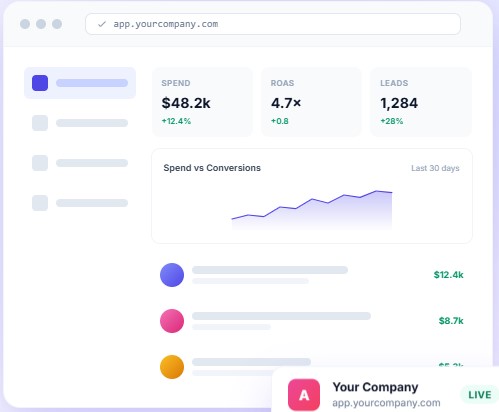
- Share a single source of truth dashboard (live data) and exportable PDF for executives.
- Create an agency communication checklist for creative reviews (deadline, format, approval owner).
- Set a clear test hypothesis and sample size before approving creative or audience experiments.
- Reserve a fixed portion of budget (5–15%) for experimental channels or tactics.
Common mistakes and trade-offs
Common mistakes
- Not granting sufficient access — slows diagnosis and implementation.
- Changing goals mid-test — invalidates results and wastes spend.
- Relying solely on platform-reported metrics without tying to backend revenue.
Trade-offs
Expect a trade-off between speed and data quality: quick fixes can boost short-term results but may obscure long-term signal if tracking is inconsistent. Similarly, full control over creative accelerates iteration but increases internal workload; delegating creative saves time but requires clearer brand guidelines.
Real-world example
A mid-size apparel retailer with 150 SKUs onboarded an agency and used the RACI Collaboration Checklist to assign responsibilities. Within 60 days the agency fixed server-side conversion tracking, consolidated low-performing SKUs into a single campaign, and introduced creative A/B tests. The result: a 22% improvement in ROAS on paid social and a defined weekly process for scaling top performers.
Measurement & optimization model
Adopt a simple iterative model: Hypothesis → Experiment → Measure → Decide. Log each experiment in a shared document with start/end dates, sample size, and outcome to build institutional learning.
How to handle billing, budgets, and scope changes
Clarify billing cycles, performance-based fees (if any), and approval thresholds for budget changes. Require written approvals for scope changes and estimate timelines and potential impact before proceeding.
Core systems and terms to know
ROAS, CPA, CPM, AOV, SKU, feed optimization, server-side tagging, A/B testing, attribution model, and lifetime value (LTV). Use common definitions in a shared glossary to prevent miscommunication.
Next steps checklist (quick)
- Sign a scope document with RACI roles and SLA.
- Grant platform and analytics access.
- Run a tracking audit and fix conversion events.
- Agree on a weekly meeting time and a shared dashboard.
- Kick off one small, measurable test within 14 days.
Core cluster questions (for internal linking)
- What should a 30-day onboarding plan with an ads agency include?
- How to set conversion tracking and attribution for ecommerce campaigns?
- Which metrics matter most for ad performance reporting in ecommerce?
- How to manage creative feedback and testing with an agency?
- When should an ecommerce brand change agencies or scale investment?
Final practical reminder
Collaboration succeeds when the brand treats the agency as an extension of the team: shared goals, transparent data, and a documented process for decisions. Use the RACI Collaboration Checklist and the 90-day onboarding sequence above to make collaboration predictable and measurable.
What should be the first steps when collaborating with an e-commerce ads agency?
Start with a kickoff that documents KPIs, grants access, and completes a tracking audit. Agree on the first 30-day priorities and a weekly meeting cadence to review the baseline report.
How often should performance reviews happen with an ads agency?
Weekly tactical reviews and monthly strategic reviews are recommended. Weekly meetings cover actions and blockers; monthly meetings cover experiments, allocation changes, and roadmap adjustments.
Which metrics should ecommerce brands prioritize in agency reports?
Prioritize revenue by campaign, ROAS, CPA, AOV, and SKU-level profitability. Include conversion rate and spend pacing to spot delivery issues early.
How to evaluate the agency's creative process and turnaround time?
Include an agency communication checklist in the SOW that defines creative formats, deadlines, review rounds, and approval owners. Track actual turnaround time against the SLA to identify bottlenecks.
What are common pitfalls when setting up ad performance reporting?
Common pitfalls include inconsistent conversion definitions, missing cross-device attribution, and not aligning ad metrics with backend revenue. Address these by defining events and validating them against analytics and order data.