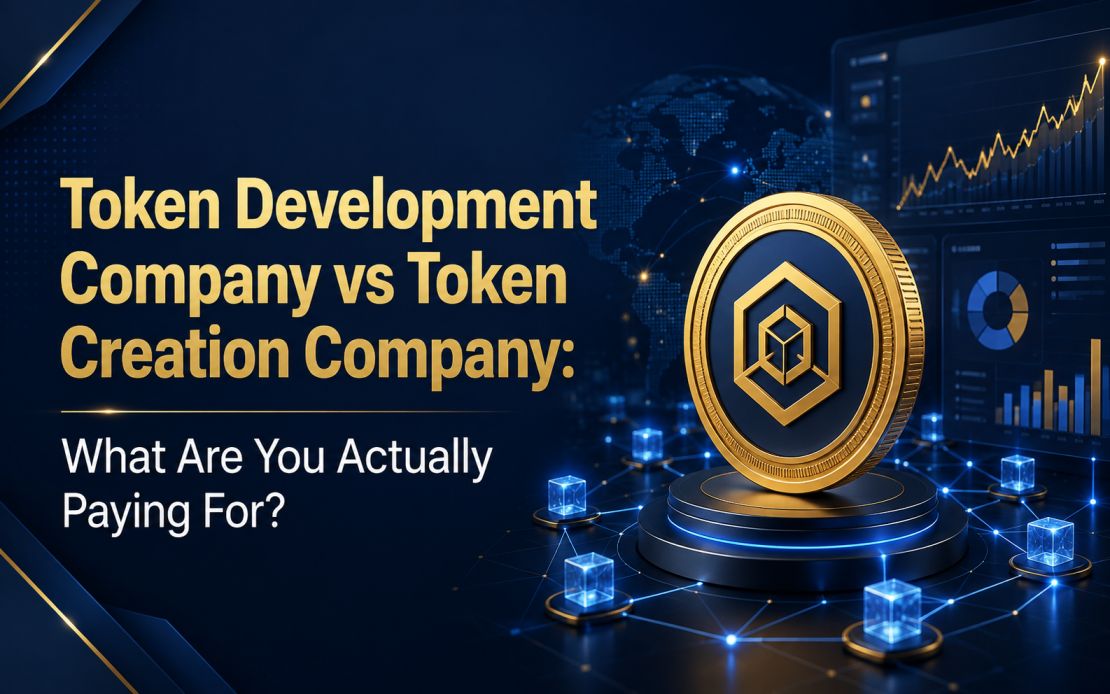
Token Development Company vs Token Creation Company: What Are You Actually Paying For?
-

- Published Updated
- 3,321 views
The terms token development company and token creation company are often used interchangeably, but they can describe very different levels of service. A business can pay for a basic token contract and receive a functioning digital asset, or it can invest in a broader development process that covers tokenomics, architecture, security, integrations, testing, deployment, and ongoing support.
This distinction matters as businesses increasingly explore blockchain for payments, loyalty programs, gaming, governance, digital assets, and tokenized real-world applications. Blockchain App Factory approaches token development as a broader technology process rather than simply generating a token contract. For businesses comparing providers, the important question is not only how much a token costs, but what capabilities and responsibilities are included in that cost.
Token Creation and Token Development Are Not the Same
Token creation generally refers to the technical process of generating a token on an existing blockchain. A provider may configure basic parameters such as the token name, symbol, supply, decimals, and selected transfer functions before deploying the contract.
This approach can be suitable for simple use cases where the token has limited functionality and the business already has the technical infrastructure required to support it.
Token development is broader. It begins with understanding the business objective and then designing the token's technical and economic architecture around that objective. The process can involve blockchain selection, tokenomics, custom smart contracts, wallet and DEX integrations, testing, security reviews, deployment, documentation, and post-launch maintenance.
The difference is similar to buying a basic software component versus commissioning a complete software system. Both may produce working technology, but their scope, complexity, and long-term value can be very different.
What Are Businesses Actually Paying For?
The cost of token development is not simply the price of writing smart contract code. Businesses are paying for a combination of expertise, development time, testing, infrastructure, security, integration, and risk management.
A basic token contract may require relatively limited configuration. A custom ecosystem can require weeks or months of architecture, development, testing, and integration work.
The price can therefore change substantially depending on the project's requirements. A token intended only for basic transfers requires a different level of development from one supporting staking, governance, dynamic rewards, transfer restrictions, marketplace functionality, or asset tokenization.
Businesses should evaluate the scope of work before comparing quotes.
Business Analysis Is Part of Development
A professional token development engagement should start with business requirements.
The development team needs to understand who will use the token, why they will use it, what actions it should enable, and how it fits into the broader product.
For example, a loyalty platform may need tokens that users earn through verified purchases and redeem for specific benefits. A gaming project may require token rewards connected to gameplay and marketplace transactions. A tokenized asset platform may need controlled transfers and links between on-chain records and off-chain ownership systems.
These requirements determine the architecture.
If a provider skips this stage and immediately offers a standard token package, the business may receive a technically valid token that does not solve its actual problem.
Tokenomics Adds Another Layer of Value
Tokenomics is one of the clearest differences between basic token creation and comprehensive token development.
A token economy needs to answer questions around supply, allocation, vesting, emissions, incentives, treasury management, staking, burning, and governance.
The design should connect economic incentives to actual platform activity.
Suppose a business distributes tokens as user rewards. If the project continually issues tokens without sufficient demand, the economic model can become difficult to sustain. Similarly, excessive allocation to a small group of participants can create concentration risks.
A development company should therefore help translate the economic model into technical rules while ensuring that the contract accurately reflects the project's published tokenomics.
Smart Contract Customization Can Increase Complexity
Basic token creation often relies on established smart contract templates or standardized token implementations. These standards provide important interoperability and can be appropriate for straightforward use cases.
Custom development becomes necessary when the business needs additional functionality.
This can include specialized vesting, staking, governance, reward distribution, transaction controls, token burning, access permissions, or other business-specific mechanisms.
Each additional feature increases the need for architecture, testing, documentation, and security review.
The business is therefore paying not just for additional code but for the expertise required to ensure that the components work together correctly.
Security Is a Major Part of the Cost
Security is one of the areas where choosing a low-cost token creation service can become expensive later.
Smart contracts can control valuable assets and critical administrative functions. A vulnerability can result in unauthorized token creation, unexpected transfers, locked assets, or other serious consequences.
A professional development process can include automated testing, manual code review, testnet deployment, vulnerability assessment, and independent auditing.
The level of security review should correspond to the project's risk profile. A simple internal utility token may not require the same level of assurance as a token connected to significant user funds or financial assets.
Businesses should ask providers exactly what security work is included rather than accepting a generic claim that the contract is secure.
Wallet, DEX, and Application Integrations Matter
A token's value depends partly on its ability to function within its intended ecosystem.
Users may need to store tokens in wallets, trade them through decentralized exchanges, use them inside applications, or transfer them between supported platforms.
Custom token features can affect these interactions. Transaction fees, transfer restrictions, automated limits, or other mechanisms can create compatibility issues if they are not designed and tested correctly.
Integration testing therefore represents a meaningful part of development work.
A provider that only creates the contract may leave the business responsible for solving these integration challenges independently.
Deployment Is More Than Pressing a Button
Mainnet deployment requires careful preparation.
Before deployment, the project needs to verify contract configuration, ownership, supply, permissions, token metadata, administrative accounts, and integration settings.
Errors during deployment can be difficult or impossible to reverse, especially when contracts are immutable.
Professional development services can include deployment planning, testnet validation, contract verification, ownership transfer, documentation, and post-deployment checks.
These processes reduce operational risks and provide a clearer transition from development to production.
Regulatory and Governance Considerations Also Matter
Businesses operating across the United States, United Kingdom, India, and other markets need to consider how their token model interacts with local regulations.
The legal treatment of a token can depend on its purpose, distribution, economic characteristics, associated rights, and jurisdiction.
A token representing access or loyalty benefits can raise different questions from one representing investment interests or an underlying asset.
Technical development teams should understand where these requirements can affect architecture, while qualified legal professionals handle formal regulatory interpretation.
Governance is also important. Businesses need to determine who can change token parameters, manage treasury assets, pause certain functions, or approve upgrades.
Post-Launch Support Separates a Product From a One-Time Creation
A token that goes live is not necessarily a finished product.
Blockchain infrastructure evolves. Wallets update their interfaces. Exchanges change integration requirements. Applications expand. Security vulnerabilities can emerge.
Ongoing monitoring and maintenance can therefore become important parts of the token lifecycle.
A comprehensive development company may provide technical support, integration maintenance, security reviews, analytics, infrastructure monitoring, and assistance with future ecosystem development.
A token creation service may simply deliver the contract and end the engagement.
That difference should be reflected in the price comparison.
How Businesses Should Compare Providers
Businesses should avoid comparing providers only by asking, "How much does a token cost?"
A better approach is to compare the complete scope.
Does the provider offer business analysis? Does it design tokenomics? Are smart contracts customized? How are contracts tested? Is an audit included? Are wallet and DEX integrations supported? Who handles deployment? Who owns the source code? What post-launch support is available?
These questions reveal what the business is actually paying for.
Two providers can quote very different prices while technically offering a "token development service" because their scopes are completely different.
When a Token Creation Service May Be Enough
Not every project needs extensive customization.
A business with a simple utility token, limited functionality, an established blockchain architecture, and its own technical team may have little need for a full-service development engagement.
In such cases, a standardized token implementation can reduce development time and cost while providing established interoperability.
The important point is to match the development model with the project's actual requirements.
Customization should exist because the business needs it, not because complexity sounds more sophisticated.
Conclusion
The difference between a token development company and a token creation company comes down largely to scope and responsibility. Token creation can provide a basic blockchain asset, while comprehensive token development can cover business analysis, tokenomics, smart contract architecture, security, integrations, testing, deployment, and ongoing technical support.
For businesses targeting the US, UK, India, and global markets, understanding this difference can make it easier to compare providers and avoid paying for capabilities they do not need or overlooking services they will require later.
Blockchain App Factory provides custom token development based on specific business requirements, covering token architecture, tokenomics, smart contract development, blockchain integration, security considerations, and deployment.
Ultimately, businesses are not simply paying for a token contract. They are paying for the technical expertise, security processes, architecture, integration work, and ongoing support required to turn a digital token into a functional part of a real blockchain ecosystem.