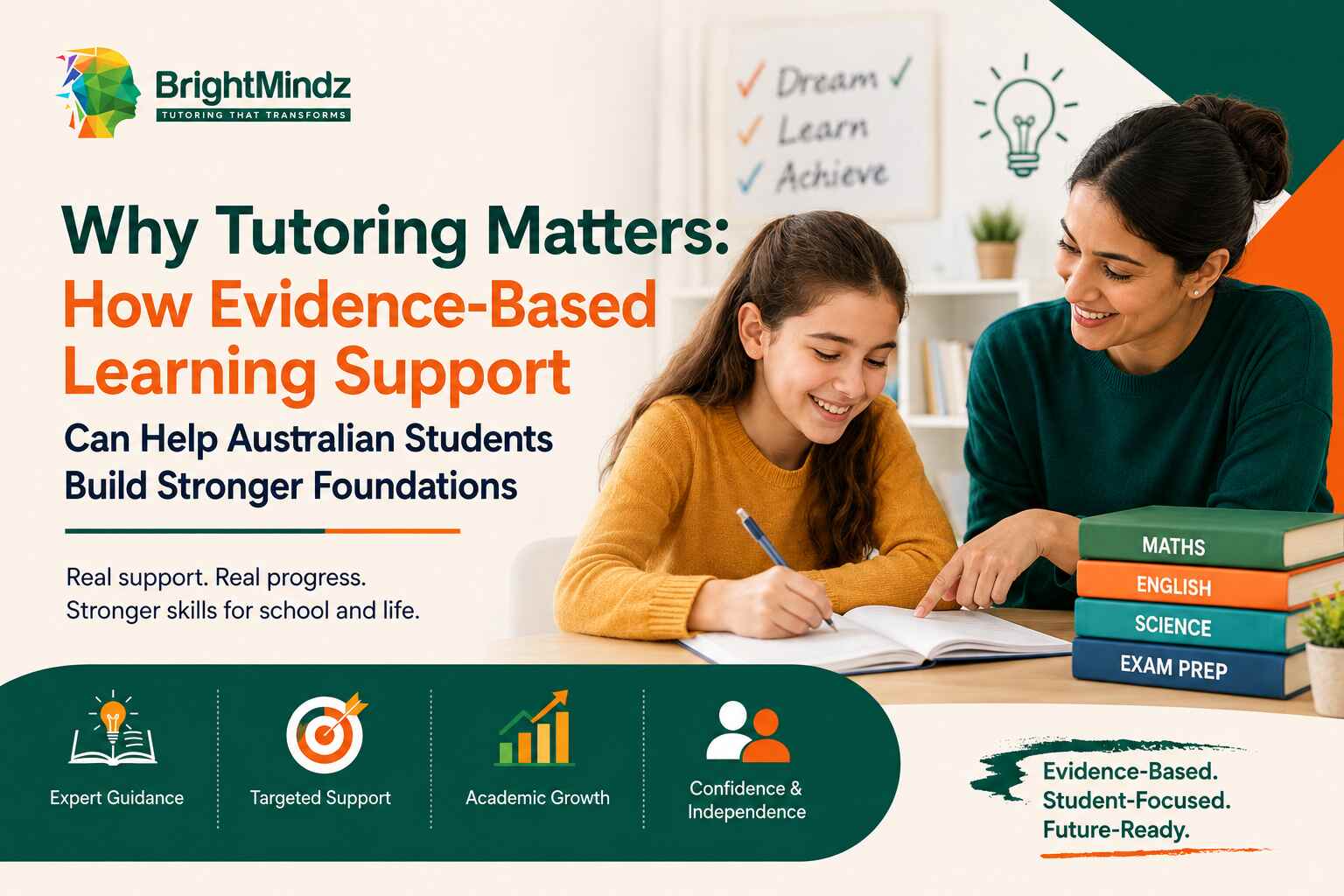
Why Tutoring Matters: How Evidence-Based Learning Support Can Help Australian Students Build Stronger Foundations
-

- Published Updated
- 3,278 views
For some Australian parents, the decision to look for tutoring starts with a school report.
For others, it happens when homework starts taking far too long, a child keeps getting the same type of Maths question wrong, reading becomes frustrating, or a student suddenly loses confidence in a subject they used to enjoy.
Then there are students who are doing well but want to go further.
They may be interested in AMC or ICAS, preparing for a selective entry or scholarship examination, or simply looking for more challenging work than they are getting at school.
So, does tutoring actually help?
It can, but the quality and purpose of the tutoring matter.
Evidence for Learning currently reports positive average effects for both one-to-one and small-group tuition. Its Teaching and Learning Toolkit estimates around five months of additional progress for one-to-one tuition and four months for small-group tuition, although these are average research findings rather than a promise of the same result for every student.
That distinction is important.
Putting a child in front of another worksheet does not automatically mean they are learning more.
Good tutoring should help a student understand what they already know, identify what is getting in the way, learn the next concept properly and eventually tackle the work with less assistance.
What Is the Point of Tutoring?
Tutoring shouldn't simply mean doing more schoolwork after school.
The purpose is to provide additional, targeted teaching where a student needs it.
A student may need help because they have missed an important foundation. Another may need a concept explained in a different way. Some students need more guided practice before they can work independently, while others need extension because the standard classroom work is no longer challenging them.
This is where the quality of teaching becomes important.
Evidence for Learning notes that tutoring can be effective, but the way it is delivered influences its effectiveness. One-to-one tuition can be particularly useful when support is targeted to a student's specific needs and connected with their normal learning.
In other words, the question shouldn't just be:
“Does my child have a tutor?”
It should be:
“Is the tutoring actually addressing what my child needs to learn?”
Strong Foundations Make Later Learning Easier
School learning tends to build on what came before.
A student who hasn't properly understood multiplication may later find fractions difficult. Problems with fractions can then make decimals, percentages and ratios harder.
English works in much the same way.
Reading comprehension, vocabulary, spelling, sentence structure and writing skills continue to develop as students move through primary and secondary school.
Science also builds from earlier understanding. Memorising a definition may help with one question, but understanding the concept gives a student something they can apply when the question changes.
This is why learning gaps are worth identifying early.
AERO's research has examined three evidence-based practices in particular: formative assessment, explicit instruction and mastery learning. Its review found positive effects across different subjects and educational contexts.
The underlying idea is quite practical:
Find out what the student understands, teach what they need next, check whether they've understood it, and don't move on simply because the timetable says it's time to move on.
More Practice Isn't Always the Answer
When a child struggles with a topic, the first reaction can be to give them more questions.
Sometimes that helps.
Sometimes it doesn't.
Imagine a student who keeps getting fraction questions wrong. Giving them another 20 questions won't necessarily solve the problem if they don't understand equivalent fractions in the first place.
Perhaps they need to revisit multiplication.
Perhaps they don't understand what the numerator and denominator represent.
Perhaps they can perform the calculation but struggle to understand the wording of the question.
The student needs different teaching, not necessarily more of the same work.
AERO's guidance on explicit instruction recommends breaking complex knowledge and skills into smaller instructional tasks, sequencing them appropriately and checking that students have mastered each step before moving forward.
That's a useful principle for tutoring too.
What Does Evidence-Based Teaching Look Like?
“Evidence-based” shouldn't just be a phrase used on a tutoring website.
Parents should be able to see what it means during a lesson.
Clear explanation
If a student doesn't understand something, the teacher needs to explain it clearly.
AERO's explicit-instruction guidance supports modelling and breaking complex skills into manageable steps.
Guided practice
Students need an opportunity to have a go while support is still available.
A tutor can watch how the student approaches the task and pick up mistakes that might otherwise go unnoticed.
Feedback
“Wrong” isn't particularly useful feedback.
A student needs to know what went wrong and what they should do differently next time.
Checking understanding
A student saying “yes, I get it” isn't always enough.
They should have an opportunity to demonstrate that understanding.
Gradually reducing support
The end goal shouldn't be a student who can only solve a problem when the tutor is sitting next to them.
The goal is independence.
Why Assessment Matters Before Tutoring
An assessment should do more than produce a number.
It should help answer:
What does the student already understand?
Where are the gaps?
Which misconceptions are getting in the way?
What should be taught next?
This is the role formative assessment can play.
AERO describes formative assessment as using information about student learning to adjust teaching. Its evidence base includes identifying students' existing knowledge and misconceptions and using that information to guide instruction.
For parents, this is worth remembering when comparing tutoring providers.
Before choosing a programme, ask whether the provider actually assesses the student's learning needs.
If every child is given exactly the same material regardless of their starting point, the programme may not be addressing individual gaps.
Maths Tutoring Should Develop More Than Calculation Skills
Maths is one of the most common reasons Australian families look for tutoring.
But Maths is about much more than getting an answer on a worksheet.
Students need to understand numbers, recognise relationships, reason through problems and apply concepts in unfamiliar situations.
A child might know how to use a formula but still struggle when the question is presented differently.
For example, they may know how to calculate the area of a rectangle but become stuck when the information is hidden inside a longer word problem.
That's where mathematical reasoning becomes important.
A useful Maths lesson can therefore involve questions such as:
What information do we have?
What are we actually being asked to find?
Which mathematical idea could help?
Can you explain why that method works?
This type of thinking becomes increasingly valuable as students move into more advanced Mathematics.
It is also relevant for students preparing for competitions such as the Australian Mathematics Competition, where unfamiliar problems require students to think carefully rather than simply repeat a familiar procedure.
BrightMindz's AMC programme currently focuses on mathematical reasoning, logical thinking, challenging competition-style questions and problem-solving.
English Tutoring Is About More Than Grammar
A student can know the rules of grammar and still struggle to write well.
They may have good ideas but find it difficult to organise them.
They may read fluently but struggle to understand implied meaning.
They might understand a story but have trouble explaining their interpretation in writing.
English support can therefore involve:
- reading comprehension
- vocabulary
- spelling
- sentence construction
- paragraph structure
- writing organisation
- persuasive writing
- creative writing
- informational writing
These skills don't only matter in English class.
Students need to understand questions in Maths, interpret information in Science and communicate ideas across their schoolwork.
BrightMindz's current programme structure includes Maths and English foundation learning as well as a dedicated Writing Program covering persuasive, creative and informational writing.
Why Science Tutoring Should Focus on Understanding
Science can become difficult when students try to memorise everything.
There are plenty of scientific terms to remember, but knowing a definition isn't the same as understanding a process.
A student should ideally be able to explain:
What is happening?
Why is it happening?
What evidence supports the explanation?
What changes if a variable is altered?
That type of thinking becomes increasingly important in secondary Science.
AERO's evidence review found positive effects for explicit instruction across subjects including science, alongside mathematics, reading, spelling and problem-solving.
BrightMindz currently offers a Science Program for Years 6–9 designed around scientific concepts and analytical thinking.
What About Students Who Are Struggling?
This is where parents need to avoid jumping to conclusions.
A lower mark doesn't automatically mean a child needs tutoring.
The first step may simply be a conversation with the classroom teacher.
Parents can ask:
- Is this a new problem?
- Has the difficulty been happening for a while?
- Which specific skill is causing trouble?
- Is the same issue appearing in classwork?
- What does the teacher recommend?
- Would additional support be useful?
If there is a persistent learning gap, tutoring may be worth considering.
But the support should be targeted.
A student struggling with fractions needs different teaching from a student struggling with reading comprehension.
And a child who is having trouble with basic concepts needs a different programme from a student preparing for a selective entry examination.
Tutoring Isn't Only for Students Who Are Behind
This is an important part of the conversation.
Some students seek tutoring because they're struggling.
Others seek it because they want more.
A student who finds normal classroom Maths straightforward may benefit from challenging problem-solving tasks.
Another might want to prepare for ICAS.
Another may be working towards a selective school or scholarship examination.
That requires a different type of teaching from remedial support.
BrightMindz's current programmes reflect this distinction. Its Mavericks programme is designed for students seeking Maths and English extension, while Take a Leap focuses on selective entry and scholarship preparation with advanced Maths, English, writing and reasoning.
So tutoring isn't necessarily about catching up.
Sometimes it's about being appropriately challenged.
One-to-One or Small-Group Tutoring: Which Is Better?
There isn't one answer for every student.
Evidence for Learning currently reports positive average effects for both approaches. Its evidence summary places one-to-one tuition at around +5 months of progress on average and small-group tuition at around +4 months.
Small-group tuition generally means a tutor works with a small number of students, often around two to five. Evidence for Learning notes that small-group tuition is more likely to work when it is targeted to students' specific needs.
One-to-one support can be particularly useful when a student needs concentrated attention or has a specific gap that requires individualised teaching.
BrightMindz offers both broader programme-based learning and one-to-one lessons in Mathematics, English, Science and Writing, with one-to-one sessions designed around individual academic needs.
The important thing is not choosing one format because it sounds better.
It's choosing the format that suits the student's needs.
NAPLAN Preparation Shouldn't Become Test Panic
NAPLAN is one of the reasons some parents begin looking for additional learning support.
But preparation should not mean teaching children to memorise a collection of tricks.
The stronger approach is to develop the literacy and numeracy skills that students need regardless of whether an assessment is coming up.
For example:
Maths: number skills, reasoning and problem-solving.
Reading: comprehension and interpreting information.
Writing: organising and communicating ideas.
Language: spelling, grammar and punctuation.
BrightMindz's current NAPLAN programme covers reading, writing, spelling, grammar and Mathematics while also giving students opportunities to work with exam-style questions.
The key is keeping the assessment in perspective.
The aim should be stronger underlying skills, not simply more practice papers.
AMC and ICAS Preparation Can Serve a Different Purpose
Academic competitions such as AMC and ICAS are not necessarily about fixing a learning gap.
For some students, they're an opportunity to stretch themselves.
AMC questions can require students to work through unfamiliar mathematical situations.
ICAS can challenge students across areas such as Mathematics, English, Science and Writing.
That means preparation needs to be more than memorising content.
Students need opportunities to reason, interpret, experiment with approaches and learn from mistakes.
BrightMindz currently offers AMC preparation for Years 3–6 and ICAS preparation across relevant year levels and subjects.
Selective School and Scholarship Preparation Requires Another Approach
Selective entry and scholarship examinations add another layer.
Students may need to work with unfamiliar questions while managing time and maintaining accuracy.
Depending on the examination, preparation can involve:
- advanced Mathematics
- reading comprehension
- writing
- verbal reasoning
- numerical reasoning
- problem-solving
- exam technique
- timed practice
BrightMindz's Take a Leap programme currently covers these areas for students preparing for selective entry and private-school scholarship examinations.
Again, the purpose isn't simply to make students complete hundreds of questions.
They need to understand how to approach a question they haven't seen before.
What Does Research Actually Say About Tutoring?
It's worth being careful here.
Research does not say that every child who attends tutoring will suddenly achieve better marks.
It says that certain forms of additional teaching can have positive effects, particularly when they are well targeted and well delivered.
Evidence for Learning describes tutoring as an approach that can be used when students need additional support, while also stressing that classroom teaching should remain the starting point for improving outcomes.
Its evidence base also suggests that tutoring is more effective when it is connected to normal learning rather than operating as a completely separate activity.
That is an important point for parents.
A tutor shouldn't simply teach a completely different curriculum for the sake of giving the student something to do.
Where appropriate, additional support should connect with what the student is learning and help them move forward.
What Should Parents Look for Before Choosing a Tutor?
Before enrolling, parents can ask some simple questions.
Does the provider assess the student?
There should be some understanding of the child's current level and learning needs.
Does the tutor explain concepts?
Practice matters, but students need clear teaching too.
What happens when the student makes a mistake?
A mistake should help identify what needs to be taught next.
Is the work matched to the student?
It shouldn't be so easy that the child is bored or so difficult that they're constantly lost.
Is progress monitored?
Parents should have some way of knowing whether the support is helping.
Does the programme connect with school learning?
Additional support shouldn't unnecessarily conflict with classroom teaching.
Is independence part of the goal?
This is perhaps the most important question.
A good outcome isn't a child who needs their tutor beside them forever.
It's a student who gradually becomes more capable of doing the work themselves.
How BrightMindz Applies These Ideas Across Its Programmes
BrightMindz's programme structure covers different stages and purposes rather than treating every student as though they need the same type of tutoring.
Its current offerings include foundation Maths and English, Writing, Science, NAPLAN preparation, AMC and ICAS preparation, selective and scholarship preparation, Maths and English extension, and one-to-one lessons.
That allows the learning goal to change depending on the student.
A younger student might need to strengthen early numeracy and literacy.
A student with a Maths gap might need targeted individual support.
A strong student might need extension.
Another might be preparing for a competitive examination.
This distinction matters because the right support depends on the problem you're trying to solve.
BrightMindz also offers a free assessment, giving families an opportunity to get a clearer picture of their child's current academic needs before deciding which type of support may be appropriate.
For families in Melbourne's western suburbs, BrightMindz currently lists locations in Point Cook and Melton, alongside its broader Melbourne offering.
The Real Measure of Good Tutoring
A better mark is useful.
So is a stronger NAPLAN result or doing well in an entrance examination.
But parents can also look for changes that aren't captured by a single score.
Can the student explain the concept?
Can they spot their own mistake?
Can they approach a new problem without immediately giving up?
Can they read a difficult passage and work out what it means?
Can they organise their thoughts before writing?
Can they solve a Maths problem without waiting for someone to tell them which formula to use?
Can they tackle homework with less frustration?
Those are meaningful signs of progress.
Tutoring Should Ultimately Lead to Independence
The best reason to consider tutoring isn't necessarily the next test.
It's what the student can take with them afterwards.
A student should gradually become better at understanding new concepts, asking questions, using feedback, solving unfamiliar problems and working independently.
That is why evidence-based teaching principles such as explicit instruction, formative assessment and mastery learning are relevant to tutoring. AERO's research supports these approaches across different subjects and student groups.
For parents, the takeaway is fairly simple.
Don't just ask:
“How much extra work will my child get?”
Ask:
“What will my child actually understand after the lesson?”
Don't just ask:
“How many practice papers are included?”
Ask:
“What happens when my child doesn't understand something?”
And don't assume that more work automatically means better learning.
Sometimes a student needs someone to slow things down, explain the missing piece, give them a chance to practise properly and then step back.
That's how stronger foundations are built.
Frequently Asked Questions
Is tutoring worth it for Australian school students?
It can be, particularly when tutoring is targeted to a student's specific learning needs and delivered well. Evidence for Learning reports positive average effects for both one-to-one and small-group tuition.
Does every struggling student need tutoring?
No. A lower mark does not automatically mean a student needs a tutor. Parents should first understand the reason for the difficulty and speak with the classroom teacher where appropriate.
Is one-to-one tutoring better than group tutoring?
Not necessarily for every student. Evidence shows positive effects for both approaches. The better choice depends on the student's needs, the quality of teaching and how well the programme is targeted.
Why is assessment important before tutoring?
Assessment can help identify what a student already understands, where misconceptions exist and what needs to be taught next. This allows support to be more targeted.
Can tutoring help students who are already doing well?
Yes. Tutoring can be used for extension as well as catching up. Students may use additional learning support for advanced Maths, competitions, selective entry or scholarship preparation.
Is Maths tutoring only useful for students who are behind?
No. Maths tutoring can support foundational learning, consolidation, extension and competition preparation. The appropriate level depends on the student's current skills and goals.
Can English tutoring help outside English class?
Yes. Reading comprehension, vocabulary and writing skills can affect how students understand and communicate information across different school subjects.
Is Science tutoring mainly about memorising content?
It shouldn't be. Strong Science learning involves understanding concepts, explaining relationships and applying knowledge to different situations.
What is the difference between NAPLAN preparation and regular tutoring?
NAPLAN preparation may include familiarity with assessment-style questions and strategies, but effective learning support should still develop the underlying literacy and numeracy skills students need throughout school.
Does BrightMindz offer an assessment before tutoring?
BrightMindz offers a free assessment, which can help families understand a student's current strengths and areas that may require further support before deciding on an appropriate programme.
Final Thought
Tutoring shouldn't be measured by how many worksheets a student completes or how long they spend sitting at a desk.
The better measure is what the student understands afterwards.
If a child can explain an idea that previously confused them, solve a problem without being shown every step, read with greater understanding, write more clearly or approach difficult work with a little more confidence, something useful has happened.
For some students, that may come from additional tutoring.
For others, classroom teaching and support at home may be enough.
The important thing is to understand what the student actually needs before deciding what to add.
That is where evidence-informed learning support has its greatest value: not simply giving students more work, but helping them build the knowledge, skills and independence they need for the next stage of school and beyond.