Embassy Attestation Cost and Timeline: A Practical Guide to Fees, Steps, and Delays
-

- March 04th, 2026
- 307 views

Get a free topical map and start building content authority today.
Understanding embassy attestation cost and timeline is essential for anyone who needs documents legalized for use abroad—degrees, marriage certificates, corporate papers, or powers of attorney. This guide breaks down typical fees, common sources of delay, a step-by-step checklist, and realistic timelines so decisions can be planned with fewer surprises.
- Costs vary by country, document type, and whether translation or notarization is required.
- Typical timelines range from 3 business days (fast-track services) to 6–8 weeks for complex chains of legalization.
- Use the ATTEST Checklist (Assemble, Translate, Notarize, State-authenticate, Embassy-legalize, Track & Collect) to reduce errors and delays.
Detected intent: Informational
What drives embassy attestation cost and timeline
Costs and timelines for embassy attestation depend on several linked factors: the document type (educational, personal, corporate), whether a notarization or certified translation is needed, the issuing country's authentication procedures (apostille vs. embassy legalization), and the specific embassy or consulate's processing cadence. Local government steps—county clerk, state/provincial authentication, and then embassy legalization—add incremental fees and days to the total processing time.
Typical fee components and how much they add up
Break down of common attestation processing fees and where money is usually spent:
- Notarization: nominal local fee or free through government offices.
- State/provincial authentication or apostille: fixed government fee (often $5–$50 in many countries).
- Embassy/consulate legalization: embassy fees vary widely—can be free, nominal, or $30–$100 per document depending on the mission.
- Translation and certification: professional translation rates apply; certified copies can add more.
- Courier, priority service, and consular appointment handling: optional but increases speed and cost.
Realistic total cost ranges: simple personal documents in many countries can be legalized for under $100; complicated chains (multiple certified translations, state authentication, and consular fees) commonly reach $150–$400 or more.
Embassy attestation cost and timeline: typical timelines by step
- Document preparation and notarization: same day to 1 week.
- State/provincial authentication or apostille: 2–10 business days (expedited options sometimes available).
- Embassy/consulate legalization: 1–3 weeks depending on appointment availability and in-house processing; walk-in services or couriers can be faster.
- International courier return: 2–7 days depending on service level.
Total practical timelines: 3 business days (very fast-track, limited scope) to 6–8 weeks (complex cases, high-demand embassies, missing documentation).
ATTEST Checklist (named framework)
Use the ATTEST Checklist to structure the workflow and avoid missed steps:
- Assemble: collect originals, certified copies, and ID.
- Translate: get certified translations for non-target-language documents.
- Notarize: have documents notarized where required.
- State-authenticate: request apostille or state/provincial authentication.
- Embassy-legalize: submit to the target country embassy/consulate for final legalization.
- Track & Collect: use tracking, confirm pickup, and verify seals/signatures.
Short real-world example
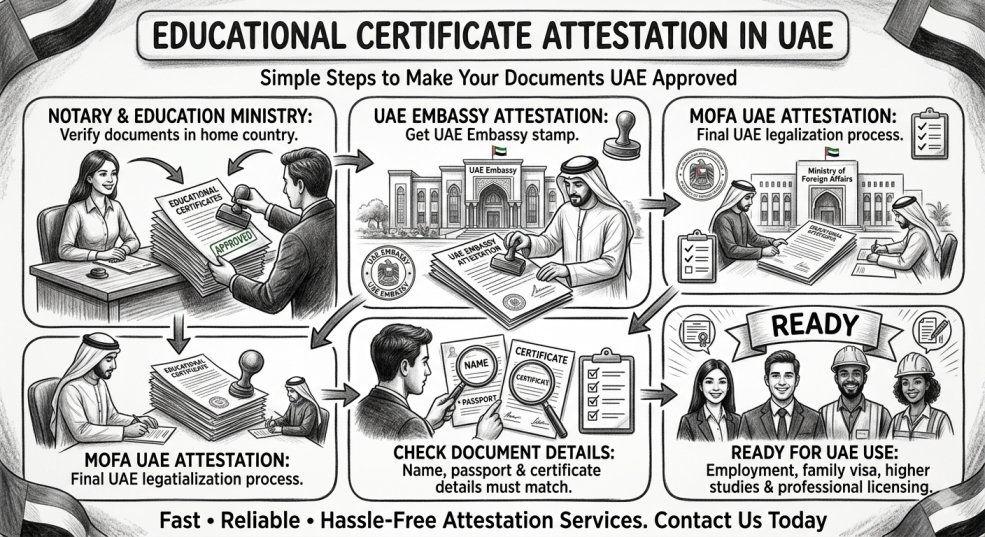
Scenario: A teacher relocating to the UAE needs a university degree attested. Steps taken: notarize degree copy (1 day, low fee), state apostille (5 business days, $15), UAE embassy attestation (10 business days, consular fee $40), courier return (3 days). Result: total 3 weeks, total out-of-pocket ~ $100–$200 depending on translation needs and courier choices.
Practical tips to reduce cost and speed up the process
- Verify exact embassy requirements before preparation—missing a required translation or a certified copy adds time and cost.
- Group documents into a single submission when allowed to save per-document embassy fees and courier costs.
- Use government or embassy checklists and downloadable forms to reduce rejections.
- Consider local expedited services for state authentication if processing windows are long, but compare fees to typical timelines.
- Keep digital scans of every document and receipt to speed disputes or resubmissions.
Common mistakes and trade-offs
Common mistakes that lengthen timelines or increase costs:
- Submitting uncertified translations or failing to notarize where required.
- Assuming apostille applies when embassy legalization is needed (apostille applies only between Hague Convention countries).
- Relying on postal shipping without tracking for critical deadlines—loss or delay can be costly.
Trade-offs: using a courier or expeditor reduces time but adds cost; preparing extra certified copies increases upfront cost but saves time if additional legalizations are requested later.
How country differences affect attestation processing
Some countries accept apostilles (Hague Convention members), which shortens the chain to state/provincial authentication. Others require embassy legalization, which adds the embassy step. Check official foreign ministry or embassy pages for exact rules; for example, official authentication guidance is available from national authorities such as the U.S. Department of State for U.S.-issued documents (source).
Core cluster questions
- How long does it take to get an apostille versus embassy legalization?
- What documents typically require embassy attestation for employment abroad?
- How much do certified translations add to the attestation cost?
- Are there reliable expedited services for state authentication and consular legalization?
- What steps prevent consulate rejections or delays during attestation?
Frequently asked questions
What affects the embassy attestation cost and timeline?
Document type, the need for notarization and translation, whether the issuing country uses apostilles, the embassy's internal processing speed, and optional courier or expedited services all affect both cost and timeline.
Can an apostille replace embassy legalization?
Only if both the issuing country and the destination country are members of the Hague Apostille Convention. Otherwise, embassy or consular legalization is required.
How can delays be prevented when submitting documents?
Follow the ATTEST Checklist, confirm embassy-specific requirements beforehand, prepare certified translations, use tracked courier services, and allow buffer time for each step.
Is rush service worth the extra cost for embassy attestation cost and timeline?
Rush services reduce time but increase expense. For tight deadlines, the premium can be justified; for routine submissions, planning ahead and preparing correct documentation is typically more cost-effective.
Who should be contacted if an embassy rejects a document?
Contact the embassy's consular section for rejection reasons, consult the issuing local authorities for corrected documents, and review the ATTEST Checklist to identify missed steps.