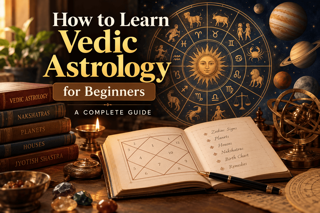
How to Learn Vedic Astrology for Beginners: A Complete Guide
-
- Published Updated
- 82 views
Vedic Astrology
Vedic Astrology, also known as Jyotish Shastra, is an ancient Indian system of astrology that studies the relationship between celestial bodies and human life. It has been a part of Indian culture and traditions for centuries. From understanding zodiac signs to studying birth charts, Vedic Astrology offers a structured way to explore traditional astrological concepts.
Today, many people are interested in learning astrology, not only for personal curiosity but also to understand Indian traditions, planetary symbolism and different approaches to interpreting a birth chart. However, beginners often find it difficult to decide where to start, which concepts to learn first and how to understand complicated astrological terminology.
If you are also interested in learning Jyotish, this guide will help you understand the fundamentals of Vedic Astrology and build a clear learning path.
1. Understand the Basics of Vedic Astrology
Before studying advanced astrological concepts, it is important to understand the fundamental principles of Vedic Astrology.
Vedic Astrology traditionally uses the positions of celestial bodies at the time of a person’s birth to construct a birth chart, commonly known as a Kundli or Janam Kundli.
There are several important elements that beginners should become familiar with:
- Zodiac Signs (Rashis): The twelve zodiac signs form an important part of astrological interpretation.
- Planets (Grahas): The nine traditional astrological Grahas, including Rahu and Ketu, are studied for their symbolic meanings.
- Houses (Bhavas): A birth chart is divided into twelve houses, each traditionally associated with different areas of life.
- Nakshatras: The twenty-seven Nakshatras are lunar divisions used in several branches of Indian astrology.
- Ascendant (Lagna): The sign rising on the eastern horizon at the time and place of birth is known as the Lagna.
Understanding these five elements provides a foundation for studying more complex astrological topics.
2. Learn the Twelve Zodiac Signs
The twelve zodiac signs, or Rashis, are among the first concepts every astrology beginner should study.
1. Aries (Mesh)
Initiative and energy
2. Taurus (Vrishabh)
Stability and persistence
3. Gemini (Mithun)
Communication and curiosity
4. Cancer (Kark)
Emotions and nurturing
5. Leo (Singh)
Expression and leadership
6. Virgo (Kanya)
Analysis and organization
7. Libra (Tula)
Balance and relationships
8. Scorpio (Vrishchik)
Transformation and depth
9. Sagittarius (Dhanu)
Knowledge and exploration
10. Capricorn (Makar)
Discipline and responsibility
11. Aquarius (Kumbh)
Innovation and ideas
12. Pisces (Meen)
Imagination and spirituality
Each sign is traditionally associated with a ruling planet, an element and particular symbolic characteristics. Learning these associations can make it easier to understand how zodiac signs are interpreted in a birth chart.
Instead of memorizing everything at once, beginners can study two or three signs every day and make short notes about their traditional characteristics.
3. Understand the Nine Planets in Vedic Astrology
Planets, known as Grahas in Jyotish, play a central role in traditional astrological interpretation. Vedic Astrology generally considers nine Grahas.
|
Graha |
Traditional association |
|
Sun (Surya) |
Identity, authority and vitality |
|
Moon (Chandra) |
Emotions, mind and sensitivity |
|
Mars (Mangal) |
Courage, action and energy |
|
Mercury (Budh) |
Communication and intellect |
|
Jupiter (Guru) |
Knowledge, wisdom and expansion |
|
Venus (Shukra) |
Relationships, beauty and comforts |
|
Saturn (Shani) |
Discipline, responsibility and limitations |
|
Rahu |
Ambition, desire and unconventional experiences |
|
Ketu |
Detachment, introspection and spirituality |
These are traditional symbolic associations rather than scientifically established descriptions of personality or future events.
Beginners should also learn about planetary friendships, planetary aspects, exaltation, debilitation and the concept of planetary strength. These topics help explain how different Grahas are traditionally interpreted in relation to one another.
4. Learn the Twelve Houses of a Birth Chart
The twelve houses, or Bhavas, represent different areas of life in Vedic Astrology. Understanding them is essential for learning how a Kundli is structured.
For example, the first house is traditionally associated with the self and physical identity, while the fourth house is associated with home, family and emotional foundations. Similarly, the tenth house is traditionally linked to career, work and public responsibilities.
Every house has its own traditional meanings, and its interpretation can depend on the sign, planets and other factors associated with it.
A useful exercise for beginners is to draw a simple twelve-house birth chart and label each house with its traditional associations. This helps develop familiarity with the structure before moving to advanced interpretations.
5. Understand Your Birth Chart (Kundli)
A birth chart is one of the most important concepts in Vedic Astrology. It is a diagram representing the positions of planets and other astrological points at a particular time and location.
To understand a Kundli, beginners should first identify the Lagna, zodiac signs, planetary placements and twelve houses.
Once these basics are clear, students can gradually explore planetary aspects, conjunctions, yogas and different chart divisions.
It is important to remember that the interpretation of a complete birth chart involves multiple interacting factors. Studying a single planet or house in isolation may not provide the full traditional interpretation.
Beginners can use sample birth charts for practice instead of immediately attempting complex readings. This also provides an opportunity to learn how different chart layouts represent the same underlying astrological information.
6. Choose the Right Astrology Books and Learning Resources
Learning from organized educational resources can make the process easier, especially for people who are completely new to astrology.
A good beginner’s book should explain technical terms in simple language, provide clear examples and introduce concepts in a logical order. Diagrams, sample Kundlis, chapter summaries and practice exercises can also make difficult topics easier to understand.
You can explore different types of learning material, including:
- Beginner’s guides to Vedic Astrology
- Books explaining planets and zodiac signs
- Guides to birth chart interpretation
- Nakshatra and planetary reference books
- Numerology and other related traditional subjects
Readers who prefer Hindi can begin with introductory Jyotish books written in simple Hindi, while those comfortable with English can explore more detailed reference material.
It is also useful to compare explanations from multiple authors, especially when studying complex or debated concepts. This helps readers understand that astrological interpretations can differ between traditions and schools of thought.
7. Follow a Practical Study Plan
Consistency is more important than trying to learn every astrological concept in a short period. A structured study plan can help beginners stay organized.
- Week 1: Astrology Fundamentals
Learn the twelve zodiac signs, their traditional characteristics and basic terminology.
- Week 2: Planets and Their Meanings
Study the nine Grahas, their symbolic associations and planetary relationships.
- Week 3: Houses and Birth Charts
Understand the twelve houses, Lagna and basic Kundli structure.
- Week 4: Practical Chart Reading
Practice identifying planetary placements, signs and houses in sample birth charts.
After completing this introductory plan, learners can explore more advanced topics such as planetary aspects, Vimshottari Dasha, yogas, divisional charts and different systems of Jyotish.
Maintaining a notebook of important concepts and practicing regularly can make the learning process more systematic.
8. Common Mistakes Beginners Should Avoid
Many beginners try to understand advanced predictions before learning the fundamentals. This can create confusion and lead to incomplete interpretations.
Some common mistakes include:
- Memorizing planetary meanings without understanding the houses and signs.
- Interpreting one planetary placement without considering the complete chart.
- Relying on unverified information from random online sources.
- Expecting to master an entire subject within a few days.
- Treating traditional astrological interpretations as scientifically proven facts.
Astrology has cultural, historical and spiritual significance for many people. However, its predictive claims have not been established as scientifically reliable methods for determining an individual’s future. It is best approached as a traditional knowledge system and studied with curiosity and critical thinking.
Conclusion
Learning Vedic Astrology is a gradual process that begins with understanding zodiac signs, planets, houses and birth charts. Once these foundational concepts become familiar, beginners can move towards more detailed topics such as Nakshatras, planetary aspects and Dasha systems.
The key is to follow a structured learning path, use reliable educational resources and practice regularly. Whether your interest is cultural, historical, spiritual or academic, studying Jyotish can introduce you to an important part of India’s traditional knowledge heritage.
With patience, organized notes and a willingness to explore different interpretations, anyone interested in the subject can begin building a solid foundation in Vedic Astrology.