Water 4.0 Market Analysis: Smart Water Infrastructure Driving Growth
-
- Published Updated
- 7,011 views
Water 4.0 Market Size and Forecast
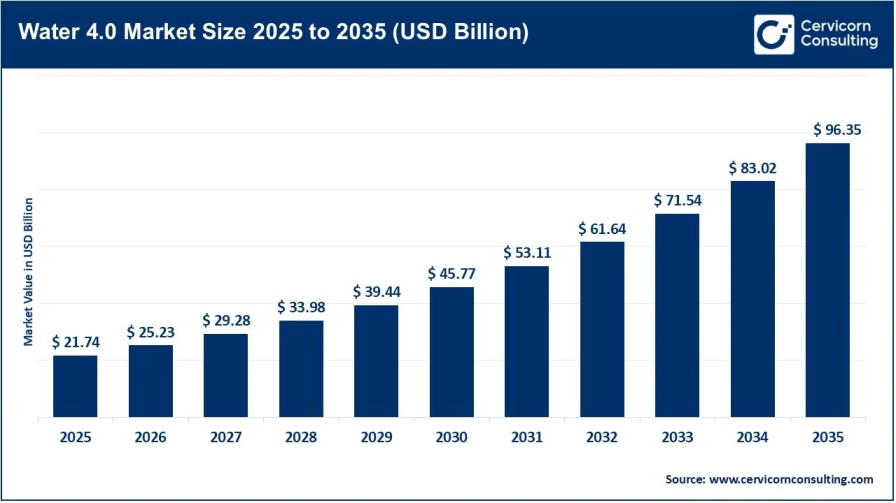
The global Water 4.0 market is gaining substantial momentum as water utilities, municipalities, and industrial facilities increasingly deploy digital technologies to improve operational efficiency and resource sustainability. The market was valued at approximately USD 21.74 billion in 2025 and is expected to reach nearly USD 96.35 billion by 2035, expanding at a strong CAGR of 16.1% during the forecast period (2026–2035).
The market's rapid growth is fueled by rising investments in smart water infrastructure, advanced automation systems, data analytics, and intelligent water management solutions that help optimize water and wastewater operations.
Read the complete market report: https://www.cervicornconsulting.com/water-4-0-market
Understanding the Water 4.0 Market
Water 4.0 represents the digital evolution of the water and wastewater industry through the adoption of Industry 4.0 technologies. The market encompasses solutions powered by artificial intelligence (AI), Industrial Internet of Things (IIoT), digital twins, predictive maintenance, cloud computing, smart metering, automated treatment technologies, and real-time monitoring platforms.
These technologies work together to enhance visibility, efficiency, and control across the entire water value chain. By combining traditional infrastructure with intelligent digital systems, Water 4.0 enables utilities, municipalities, and industrial organizations to optimize water sourcing, treatment, distribution, consumption, wastewater processing, recycling, and reuse.
Major solution categories include:
- Smart water distribution and monitoring networks
- Advanced treatment and purification technologies
- Digital control and supervisory platforms
- Smart metering systems
- Leak detection and asset performance solutions
- Predictive maintenance technologies
- Automated wastewater treatment systems
- Cloud-based water intelligence and analytics platforms
Why Water 4.0 Is Becoming Critical
The increasing impact of climate change, rapid urbanization, population growth, and deteriorating infrastructure is placing significant pressure on global water resources. Traditional water systems often face challenges such as water losses, reactive maintenance practices, and insufficient operational visibility.
Water 4.0 technologies address these challenges by providing real-time insights, automation, and predictive capabilities that improve system performance and sustainability.
Key benefits include:
- Reduction of non-revenue water losses
- Enhanced water quality monitoring
- Increased operational efficiency
- Lower energy consumption
- Extended asset lifespan
- Predictive maintenance capabilities
- Improved compliance with environmental regulations
- Greater resilience against droughts and water shortages
- Support for water recycling and reuse programs
As water security becomes a strategic priority worldwide, digital transformation is emerging as an essential component of long-term water sustainability.
Access a complimentary sample report:
https://www.cervicornconsulting.com/sample/2960
Key Factors Driving Market Growth
The Water 4.0 market is expanding due to a combination of environmental, technological, and regulatory factors. Growing concerns about water scarcity, increasing investment in smart city infrastructure, widespread adoption of IoT-enabled monitoring technologies, rapid urban development, aging utility assets, and stricter environmental standards are all contributing to market growth.
Additional drivers include continuous advancements in artificial intelligence and machine learning, the growing adoption of cloud-based water management platforms, government funding for wastewater infrastructure modernization, sustainability initiatives, increased deployment of smart meters, and rising demand for predictive maintenance and real-time operational monitoring across municipal and industrial sectors.
Major Companies Driving Innovation in the Water 4.0 Market
Several global technology and water management leaders are helping accelerate the adoption of intelligent water solutions.
Xylem
Xylem is recognized for its expertise in smart water infrastructure and digital analytics. The company focuses on smart metering, intelligent water networks, and advanced treatment technologies. Its portfolio includes AI-enabled water management platforms, digital twin solutions, and sophisticated leak detection systems. In 2025, Xylem generated approximately USD 9.0 billion in revenue, maintained an estimated 8–10% market share, and operated across more than 150 countries.
Veolia Water Technologies
Veolia Water Technologies specializes in water and wastewater treatment solutions, including industrial water treatment, desalination, and water reuse systems. The company is known for its sustainability-focused technologies and resource recovery capabilities. Its Water Technologies division generated approximately €4.95 billion in revenue during 2025, representing an estimated 7–9% share of the global market, with operations spanning more than 50 countries.
SUEZ Water Technologies & Solutions
SUEZ delivers advanced water treatment, digital water services, and resource recovery solutions for industrial and municipal customers. The company focuses on smart treatment facilities, digital optimization services, and sustainable water management strategies, holding an estimated 5–7% market share globally.
ABB
ABB is a leading provider of industrial automation and digitalization technologies. Within the Water 4.0 landscape, ABB offers SCADA systems, intelligent pumping solutions, and advanced analytics platforms that enable AI-driven process optimization. The company reported annual revenue exceeding USD 30 billion in 2025 and held approximately 4–6% market share in Water 4.0-related applications.
Schneider Electric
Schneider Electric provides advanced automation and energy management solutions designed specifically for water utilities and infrastructure operators. Its EcoStruxure Water platform supports intelligent network management, digital infrastructure optimization, and operational automation. The company reported annual revenue exceeding €38 billion in 2025 and maintained an estimated 4–6% market share worldwide.
Emerging Trends Influencing the Water 4.0 Market
Artificial Intelligence and Predictive Analytics
AI-powered technologies are helping utilities improve asset performance, optimize treatment processes, and predict equipment failures before they occur. Predictive analytics significantly reduces maintenance costs and operational disruptions.
Key benefits:
- Lower downtime
- Reduced maintenance expenses
- Improved treatment efficiency
- Better allocation of resources
Smart Water Metering
Advanced Metering Infrastructure (AMI) solutions provide real-time visibility into water consumption patterns, improving leak detection and billing accuracy.
Key benefits:
- Reduced water losses
- Enhanced customer engagement
- Improved revenue collection
- More accurate demand forecasting
Digital Twin Adoption
Digital twin technology creates virtual replicas of physical water assets, enabling operators to test scenarios, assess risks, and optimize system performance.
Key benefits:
- Improved planning and forecasting
- Faster operational decision-making
- Reduced infrastructure risks
- Enhanced network resilience
IoT-Based Monitoring Systems
IoT sensors continuously collect data related to water flow, pressure, quality, and equipment health, providing utilities with real-time operational intelligence.
Key benefits:
- Continuous monitoring
- Early leak identification
- Better regulatory compliance
- Improved operational performance
Cloud-Based Water Management Platforms
Cloud technologies enable centralized management of distributed assets and support data-driven decision-making across entire water networks.
Key benefits:
- Greater scalability
- Lower technology infrastructure costs
- Enhanced collaboration
- Improved access to operational data
Water Reuse and Circular Water Strategies
Increasing water stress is driving investment in water recycling and reuse technologies that reduce reliance on freshwater resources.
Key benefits:
- Reduced freshwater demand
- Improved sustainability performance
- Lower operating costs
- Stronger long-term water security
Notable Water 4.0 Success Stories Worldwide
Singapore's Smart Water Ecosystem
Singapore has become a global benchmark in digital water management through the deployment of advanced sensors, predictive analytics, and intelligent monitoring systems.
Key outcomes include:
- Real-time network visibility
- Enhanced water quality management
- Reduced water losses
- Improved drought preparedness
Thames Water's Digital Transformation (United Kingdom)
Thames Water has implemented advanced leak detection and monitoring technologies to improve network performance and customer service.
Achievements include:
- Faster leak detection
- Reduced non-revenue water losses
- Enhanced service reliability
- Improved customer satisfaction
South Korea's Smart Water Grid Program
South Korea has integrated AI and IoT technologies throughout municipal water systems to improve conservation efforts and infrastructure efficiency.
Australia's Digital Water Initiatives
Australia is leveraging intelligent water management technologies to improve drought resilience and optimize resource allocation across water networks.
Smart Water Cities in the Netherlands
The Netherlands is utilizing digital twins and AI-driven water management platforms to strengthen flood resilience, urban planning, and infrastructure management.
Regional Market Analysis
North America
North America remains one of the most mature Water 4.0 markets, supported by extensive infrastructure modernization programs, utility digitization initiatives, and smart city investments.
Key growth drivers:
- Aging water infrastructure
- Water conservation initiatives
- Smart utility investments
- Advanced digital ecosystems
Europe
Europe continues to lead in sustainable water management due to strong environmental regulations, circular economy initiatives, and aggressive climate targets.
Key growth drivers:
- Water reuse programs
- Carbon neutrality goals
- Circular economy strategies
- Utility digital transformation
Asia-Pacific
Asia-Pacific is expected to register the highest growth rate throughout the forecast period, driven by rapid urbanization, industrial development, and increasing water stress.
Major government programs include:
- Jal Jeevan Mission (India)
- Smart Cities Mission (India)
- AMRUT
- National Water Mission
- Smart city investments across China
- Advanced automation and treatment initiatives in Japan
Latin America
Countries throughout Latin America are increasingly adopting smart water technologies to improve utility efficiency, minimize water losses, and strengthen climate resilience.
Middle East & Africa
Growing water scarcity and large-scale desalination investments are creating significant opportunities for Water 4.0 technologies across the region.
Notable initiatives include:
- Saudi Arabia Vision 2030
- AI-enabled water management programs in the United Arab Emirates
Future Outlook
The Water 4.0 market is expected to witness sustained growth as governments, industries, and utilities continue prioritizing digital transformation, sustainability, and water security. Technologies such as AI, IoT, predictive analytics, cloud computing, digital twins, and water reuse systems will continue reshaping the global water sector.
Increasing investments in smart cities, climate adaptation initiatives, intelligent infrastructure, and wastewater recycling projects are expected to strengthen market growth further, making Water 4.0 a foundational component of future water management strategies worldwide.
For customized market intelligence and strategic consulting services:
https://www.cervicornconsulting.com/contact-us