Website vs Social Media: Where Small Businesses Invest
-

- September 16th, 2026
- 1,667 views
A Question Every Business Owner Asks Eventually
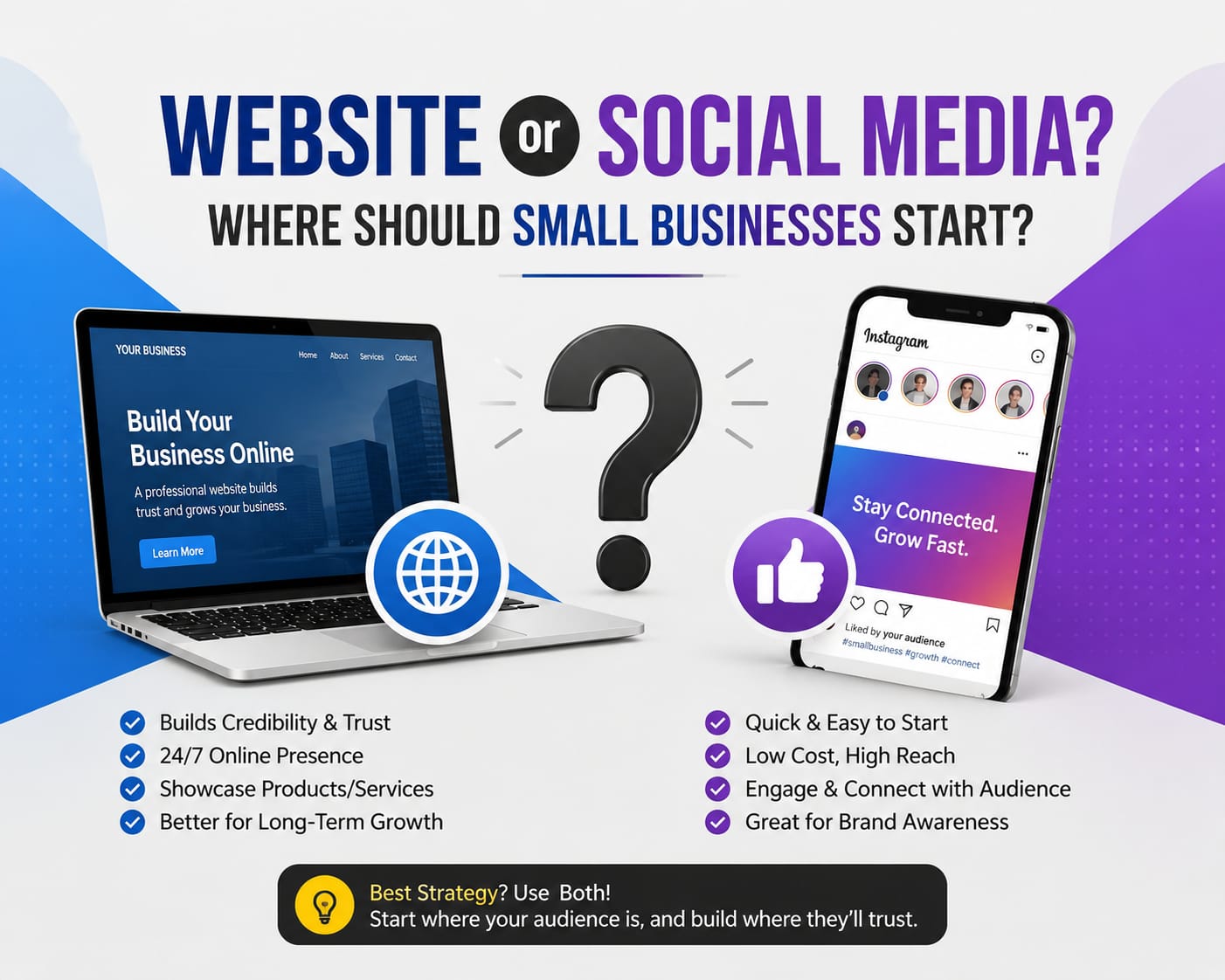
If you're running a small business and just starting to think seriously about digital marketing, you've probably already asked yourself this: should I put my money into a website, or should I just focus on Instagram and Facebook? It's a fair question — you don't have unlimited budget, and doing both properly at the same time isn't realistic for most businesses starting out.
Here's the thing though — there's no single correct answer that works for everyone. It really comes down to what you're selling, who you're selling to, and how your customers actually go about deciding to buy from you. Once you understand what a website is genuinely good for versus what social media is good for, the decision gets a lot easier.
What a Website Actually Gives You
Think of a website as your own piece of digital property. Nobody else controls it — not an algorithm, not a platform update, nobody. You decide what it looks like, what it says, and how someone moves from "just browsing" to "okay, I'll buy this." That's a big deal, because on social media, you're always at the mercy of whatever the algorithm decides to show people that week.
There's also a trust factor most people don't think about until it bites them. Picture a customer searching for your business and finding... nothing. No website, just a Facebook page with 40 followers. That's going to make them wonder how serious or established you really are, even if your work is great. A website fixes that instantly — pricing, testimonials, past work, a way to actually book or ask a question, all sitting in one place where the customer doesn't have to dig for it.
The catch? Websites take longer to pay off. SEO doesn't work overnight — you're looking at months before Google really starts sending you traffic, and if you want faster results, you're paying for ads on top of everything else.
What Social Media Actually Gives You
Social media plays a totally different role — it's where people find you without even looking for you. Someone scrolling through reels stumbles onto your bakery, your salon, your clothing brand, and suddenly they're interested in something they didn't know existed five minutes ago. It's quick to start, cheap to run, and you get instant feedback through likes and comments.
If what you sell is visually appealing — food, fashion, décor, beauty, anything people like looking at — social media will probably outperform a brand-new website in the early days. One good reel can put you in front of thousands of local people in a single day. No website is doing that for you without serious ad money behind it.
The downside is you don't actually own any of it. Your followers aren't yours the way a domain name is yours. One algorithm change and your reach can drop overnight, and there's nothing you can do about it.
The Real Question to Ask Yourself
Instead of "website or social media," a better question is: how does my ideal customer actually decide to buy? Someone looking for a wedding photographer, an accountant, or a contractor for their home renovation isn't going to make a snap decision. They'll compare a few options, read reviews, look at past work — and for that kind of buyer, a solid website with a real portfolio matters more than social media reach, because they want proof before they commit.
But someone discovering a new café or a small clothing brand? That's often an impulse thing — a photo or video catches their eye mid-scroll, and that's it, decision made (or at least, interest sparked). For businesses like that, social media is usually where it all starts, even if other things influence whether they come back.
Why You Probably Need Both — Just Not at the Same Time
Realistically, very few businesses can afford to permanently write off one or the other. What actually works is sequencing — start with whichever channel fits how your customers behave right now, then build the second one once you've got enough traction to support it.
A visual, impulse-driven business might start on social media, get some early sales and awareness going, and then invest in a proper website once there's a customer base large enough to justify things like online ordering or long-term SEO. A service business might flip that order — website first, to build credibility and pull in serious leads, then social media later to stay visible and keep existing customers engaged.
How We Think About This at MatesMark
MatesMark we don't hand every client the same playbook. Before we recommend where to start, we actually look at who your customers are, what your budget looks like, and what you're trying to achieve. It's not about what's trending — it's about figuring out where your first rupee will actually move the needle for your specific business.
We've walked more than 50 businesses across Kerala through this exact decision, and honestly, the pattern is pretty clear — the ones that grow steadily are almost always the ones that picked the right starting channel, instead of trying to do everything at once on a stretched budget and getting mediocre results everywhere.
There's no universal right answer here — only the right answer for your business, at your stage, with your customers. The businesses that get the most out of a limited budget are the ones willing to actually think through their customer's journey before deciding where the first rupee goes. Get that sequencing right, and every rupee you spend builds on the last one instead of getting spread thin across channels that weren't ready for it yet.
Not sure where to start? Working with a team like MatesMark that actually looks at your audience, budget, and goals before pointing you in a direction can save you months of trial and error.