How to Scrape Kroger Store Locations and Competitor Data: A Practical, Compliant Guide
-

- Published Updated
- 392 views
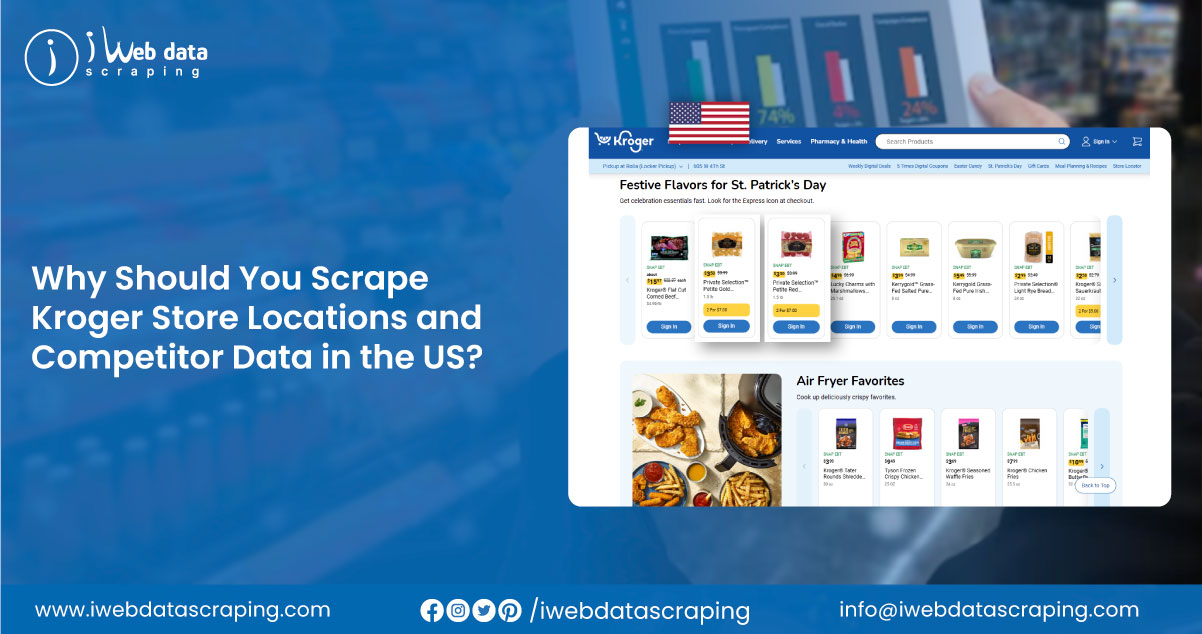
scrape Kroger store locations reliably and legally requires a clear plan for discovery, respectful crawling, parsing location data, and handling competitor records. This guide explains a repeatable workflow, compliance checkpoints, and practical tooling choices for analysts and engineers collecting store-level data across the US.
Goal: collect accurate Kroger store locations and comparable competitor data (latitude/longitude, address, hours, store type) into a reusable CSV/JSON. Includes a named framework (SCRAPE), a short real-world example, a checklist, and practical tips.
Detected intent: Procedural
How to scrape Kroger store locations: step-by-step
Start with discovery: find Kroger’s official store locator endpoints, sitemaps, or public APIs. Typical targets are a store-finder web page, an internal JSON endpoint used by the site, or an open data feed. Record the URL patterns, query parameters, and sample responses before writing any extraction code.
SCRAPE framework: a named checklist for safe, reliable scraping
Use the SCRAPE framework as an operational checklist before any data collection effort:
- Scan — inventory endpoints, sitemaps, and robots.txt for allowed paths.
- Comply — check terms of service and legal constraints; respect rate limits and privacy rules.
- Retrieve — choose the minimal method (API or sitemap) to fetch data, prefer JSON endpoints over HTML parsing when available.
- Analyze — parse addresses, geocode missing coordinates, normalize store types (e.g., supermarket, fuel center).
- Persist — store results in a structured format (CSV/JSON/SQL) with timestamps and provenance fields.
- Enhance — enrich with competitor data, census tract, or market codes for downstream analysis.
Step-by-step technical approach
1. Discovery and permissions
Check the site’s robots.txt and sitemaps to identify allowed paths. The Robots Exclusion Protocol and site sitemap often point to store endpoints; consult the official robots.txt reference for best practices: robots.txt protocol.
2. Prefer APIs and sitemaps
Many store locators use JSON endpoints behind the web UI. Inspect network activity in developer tools, capture example requests, and replicate them with scripted HTTP clients. Using an API-like endpoint reduces the need for brittle HTML parsing and speeds up collection.
3. Rate limiting, retries, and politeness
Implement exponential backoff, a conservative request rate, and randomized delays. Track HTTP status codes and honor 429/5xx responses. Use a clear, consistent User-Agent string and include contact info if large-scale requests are planned.
4. Parsing and normalization
Normalize addresses, convert coordinates to decimal degrees, and standardize store categories. Keep a provenance field (source URL, request timestamp, response snippet) for auditing.
5. Enriching competitor data
Collect competitor store locators (e.g., regional grocers) using the same workflow to ensure consistent fields. Enrich with market boundaries, drive-time polygons, or demographic overlays for competitive analysis.
Store location scraping best practices and legal considerations
Respecting terms of service and privacy is mandatory. The Federal Trade Commission (FTC) provides guidance on data practices; treat scraped personal data and protected information cautiously. Maintain logs, limit scope to business listings (store addresses, hours), and do not attempt to access restricted or private endpoints.
Real-world example: regional market share analysis
An analytics team needs Kroger and two competitors' store locations across Ohio. Using the SCRAPE framework: scan Kroger’s store-finder JSON endpoint, retrieve a full list of stores, normalize addresses and coordinates, and enrich with census tract codes. Results are exported as CSV and loaded into a GIS tool to calculate store density and 15-minute drive-time overlaps for competitive mapping.
Practical tips
- Prefer JSON endpoints over HTML scraping — they are more stable and easier to parse.
- Log request and response metadata to support reproducibility and debugging.
- Use incremental updates: store last-updated timestamps and fetch only changed records.
- Validate geocoordinates with a geocoding service and store confidence scores.
Trade-offs and common mistakes
Trade-offs:
- Speed vs. politeness: aggressive scraping is faster but risks blocking and legal exposure. Conservative rates protect access.
- Completeness vs. maintenance: deep DOM parsing can extract more fields but is brittle; API-based collection requires less upkeep.
Common mistakes:
- Not checking robots.txt or ignoring site terms of service.
- Failing to normalize addresses, causing duplicate or mismatched records.
- Overlooking timezone and opening-hours standardization.
Core cluster questions
- How to extract store location coordinates from a grocery store API?
- What fields should a store location dataset include for competitive analysis?
- How to safely rotate IPs and manage rate limits when scraping location data?
- How to validate and geocode addresses collected from store locators?
- How to compare Kroger store footprints with regional competitors using drive-time analysis?
FAQ
Can an analyst legally scrape Kroger store locations?
Collecting publicly available business information like store addresses and hours is commonly permissible, but compliance depends on the site’s terms of service and local law. Consult legal counsel for large-scale projects and avoid accessing restricted APIs or private data. Follow robots.txt and industry best practices.
What is the best way to scrape Kroger store locations without breaking the site?
Use discovery to find official JSON endpoints or sitemaps, implement conservative rate limits, randomize delays, honor HTTP responses, and include provenance in saved records. Prefer incremental updates rather than full re-crawls.
Which fields should be captured when scraping grocery store data?
At minimum capture store name, address (structured), city, state, ZIP code, latitude, longitude, phone, store type, hours, and a timestamp. Add source URL and raw response for auditing.
How should scraped location data be stored and shared?
Store data in structured formats (CSV, newline-delimited JSON, or a relational database). Include schema versioning, a provenance column, and timestamps. Sanitize any personal data per privacy requirements before sharing.
How can duplicates be avoided when combining Kroger and competitor datasets?
Normalize addresses using a reference geocoder or address standardization library, use coordinates and fuzzy matching on address fields, and keep an audit trail for merge decisions.