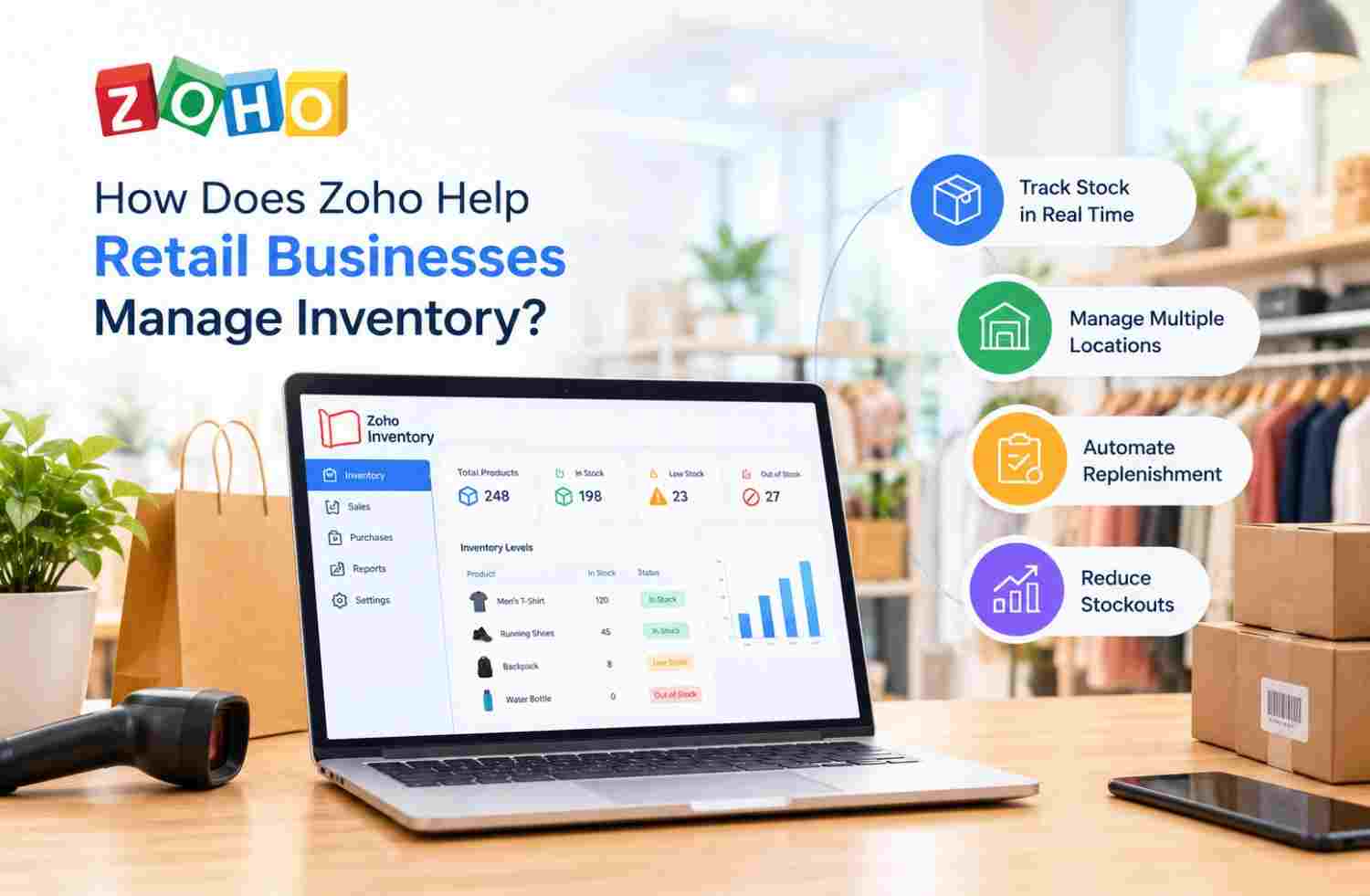
How Does Zoho Help Retail Businesses Manage Inventory?
-

- Published Updated
- 1,825 views
One of the most critical aspects of a successful retail business is inventory management. A high level of inventory can tie up cash and raise storage expenses, whereas a low level can lead to stock-outs, lost sales, and displeased customers. Retailers require correct information about what they can order, what is being sold, and when they should order again.
This is where Zoho for Retail Business can come in handy. Zoho offers retailers the tools to manage inventory, track inventory movement, automate repetitive tasks, and keep inventory information in sync with sales and other business operations. The enhanced visibility and automation provide retailers with a clearer view and enable them to make more informed decisions about stock levels, ensuring smoother day-to-day operations.
What Is Zoho for Retail Business?
Zoho for Retail Business is the opportunity to use Zoho's business applications to run vital aspects of retail, like inventory, sales, purchases, customer relationships, accounting, and reporting.
Retailers can use connected Zoho applications to maintain business information in an organized way instead of using a spreadsheet or isolated systems. Information regarding inventory can be correlated with sales orders, purchase orders, customer, supplier, and financial data.
This is a centralized solution that lets companies know what they have on hand and be more ready to meet customer demand when it shifts.
How is Zoho helpful for retail businesses?
Zoho can support retail inventory management in several practical ways. From real-time stock visibility to automated reorder processes, its tools can help reduce manual work and improve inventory control.
Real-Time Inventory Visibility
With Zoho, retailers can track the movement of products, stock levels, sales orders, purchase orders, and warehouse activities. This real-time visibility will help businesses see low-stock and slow-moving products, track inventory from point to point, and minimize reliance on manual spreadsheets.
Automated Reordering
Using inventory levels and reorder points will simplify replenishment in Zoho. When stock reaches a predefined threshold, retailers can identify products requiring replenishment and manage purchase orders more efficiently, helping maintain suitable inventory levels without unnecessary purchasing.
Multi-Location Inventory Management
Retailers with multiple stores or warehouses can manage their inventory from a single platform with Zoho. Product availability, transfers, and inventory tracking between locations are tracked, making it easier to instantaneously identify shortages and re-distribute products available.
Better Sales and Inventory Coordination
Zoho can link sales activities with inventory, which will aid retailers in keeping better track of stock. Sales and inventory data can be used together to identify fast-selling products, to track product demand, and to make purchase and replenishment decisions.
Purchase Order Management
Zoho organizes the purchase order and supplier information in a structured workflow for retailers. This enables teams to keep track of incoming goods, verify procurement vs. current inventory needs, and eliminate manual follow-ups, making procurement more organised and efficient.
How Zoho Improves Inventory Planning for Retail Businesses
Effective inventory planning helps retailers maintain the right products in the right quantities at the right time. Poor planning can lead to excess stock, limited storage space, tied-up capital, or products becoming unavailable when customers need them. Zoho helps retail businesses organize inventory information and use sales and purchasing data to make more informed planning decisions.
Analyze Sales and Product Movement
Understanding which products sell quickly and which move slowly is essential for inventory planning. Zoho helps retailers monitor sales activity and product movement, allowing managers to identify changing demand patterns.
By reviewing historical sales information, retailers can determine which products require regular replenishment and which items may need closer monitoring. This information can support purchasing decisions and help businesses plan inventory based on actual sales activity rather than assumptions.
Set Reorder Levels
Retailers need to know when products should be reordered. Waiting until inventory is almost empty can create supply problems, while ordering too early can result in unnecessary stock.
Zoho can help businesses establish reorder points based on their operational requirements. When inventory reaches a defined level, teams can identify products that require replenishment and take action before stock becomes critically low.
This creates a more structured approach to inventory planning and reduces reliance on manual stock checks.
Plan Inventory Based on Demand
Customer demand can change because of seasons, promotions, holidays, new products, or changing buying behavior. Retailers therefore need to regularly review their inventory requirements.
Zoho provides access to business and sales information that can help retailers evaluate demand and plan future inventory requirements. Managers can compare product performance over different periods and use those insights when planning purchases.
For example, a retailer may notice that certain products consistently experience higher demand during a particular season. This information can be considered when preparing future purchasing plans.
Improve Purchase Planning
Inventory planning and purchasing are closely connected. Retailers need to determine what products to purchase, how much to order, and when to place supplier orders.
Zoho can help organize purchasing information alongside inventory data. Businesses can review current stock levels, incoming purchases, sales activity, and product requirements before making purchasing decisions.
This gives purchasing teams better visibility and can help them coordinate orders more efficiently.
Manage Inventory Across Locations
Businesses with multiple stores or warehouses need a clear understanding of inventory at each location. A product may be available in one store but unavailable in another.
Zoho can help retailers organize inventory information across multiple locations. Managers can review stock availability and identify locations that may require additional inventory.
This can support better inventory distribution and reduce situations where one location has unnecessary excess stock while another location needs replenishment.
How Zoho Supports Growing Retail Businesses
As a retail business grows, inventory management becomes more complex. A small retailer may initially manage products using spreadsheets, but multiple locations, larger product catalogs, and increasing order volumes can make manual processes difficult to maintain.
A connected business management ecosystem can help retailers manage these growing requirements more efficiently. Retailers can connect inventory with other important business functions, such as
- CRM: Manage customer information, interactions, and sales opportunities in one place.
- Accounting: Connect financial information with sales and inventory activities for better visibility.
- Sales: Keep product and inventory information connected with sales orders and customer purchases.
- Purchasing: Monitor stock requirements and coordinate purchasing activities more effectively.
- Customer Management: Use customer and sales information to understand buying patterns and improve service.
This connected approach can reduce information silos and give teams a more complete view of daily business operations.
Connecting Retail Inventory With Other Business Operations
Inventory rarely operates independently. It affects purchasing, sales, accounting, customer service, and planning. A retailer may need to know whether a product is available before confirming an order. The finance team may need inventory and sales information for accounting. Purchasing teams need stock data to determine when new products should be ordered.
Zoho's connected applications can help businesses bring these processes closer together. For organizations that require structured planning and coordination, Zoho for Project Management Consultancy can also be relevant when implementing or managing complex Zoho-based business workflows. The objective is not simply to install software but to configure processes around the actual needs of the organization.
Industry-Specific Zoho Solutions
Zoho can be applied across different industries, but each industry has different operational requirements.
For example, Zoho for the Pharmaceutical Industry can support pharmaceutical businesses with workflows that require greater organization around products, customers, and business operations.
Meanwhile, Zoho for Textile Trading can be relevant for textile businesses managing product variations, trading activities, suppliers, and inventory-related processes.
These examples demonstrate how businesses can build Zoho workflows around their specific operational requirements rather than treating every organization the same way.
Why Businesses Choose Zoho for Inventory Management
The main value of Zoho for retail inventory management comes from combining visibility, automation, and connected business processes.
Retailers can use it to reduce dependence on manual inventory tracking, improve access to stock information, organize purchasing activities, and better understand product movement.
However, successful implementation depends on configuring the system correctly. Inventory workflows should reflect the company's products, warehouses, sales channels, suppliers, and business processes.
A well-planned implementation can help employees use the system efficiently while giving management better visibility into inventory operations.
Why Choose Vision Infotech for Zoho Retail Solutions?
Implementing Zoho effectively requires more than simply selecting software. Businesses need to understand their existing workflows, identify process gaps, configure the appropriate Zoho applications, and connect them with other systems where required.
Vision Infotech helps businesses plan and implement Zoho solutions according to their operational requirements. From inventory and sales workflows to integrations and automation, the focus is on creating practical systems that support everyday business operations.
For retail companies looking to improve inventory visibility and streamline business processes, a properly configured Zoho solution can provide a structured foundation for growth.
Conclusion
Proper stock control directly affects retail profits, customer satisfaction, and operational efficiency. Stock data, purchase cycles, and movement of products must be accurate to guide businesses in making better decisions.
Retail businesses can achieve all these things with Zoho for Retail Business by managing inventory, ordering, sales, multi-location visibility, automation, and reporting. Retail systems are becoming more complex and connected, and business systems can streamline manual tasks and enable easier access to critical information. When properly implemented, Zoho can be a vital component in a retailer's overall technology and business management solution.
FAQs
1. Is Zoho suitable for retail inventory management?
Yes. Zoho offers tools that can help retailers manage inventory, purchasing, sales, warehouses, product information, and reporting from connected business applications.
2. Can Zoho manage inventory across multiple retail locations?
Zoho can support multi-location inventory management, allowing businesses to monitor stock across different warehouses or retail locations and manage inventory movement more efficiently.
3. Can Zoho help prevent retail stockouts?
Zoho can provide inventory visibility and support reorder processes, helping retailers identify products approaching low-stock levels and plan replenishment more effectively.
4. Can Zoho connect inventory with e-commerce operations?
Yes. Retail businesses can use Zoho applications to connect inventory and e-commerce workflows, helping maintain consistent information across operations.
5. Does Vision Infotech provide Zoho retail solutions?
Vision Infotech provides Zoho-related development, consulting, integration, and customization services designed around individual business requirements, including retail workflows.