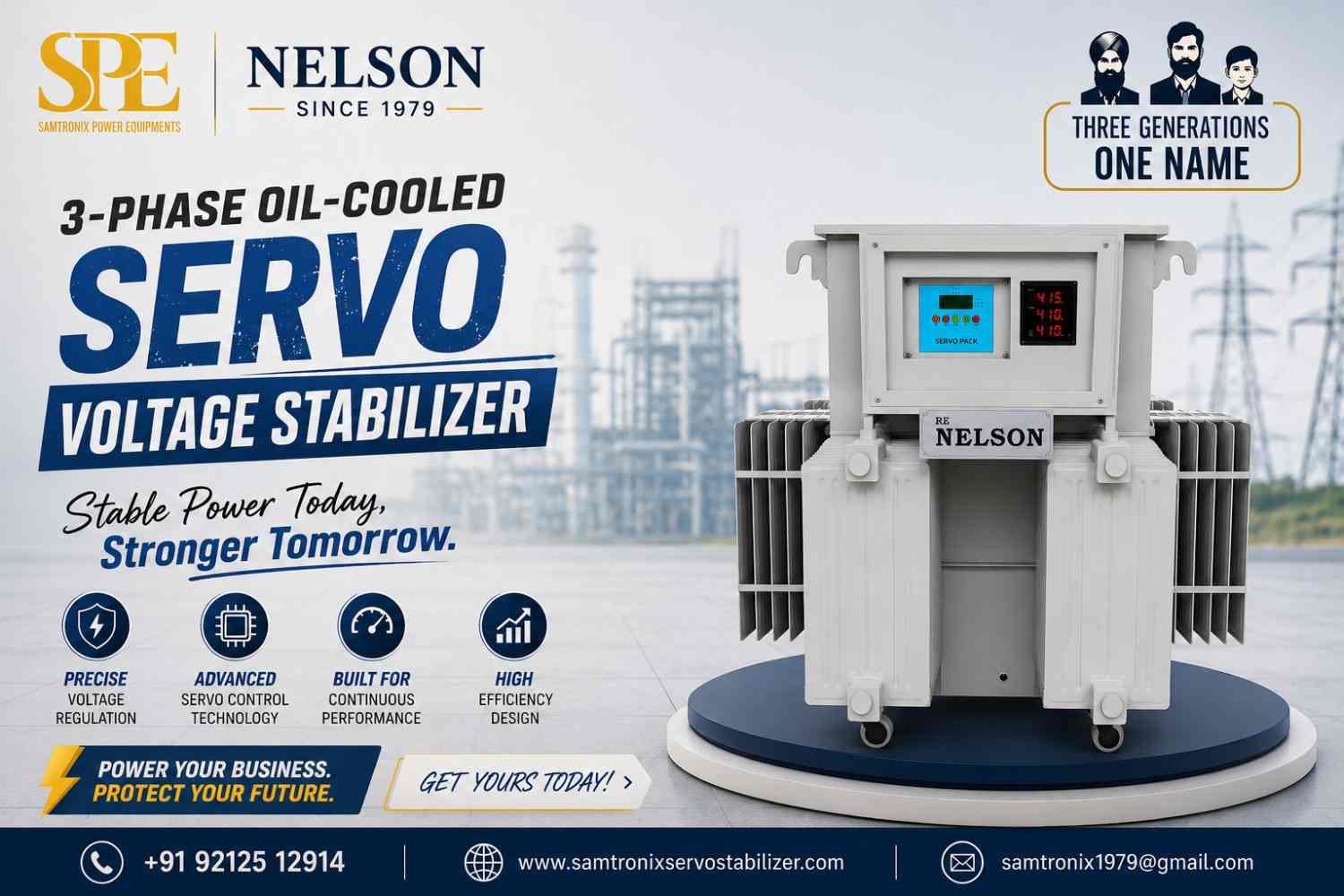
3 Phase Oil Cooled Servo Voltage Stabilizer: Protecting Productivity, Machinery and Business ROI
-

- Published Updated
- 2,125 views
The Power Behind Every Productive Hour
Every industrial business makes investments with one objective: to generate value.
Machines are purchased to increase production. Automation is installed to improve consistency. Employees are trained to operate equipment efficiently. Raw materials are stocked to keep production moving.
But there is one requirement connecting all of these activities — reliable electrical power.
When the incoming voltage is unstable, the effect may not always be visible immediately. A machine may trip once and restart. Another may show an error. A production process may pause for a few minutes. On its own, each incident may appear manageable.
The financial picture changes when these interruptions happen repeatedly.
Lost production time, additional maintenance attention, delayed orders and lower machine utilization can gradually affect operating costs.
A 3 Phase Oil Cooled Servo Voltage Stabilizer is designed to help businesses manage voltage fluctuations in three-phase electrical systems and provide a regulated supply to connected equipment.
For an industrial operation, that makes voltage stabilization more than an electrical requirement. It can become part of a strategy for protecting productive capacity and improving the long-term value of machinery investments.
Why Businesses Should Look Beyond the Purchase Price
When purchasing electrical equipment, it is natural to compare prices.
However, the purchase price represents only one part of the financial decision.
The more useful question is what the equipment can contribute throughout its operating life.
For a business dealing with voltage fluctuations, the cost of doing nothing may include repeated interruptions, equipment troubleshooting, production delays and additional maintenance.
These costs may never appear on a single invoice.
They are spread across different parts of the business.
That is why a stabilizer should be evaluated according to the problem it is expected to solve.
If voltage fluctuations are affecting expensive machinery, then the value of voltage regulation should be considered against the potential cost of those disturbances.
A lower initial investment is not necessarily a lower long-term cost.
What Is a 3 Phase Oil Cooled Servo Voltage Stabilizer?
A 3 Phase Oil Cooled Servo Voltage Stabilizer is an automatic voltage regulation system designed for three-phase electrical loads.
Its sensing system continuously monitors incoming voltage. When the supply voltage rises or falls, the control circuit detects the variation and activates the servo mechanism to make the required correction.
The stabilizer works to bring the output voltage toward the desired level within its specified operating range.
Unlike a manual voltage adjustment system, the correction takes place automatically while the equipment is operating.
The oil-cooled construction provides a method of managing heat generated by the stabilizer while also providing electrical insulation to internal components.
This combination of automatic servo regulation and oil cooling makes the configuration suitable for many industrial applications involving continuous or demanding electrical operation.
What Makes Servo Regulation Different?
The word “servo” refers to the automatic control mechanism used to regulate voltage.
The system monitors the incoming supply and responds when a voltage variation is detected.
If the input moves away from the desired level, the servo motor adjusts the regulating mechanism. This changes the voltage relationship within the stabilizer and helps bring the output toward the required level.
The process is continuous and automatic.
For industrial users, this means voltage correction does not depend on someone standing beside the equipment and manually making adjustments throughout the working day.
A digital display or control panel can also allow operators to monitor relevant operating parameters depending on the stabilizer's configuration.
This makes the system easier to observe as part of routine electrical management.
Where Does the ROI Actually Come From?
A stabilizer does not generate additional sales by itself.
Its financial contribution comes from supporting the systems that generate those sales.
Think about a production machine.
The business invests money in purchasing it.
The machine then produces goods.
Those goods generate revenue.
If the machine remains available and productive, the business has a better opportunity to recover its original investment and generate profit.
If the machine repeatedly stops because of voltage-related issues, its actual utilization can fall.
This is where voltage stabilization can have an economic role.
By helping regulate voltage fluctuations within its designed range, a suitable stabilizer can support a more consistent operating environment for connected equipment.
The resulting ROI depends on the application, but the principle is straightforward:
Better equipment availability can mean better utilization of capital assets.
Calculate the Value of Downtime
Businesses can make the ROI discussion much more practical by calculating their downtime cost.
Start with one important machine.
How much production does it normally generate per hour?
How many operators depend on it?
What happens to the production process if it stops?
Does material have to be discarded or reprocessed?
Does another machine have to wait?
Does the interruption affect customer delivery?
Now multiply the estimated productive loss by the number of relevant incidents.
This provides a clearer picture of the financial impact.
For example, losing a small amount of production once may not justify a major investment.
But if similar interruptions occur every week or every month, the annual impact can become substantial.
This is why businesses should base their stabilizer decision on real operating conditions rather than assumptions.
Protecting Machinery Is Also Protecting Investment
Industrial machinery represents significant capital expenditure.
A CNC machine, production line, compressor, pump or automated system is expected to remain useful for years.
The longer an asset remains productive and reliable, the greater the opportunity for the business to recover its investment.
A suitable servo stabilizer can help regulate voltage and provide a controlled supply to connected equipment.
This may help reduce exposure to unsuitable voltage variations within the stabilizer's specified range.
However, voltage regulation should not be confused with complete equipment protection.
Industrial machinery also requires appropriate circuit protection, earthing, overload protection, preventive maintenance and correct operating procedures.
A stabilizer is one part of the electrical protection and power-management system.
Why Oil Cooling Matters for Continuous Operation
Industrial equipment often operates for long working hours.
When electrical equipment carries a significant load, heat generation becomes an important design consideration.
Oil-cooled stabilizers use insulating oil to assist in heat transfer and electrical insulation.
This can make them suitable for applications where continuous operation and substantial loads are important requirements.
The benefit is particularly relevant in environments where equipment cannot simply be switched off frequently for cooling.
However, businesses should still select the stabilizer according to the actual application.
Oil cooling does not determine the required KVA capacity or input correction range.
Those factors must be assessed separately.
Stable Voltage Can Support Production Consistency
Production managers plan output according to machine capacity and available working hours.
Unexpected electrical interruptions can interfere with those plans.
A machine may need to be restarted. A process may have to begin again. An operator may need to troubleshoot an error. Production schedules may need to be changed.
A properly selected stabilizer can help manage voltage-related interruptions by regulating the incoming supply within its specified capabilities.
This can contribute to more predictable operation.
It does not guarantee uninterrupted production because equipment can stop for many other reasons.
But controlling voltage removes one potential source of instability from the production environment.
For businesses where every production hour matters, that can have meaningful value.
Voltage Stability and Equipment Operating Conditions
Electrical equipment is generally designed to operate within particular voltage conditions.
When the supplied voltage remains within a suitable range, the equipment can operate under the electrical conditions expected by its manufacturer.
When voltage fluctuates significantly, the impact depends on the type of equipment and the nature of the fluctuation.
Some systems may trip.
Some may experience operational disturbances.
Certain components may be subjected to additional electrical stress.
A servo voltage stabilizer is designed to regulate voltage variations and help maintain the desired output.
This makes it particularly relevant where inconsistent incoming voltage is a known concern.
Choosing the Correct KVA Capacity
One of the most important purchasing decisions is selecting the appropriate capacity.
A stabilizer should be sized according to the actual connected load.
However, simply adding the rated power of machines may not always be enough.
Motors, compressors, pumps and other inductive loads can have higher starting-current requirements.
These starting characteristics need to be considered.
The input voltage range is equally important.
A stabilizer must be capable of correcting the voltage fluctuations experienced at the site.
Output voltage requirements must also be established.
If the business plans to add machinery in the future, that potential expansion should be included in the assessment.
Correct sizing helps ensure that the stabilizer performs its intended function without unnecessary capital expenditure.
Why Oversizing Can Reduce Financial Efficiency
There is a common belief that buying a larger stabilizer automatically provides greater protection.
That is not necessarily true.
If the actual requirement is significantly lower than the selected capacity, the business may spend additional capital without receiving equivalent practical value.
At the same time, selecting a stabilizer that is too small can create its own problems.
The objective is therefore to find the correct balance.
The ideal system should provide enough capacity for the present load while allowing for reasonable future requirements.
This is where technical assessment becomes part of financial planning.
Correct sizing protects both the equipment and the investment.
Applications in Industrial and Commercial Facilities
A 3 Phase Oil Cooled Servo Voltage Stabilizer can be considered for a range of three-phase applications.
Manufacturing plants may require voltage regulation for CNC machines, production machinery, motors and automated systems.
Processing industries may use pumps, compressors and electrically driven equipment where consistent voltage is important.
Industrial workshops may also consider servo stabilization for machinery affected by fluctuations in the incoming supply.
Other commercial and infrastructure installations with significant three-phase loads can evaluate the technology according to their electrical requirements.
The stabilizer should always be selected according to the actual application.
Different equipment combinations can create different electrical demands.
Maintenance and Long-Term Operating Value
The financial value of electrical equipment should also be considered over its operating life.
Businesses naturally want their electrical infrastructure to remain dependable rather than becoming another source of unexpected expense.
Routine inspection, proper installation and appropriate maintenance are important for achieving reliable operation.
The stabilizer itself should also be operated according to the manufacturer's recommendations.
A well-maintained voltage regulation system can become a long-term part of an industrial electrical setup.
The goal is not to purchase a stabilizer and forget about it.
The goal is to make voltage regulation a planned part of the facility's power infrastructure.
Why the Cheapest Solution Can Become Expensive
A low purchase price can be attractive.
But if the selected stabilizer does not match the load, voltage range or operating requirements, the business may not receive the expected benefit.
That can turn a seemingly economical purchase into an expensive decision.
Instead of asking only about the price, businesses should evaluate:
The required KVA capacity.
The input voltage range.
The required output voltage.
The type of connected load.
Motor starting requirements.
Operating hours.
Installation conditions.
Future expansion.
Maintenance requirements.
These factors provide a much better basis for evaluating the overall investment.
A Stabilizer Can Help Businesses Get More From Existing Machinery
Increasing production does not always require immediately purchasing new equipment.
Sometimes the first step is to improve the utilization of existing assets.
If machines are available but repeatedly interrupted by voltage-related issues, their actual productive output may be lower than their potential.
A voltage stabilizer can help regulate the supply and support more consistent operation.
It does not increase the rated capacity of the machine.
Instead, it helps provide electrical conditions in which the equipment can operate more appropriately.
For a business that has already invested heavily in machinery, improving asset utilization can be an important route toward better ROI.
Why NELSON by Samtronix Power Equipments?
NELSON, under Samtronix Power Equipments, carries the legacy of Since 1979 and the philosophy of “Three Generations, One Name.”
For businesses looking at voltage stabilization, the selection process should begin with the application.
The objective should be to understand the electrical requirement and select a suitable configuration rather than choosing equipment only because of its capacity, appearance or price.
Samtronix Power Equipments focuses on voltage stabilization solutions for industrial and commercial requirements.
For customers, the most important consideration is finding a solution that corresponds with their load, voltage conditions and operating environment.
Stable Power Is About More Than Voltage
At first glance, a voltage stabilizer may appear to be a simple electrical device.
But its role can extend into several areas of business operation.
It can help regulate voltage.
Regulated voltage can support suitable equipment operation.
Suitable operation can support machine availability.
Better machine availability can support production.
Production supports revenue.
That is the connection between power stability and ROI.
The stabilizer itself is not the source of business growth.
It helps support the electrical infrastructure behind the activities that create business growth.
Look at the Investment From a Long-Term Perspective
The value of a stabilizer should not be judged by the day it is purchased.
It should be considered over months and years of operation.
How much productive time can the business protect?
How valuable is the connected machinery?
How frequently do voltage fluctuations affect operations?
How important is continuous production?
How much could repeated interruptions cost?
These questions provide a more meaningful picture of the potential value.
A correctly selected 3 Phase Oil Cooled Servo Voltage Stabilizer can become an important part of a long-term power management strategy for businesses dependent on three-phase equipment.
Make Your Power Infrastructure Work Smarter
Voltage problems should not be treated as unavoidable simply because they have become part of daily operations.
If fluctuations are affecting important machinery, production schedules or equipment performance, it is worth evaluating the electrical supply and understanding the underlying problem.
A suitable servo stabilizer can help regulate voltage fluctuations and provide a more controlled supply for connected three-phase equipment.
The actual financial benefit will vary from one installation to another.
But when machinery is expensive and downtime is costly, improving the quality and consistency of the electrical supply can be a sensible business decision.
Protect the power. Protect the machinery. Protect the productivity behind your ROI.
Get the Right Solution for Your Electrical Requirement
Selecting a voltage stabilizer should begin with your actual site conditions.
Evaluate the connected load, incoming voltage fluctuations, starting-current requirements, output voltage, operating hours and expected future expansion.
The right KVA capacity and configuration should be determined from these requirements.
If unstable voltage is affecting your three-phase machinery or production operations, a 3 Phase Oil Cooled Servo Voltage Stabilizer can provide an approach to automatic voltage regulation.
For enquiries, contact Samtronix Power Equipments at +91 92125 12914, visit www.samtronixservostabilizer.com, or email [email protected].
Reliable power helps your machinery stay productive — and productive machinery helps your investment work harder.
Frequently Asked Questions
1. What is a 3 Phase Oil Cooled Servo Voltage Stabilizer?
It is an automatic voltage regulation system designed for three-phase electrical loads. It monitors incoming voltage and uses a servo-controlled mechanism to adjust the output toward the required voltage level within its specified operating range.
2. How can voltage fluctuations affect a business?
Voltage fluctuations can cause equipment trips, interruptions or unsuitable operating conditions depending on the machinery and severity of the variation. Repeated interruptions can contribute to downtime and additional operating costs.
3. Why is oil cooling used in servo stabilizers?
Oil cooling helps manage heat generated inside the stabilizer and provides electrical insulation to internal components. It can be suitable for applications involving substantial loads and extended operation.
4. How does a servo stabilizer contribute to ROI?
Its potential contribution comes from helping manage voltage fluctuations, supporting equipment availability and reducing the impact of certain voltage-related interruptions. The actual ROI depends on the individual installation and operating conditions.
5. Can a servo stabilizer completely prevent machine breakdowns?
No. A stabilizer primarily regulates voltage. Machinery can also experience mechanical, electrical, control-system and maintenance-related problems that require separate solutions.
6. What information is required to select the correct stabilizer?
The connected load, motor starting requirements, input voltage range, required output voltage, load type, operating hours and future expansion plans should be considered before selecting the capacity and configuration.
7. How can I enquire about a 3 Phase Oil Cooled Servo Voltage Stabilizer?
You can contact Samtronix Power Equipments at +91 92125 12914, visit www.samtronixservostabilizer.com, or email [email protected] for product and application-related enquiries.