4D vs 5D Massage Chairs: Every Question Answered Before You Buy in 2026
-

- Published Updated
- 7,119 views
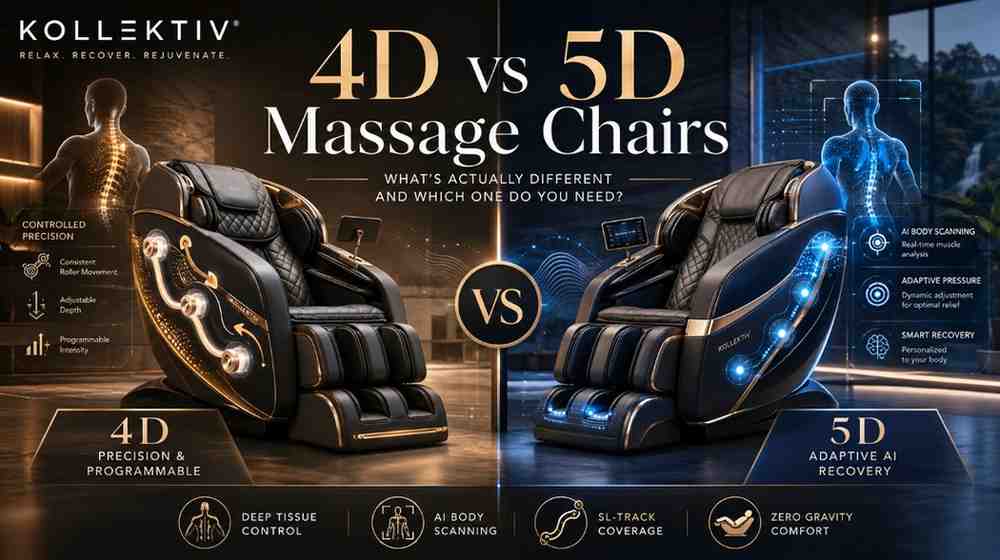
The 4D vs 5D question generates more confusion in the massage chair category than almost any other specification decision — and most of that confusion is preventable with clear, direct answers to the questions buyers actually ask.
This guide is structured around those questions. Not the ones that make for impressive-sounding product descriptions, but the ones that actually determine whether a specific technology is right for a specific buyer. By the end, the decision should be straightforward — not because the technology is simple, but because the criteria for choosing between them are clearer than most buying guides make them appear.
What do the dimension numbers in massage chairs actually mean?
The dimension numbers — 2D, 3D, 4D, 5D — describe specific mechanical capabilities of the roller system, and each number in the progression added something that meaningfully changed therapeutic performance.
2D rollers move in two directions: along the track and side to side. Fixed depth. Consistent but limited pressure.
3D rollers add depth — the rollers can extend outward from the backrest for deeper pressure and retract for lighter coverage. This is the addition that made variable depth possible and transformed massage chairs into genuinely therapeutic devices.
4D rollers add speed modulation within individual movements. The mechanism varies its pace during a single stroke — slowing and deepening into areas of higher resistance, accelerating through areas of lower resistance. This rhythmic variation is what makes a 4D massage feel qualitatively closer to a human therapist's hands rather than a mechanical device running a fixed sequence.
5D rollers — in genuine implementations — add continuous real-time adaptive response. The mechanism uses ongoing body sensing to detect muscle tension and physiological state throughout the session and adjusts depth, speed, and pressure dynamically in real time. Rather than executing a program, it responds to the body it is working on.
Is 5D always better than 4D?
No — and this is the most important answer in this entire guide.
5D adaptive technology is better for specific buyer profiles. For other profiles, a well-implemented 4D system produces equal or superior outcomes at a lower price point. The dimension number describes the technology. Whether that technology matches your recovery needs is a separate question that the number alone cannot answer.
A buyer with consistent, defined recovery needs — the same lower back tension session to session, the same post-workout soreness pattern, the same stress-driven shoulder tightness — gets optimal value from a quality 4D system. The predictable, precise control that 4D provides is an advantage for this profile, not a limitation.
A buyer with variable recovery needs — significant day-to-day or week-to-week variation in tension pattern, location, or intensity — benefits from 5D's adaptive capability in a way that justifies the premium. The chair adjusts to the current state rather than requiring the user to manually identify and program the appropriate settings each session.
The right technology is the one that matches your recovery profile. Neither 4D nor 5D is categorically superior.
What does 5D actually add that 4D does not?
The specific addition of genuine 5D over 4D is continuous real-time adaptive response — and understanding what continuous means in this context is critical.
Many chairs perform an initial body scan at session start and then run a preset program calibrated to the scan result. This is body-scan-assisted 4D, not genuine 5D. The scan informs the program selection. Once the program runs, the mechanism does not continue adjusting based on how the tissue responds.
Genuine 5D maintains ongoing body sensing throughout the entire session. The mechanism detects how the tissue responds to pressure as the massage progresses — whether a tight area is releasing, whether a previously relaxed area is tensioning, whether the current depth and speed are producing the intended therapeutic response — and adjusts continuously in real time.
The practical consequence is a session where the chair makes ongoing therapeutic decisions rather than executing a predetermined sequence. It prioritises areas of detected high tension, modulates pressure as the tissue responds, and provides a level of session-to-session variability that automatically matches the chair's intervention to the body's current state rather than a static profile created at session start.
Does 5D mean deeper pressure?
No — and this is one of the most common misconceptions about the distinction.
Deep tissue pressure is determined by roller depth settings and intensity levels — capabilities that are fully available on quality 4D systems. A 4D chair with five intensity levels can deliver genuine deep tissue pressure across every area the track covers.
What 5D adds is intelligent adaptation of when and how deeply to apply that pressure. If you need deep tissue work in the lumbar region and direct a 4D chair to provide it at high intensity, the depth is available. What 5D adds is the system's ability to make that determination on your behalf — detecting that the lumbar region presents high tension and applying deep pressure there without requiring you to identify it and program it manually.
5D is about adaptive intelligence, not additional mechanical depth.
Are all 5D chairs genuinely 5D?
No — and this caveat is as important as any specification comparison in this guide.
The dimension numbering system is not standardised across manufacturers. Different brands define 5D differently. Some use it to describe genuine AI-adaptive massage with continuous real-time body sensing and dynamic parameter adjustment throughout the session. Others use it to describe a system that performs an initial body scan and then runs a calibrated preset — which is functionally 3D with body scan capability.
The price tag does not reliably distinguish between these implementations. A chair marketed as 5D at $4,000 from a brand with a loose definition of the term can deliver an inferior experience to a well-engineered 4D chair at $2,500 from a brand with rigorous engineering standards.
Before making any decision based on the 5D designation, verify what the body scanning system actually does — whether it operates continuously throughout the session or only at the initial calibration — and examine the supporting specifications that determine how much of the available therapeutic potential the roller system can deliver.
The Kollecktiv 205 full-body massage chair is a clear example of what rigorous 4D engineering produces — a 57-inch SL-track, five intensity levels, Thai stretching, zero gravity, AI voice control, and full-body airbag coverage that consistently outperforms superficially labelled 5D chairs at comparable or higher price points from brands with less engineering rigour.
Which user profile needs 5D and which does not?
This is the question that should drive the decision — and the answer is more specific than most guides acknowledge.
4D is the right choice for buyers with consistent, recurring recovery needs. Lower back tension from desk work. Shoulder tightness from a specific activity. Post-workout soreness from a predictable training load. If your recovery pattern is stable enough that a well-selected program addresses it reliably session to session, 4D gives you precise, repeatable therapeutic outcomes without paying for adaptive capability your pattern does not require.
4D is also the right choice for first-time premium massage chair buyers. The 4D experience is genuinely transformative, and the 5D premium is better justified after experiencing quality 4D and identifying a specific limitation that adaptive technology would address.
5D is the right choice for athletes whose training loads — and therefore recovery needs — vary significantly week to week. Heavy training blocks demand different therapeutic inputs than recovery weeks. 5D automates the adjustment rather than requiring the user to manually reconfigure between sessions.
5D is the right choice for high-stress professionals whose tension patterns shift significantly by project phase or stress level — concentrated differently during deadline periods than during lighter workloads.
5D is the right choice for anyone managing an evolving physical condition where the therapeutic requirement changes as the tissue heals or responds to treatment.
And 5D is the right choice for buyers making a long-term primary wellness investment who want technology that adapts as their needs change over years rather than requiring reprogramming or replacement when the pattern shifts.
Do supporting specifications matter as much as the dimension level?
Yes — significantly so. This is the aspect of the 4D vs 5D decision that most buying guides underweight.
Track length is the most critical supporting specification. A long SL-track covering the complete posterior chain — glutes and hamstrings included — allows the roller system to address the full anatomy involved in lower back pain and sciatica. A short S-track that stops at the lumbar spine leaves the most therapeutically important areas in many conditions unaddressed regardless of whether the rollers above them are 4D or 5D.
Zero gravity integration amplifies either roller technology significantly. In zero gravity, the postural muscles disengage and the back is in full, even contact with the track surface. The same intensity setting produces deeper, more even, more therapeutically effective pressure than upright because the tissue is no longer partially braced against the intervention. A 4D or 5D chair used consistently in zero gravity outperforms the same chair used upright.
Heat therapy — infrared lumbar heat in particular — loosens the connective tissue the rollers work through. Sessions with heat activated consistently produce better outcomes than sessions without it at equivalent roller intensity settings.
A 5D chair with a short track, inadequate zero gravity, and no heat therapy does not outperform a 4D chair with a long SL-track, three-stage zero gravity, and lumbar heat. The dimension number is one variable in a system where track design, zero gravity staging, and heat integration determine how much of the available therapeutic potential the chair actually delivers.
For buyers who want a structured comparison of how these variables combine across specific Kollecktiv models, the Kollecktiv buying guide provides exactly that — a complete breakdown of every model by feature combination, primary use case, and price tier.
What is Kollecktiv's approach to the 4D vs 5D distinction?
Kollecktiv's flagship model — the 301 — resolves the 4D vs 5D choice rather than forcing it. The 301 uses a combined 4D × 5D mechanism that integrates precision programmable 4D roller control with AI-driven 5D continuous body sensing in a single system.
When you want direct control over the session — selecting a specific program at a specific intensity for a known recovery need — the 4D programmable layer delivers it with precision and consistency. When you want the chair to interpret your current physiological state and make the therapeutic decisions — particularly useful when your recovery needs are less predictable or you want maximum adaptive intelligence — the 5D layer engages continuously throughout the session.
The two capabilities reinforce each other rather than competing. The result is a chair that is optimally therapeutic for both consistent-pattern users and variable-need users — in the same session if required.
What is the practical decision?
For most buyers entering the premium massage chair category, a well-specified 4D chair provides everything needed for serious daily therapeutic use — and provides it at a price point that makes the investment significantly more accessible than a premium 5D model.
For buyers with variable recovery needs, long-term investment intent, or a specific desire for adaptive therapeutic intelligence rather than programmable precision — a genuine 5D implementation with rigorous engineering behind the label justifies the premium.
The supporting specifications — track length, zero gravity stages, heat integration — matter as much as the dimension designation in determining daily therapeutic value. Evaluate all three before the number drives the decision.
Explore the complete range of 4D and 5D technology across every price tier in the Kollecktiv luxury massage chair collection — every model ships free across the continental US with a 30-day return policy, no sales tax, and up to a 6-year warranty.
originally published on :
https://kollecktiv.com/4d-vs-5d-massage-chair-comparison/