ACCA Course in India: Everything You Need to Know Before You Start
-

- May 19th, 2026
- 3,624 views

FREE SEO Topical Map Generator: Find Your Next Content Ideas
If you are a commerce student sitting in India right now, wondering what to do after your 12th or graduation, chances are someone has already thrown the word "ACCA" at you. Maybe your cousin mentioned it. Maybe you saw it on LinkedIn next to someone's name who is now working abroad. Either way, you are here — and that means you are curious enough to find out more.
So let me walk you through everything honestly. No fluff. No sales pitch. Just what ACCA actually is, why it matters for Indian students specifically, and how you can plan your preparation the right way.
What Is ACCA Course in India and Why Should Indian Students Care?
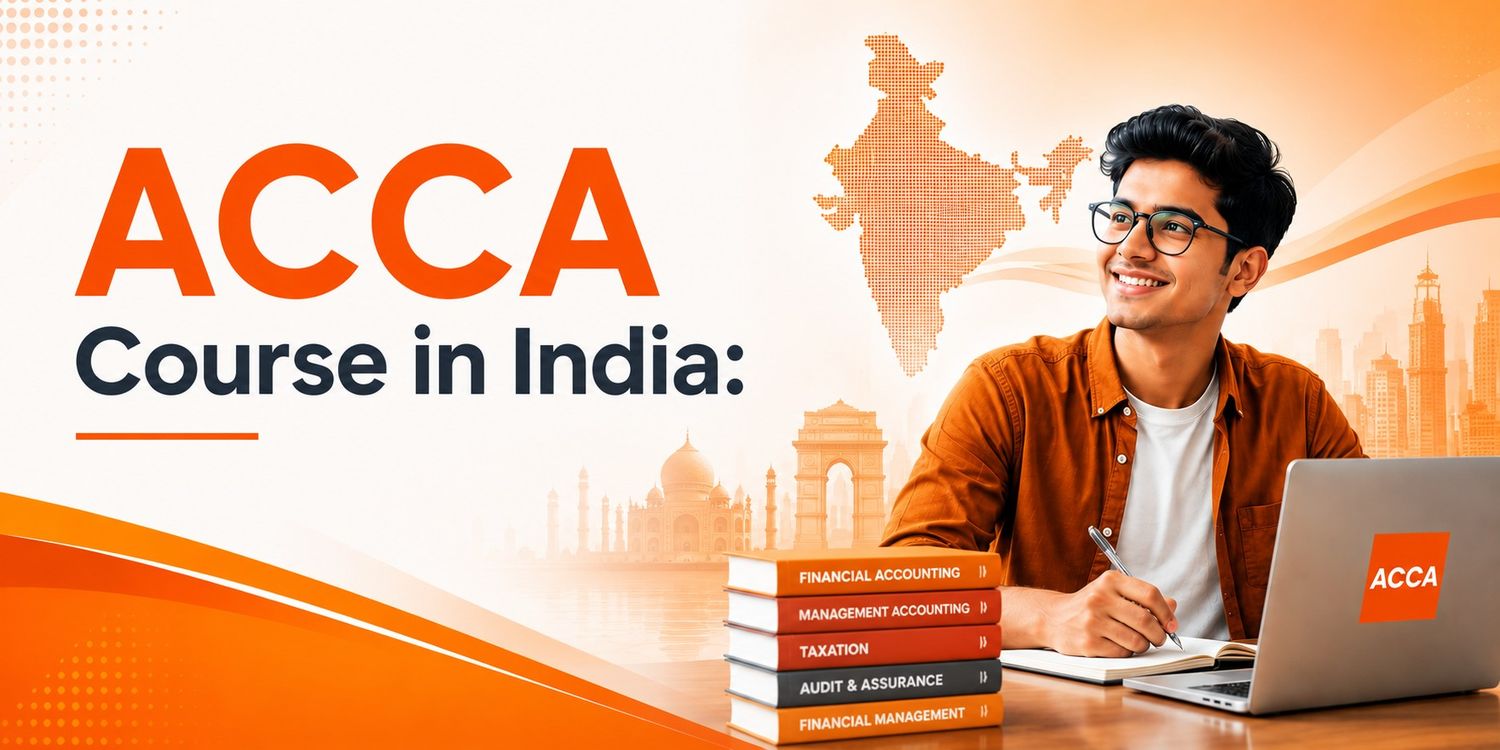
ACCA course in India is built around the globally recognised qualification offered by the Association of Chartered Certified Accountants — a UK-based body whose certification is accepted in over 180 countries, including the UK, UAE, Canada, Australia, Singapore, and dozens more.
Now here is what makes it particularly relevant for Indian students.
India's finance and accounting sector is growing at a pace we have not seen before. Companies are expanding internationally. MNCs are setting up their India offices. The demand for professionals who understand both Indian financial regulations and global accounting standards — IFRS, for instance — is genuinely high.
Pursuing an ACCA course in India positions you exactly there. It makes you fluent in international finance language while keeping you relevant in the domestic market too. That is a powerful combination.
ACCA Course Structure
Before you enroll anywhere or invest money, you should understand the structure clearly.
The ACCA qualification is divided into three levels:
1. Applied Knowledge Level This is where you build your foundation. The three papers here — Business and Technology (BT), Management Accounting (MA), and Financial Accounting (FA) — introduce you to the basics of how businesses operate and how financial information is recorded and reported.
2. Applied Skills Level This is the real substance of the qualification. Six papers covering Corporate and Business Law (LW), Performance Management (PM), Taxation (TX), Financial Reporting (FR), Audit and Assurance (AA), and Financial Management (FM). These papers are what separate a qualified ACCA professional from someone with just a surface-level understanding of finance.
3. Strategic Professional Level This is where things get serious. You have two mandatory papers — Strategic Business Leader (SBL) and Strategic Business Reporting (SBR) — plus two optional papers from Advanced Financial Management, Advanced Performance Management, Advanced Taxation, and Advanced Audit and Assurance.
Beyond exams, you also need 36 months of practical work experience and an Ethics and Professional Skills module. ACCA is not just a certificate — it is a full professional qualification.
ACCA Eligibility for Indian Students
This is one of the most common questions, and the answer is reassuringly simple.
If you have passed your 10+2 (Class 12) with at least 65% in English and Mathematics or Accounts, and at least 50% in other subjects — you can apply directly for ACCA.
If you do not meet these marks, you can still start from the Foundation level (also called the FIA pathway).
For graduates — B.Com, BBA, MBA, CA Inter — ACCA provides exemptions. This means you may not have to sit all 13 papers. A B.Com graduate can typically get exemptions for up to 9 papers depending on the university and marks. This is a huge advantage and significantly reduces your time to qualify.
ACCA vs CA: The Comparison Everyone Makes
Let us address this honestly because almost every Indian student asks this question.
CA (Chartered Accountancy from ICAI) is India's most prestigious accounting qualification. Nobody is denying that. If you want to practice as a statutory auditor in India, sign audit reports, or work in taxation with deep Indian law focus — CA is designed for exactly that.
But here is what CA does not give you: global mobility.
ACCA opens doors internationally in a way CA alone does not. If your ambition includes working in London, Dubai, Singapore, Toronto, or Melbourne — ACCA is the qualification employers there recognise and hire for.
Many Indian students now pursue both — using CA Inter exemptions to fast-track ACCA — which gives them the best of both worlds. It is not always about choosing one over the other.
How Long Does It Take to Complete ACCA in India?
This depends on your starting point and how seriously you study.
On average, a student starting from Class 12 without any exemptions takes about 3 to 4 years to complete all 13 papers along with work experience and the Ethics module.
A commerce graduate with exemptions can realistically finish in 2 to 2.5 years.
ACCA exams are held in March, June, September, and December — four exam windows per year. This gives you flexibility that CA's limited attempts do not. You can pace yourself based on your work, college schedule, or personal commitments.
ACCA Exam Fees in India: What It Realistically Costs
Transparency matters here. Let us talk numbers.
ACCA charges fees in GBP (British Pounds), so the Indian Rupee cost fluctuates with exchange rates. As a rough estimate:
- Initial registration fee: Approximately ₹10,000 to ₹12,000
- Annual subscription: Around ₹8,000 to ₹10,000 per year
- Per exam fee (Applied Knowledge): Around ₹6,000 to ₹8,000 per paper
- Per exam fee (Applied Skills and Strategic Professional): Around ₹10,000 to ₹20,000 per paper depending on the level
Additionally, you will need to budget for study materials and tuition — which we will get to in a moment.
The total investment across the full qualification, including tuition, typically ranges from ₹3 lakhs to ₹7 lakhs depending on how many papers you are exempt from and what study support you choose.
That may sound like a lot. But consider that an ACCA-qualified professional with two to three years of experience can command a salary that recovers this investment within the first year of employment in many cases — especially in the UAE or UK markets.
ACCA Jobs and Career Opportunities After Qualifying
This is where the effort pays off.
In India, ACCA professionals are hired by Big 4 firms (Deloitte, PwC, EY, KPMG), MNCs, banking institutions, and financial services companies. Roles include financial analyst, management accountant, internal auditor, finance manager, and more.
Globally, the opportunities widen further. The UAE has a strong demand for ACCA professionals, particularly in Dubai and Abu Dhabi's finance sector. The UK, Australia, Canada, and Singapore all recognise the ACCA qualification for immigration and employment purposes.
Average salary for an ACCA qualified professional in India ranges from ₹6 LPA to ₹18 LPA depending on experience and the employer. In the UAE, equivalent roles start from AED 8,000 to AED 15,000 per month.
The qualification also counts toward professional recognition with bodies like ICAEW, CPA Australia, and CPA Canada through mutual recognition agreements — expanding your credentials further.
How to Prepare for ACCA Exams: Practical Advice
Passing ACCA papers is not just about reading textbooks. The exams, especially at the Skills and Strategic Professional levels, test your ability to apply knowledge, not just recall it.
Here is what works:
Understand the examiner's approach first. ACCA publishes examiner reports after each sitting. Reading these shows you exactly where students lose marks and what the examiner actually wants to see. Most students skip this and it costs them.
Practice past papers — but actively, not passively. Do not just read the solutions. Attempt the question under timed conditions, then compare your answer critically. Ask yourself: Did I identify the right issues? Did I apply the right framework? Did I write it clearly enough?
Cover the full syllabus. ACCA exams are unpredictable in the best sense — any topic can appear. Selective study that works in university exams does not work here.
Manage the Ethics and Professional Skills module early. Many students leave this to the end and then feel rushed. Start it as soon as you are eligible; it will make you a better exam taker too.
Why Good Tuition Makes a Difference
ACCA can technically be self-studied. The BPP and Kaplan study materials are excellent. But most students — especially those working part-time or studying alongside college — find structured tuition significantly improves both their pass rates and the time they spend studying.
A good tuition provider does more than read slides at you. They help you understand why a concept works, connect it to exam scenarios, and give you feedback on your practice attempts. They also keep you accountable when motivation dips — which it will at some point in a multi-year qualification.
When choosing a tuition provider in India, look for a few things. Do they have ACCA-approved learning partner status? Do they offer flexibility — evening classes, recorded sessions, weekend batches? Are their tutors practitioners who actually understand the profession, not just the syllabus?
Mirchawala Hub of Accountancy has built a strong reputation in this space precisely because they bring professional depth to ACCA tuition. Students preparing through structured programs with experienced faculty consistently report higher confidence going into exams — and the results reflect that.
Common Mistakes Indian ACCA Students Make
After speaking to students and professionals who have been through the journey, a few mistakes come up again and again.
Underestimating the Strategic Professional level. Many students breeze through Knowledge and Skills papers and then get caught off guard by SBL and SBR. These papers require a different kind of thinking — strategic, integrated, professional. Give them the respect they deserve.
Delaying the Ethics module. It is not an exam in the traditional sense, but it is mandatory and it takes time. Do not leave it until the end.
Ignoring the work experience requirement. You need 36 months of relevant practical experience, documented through the ACCA's PER framework. Start logging this early. Many students qualify on exams but delay certification because they have not tracked their experience properly.
Choosing tuition based on price alone. Cheap tuition that does not help you pass wastes both money and time. Invest in quality guidance upfront.
ACCA in India: Is It the Right Choice for You?
If you are someone who wants to work in finance, has an eye on international opportunities, and is willing to put in consistent effort over two to four years — ACCA is genuinely one of the best qualifications you can pursue.
It is not a shortcut. It is not a "easy" alternative to CA. It is a rigorous, globally respected qualification that rewards students who take it seriously.
India's growing integration with the global economy means ACCA-qualified professionals are more valued here than they were even five years ago. That trend is continuing.
Start by understanding your eligibility and exemptions. Register with ACCA directly. Choose your study support carefully. Plan your exam sittings realistically. Log your work experience from day one.
And if you want guidance through the process — the kind that comes from people who have taught ACCA for years and know exactly where students struggle — reach out to Mirchawala Hub of Accountancy. They have helped hundreds of students across India build careers in global finance, and they can help you too.