What Is an AI Agent? A Plain-English Guide for Business Owners (2026)
-
- September 19th, 2026
- 133 views
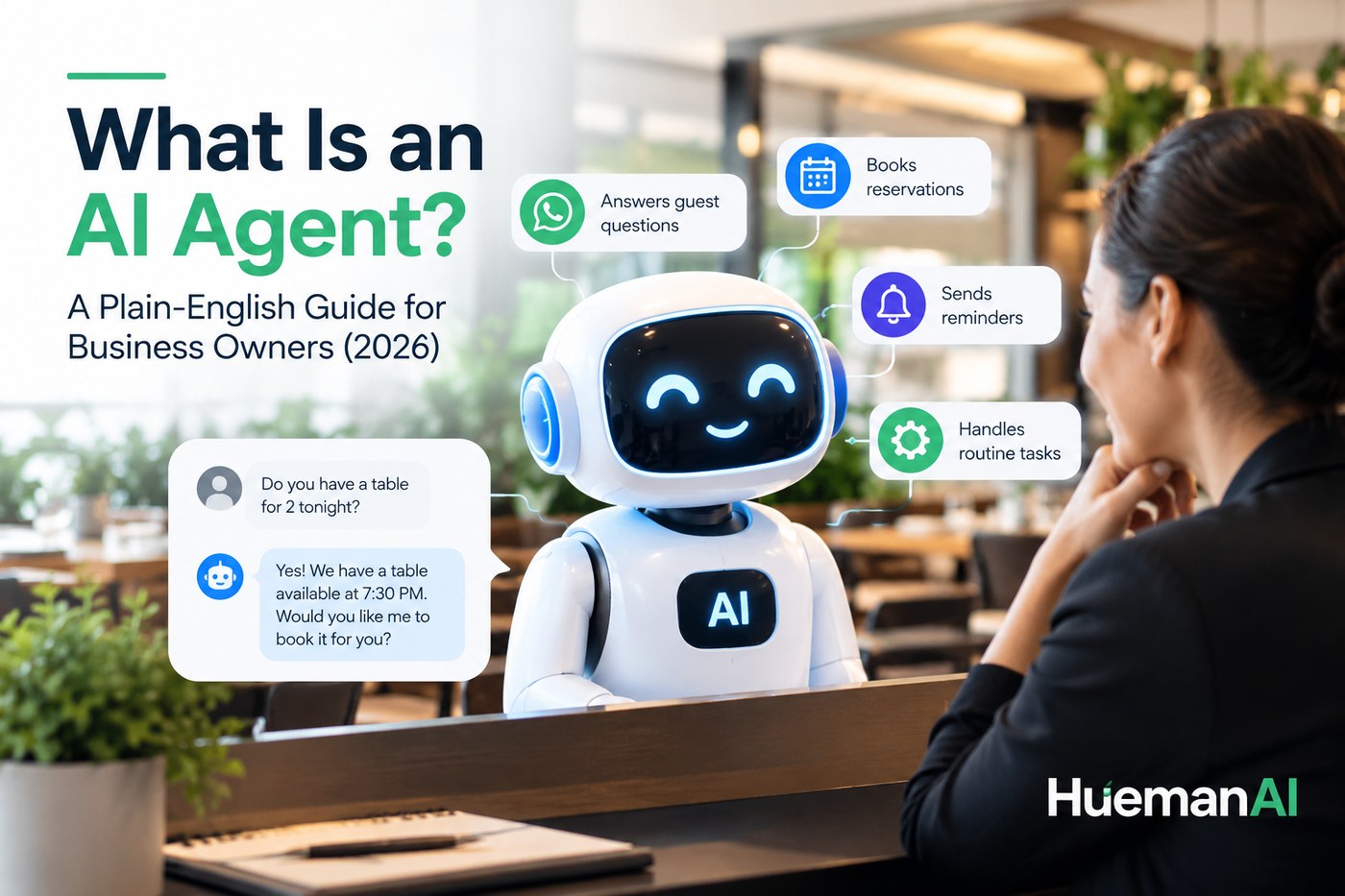
If you've spent any time online this year, you've probably seen the term "AI agent" everywhere — in software ads, LinkedIn posts, even in conversations with your own team. But ask five people what it actually means, and you'll likely get five different answers.
That confusion is understandable. "AI agent" has become one of those terms that gets used so often, by so many different products, that its actual meaning has gotten blurry. This guide cuts through that noise and explains, in plain English, what an AI agent actually is — and just as importantly, what it isn't.
What Is an AI Agent, Really?
Here's the simplest way to think about it: an AI agent is like hiring a super-fast assistant who never sleeps, never forgets, and always follows through.
It doesn't just answer your question — it actually goes and does the task, the way a real team member would.
That last part is the whole point. Most people's mental model of "AI" is a chatbot: you type a question, it types back an answer, and that's the end of the interaction. An AI agent goes a step further. It doesn't just tell you something — it does something.
AI Agent vs. Chatbot vs. Automation: What's the Difference?
These three terms get used almost interchangeably, but they're not the same thing.
A chatbot answers questions. Ask it "Do you have rooms available this weekend?" and it will tell you yes or no. That's where it stops. If you want to actually book something, you're usually redirected somewhere else — a form, a phone call, a human.
Automation follows a fixed set of rules. Think of the classic "if this, then that" logic: if a form is submitted, send an email. It's reliable, but it can't handle anything outside the rules it was given. Ask it something unexpected, and it breaks.
An AI agent does both — and more. It understands what you're actually asking, even if you don't phrase it perfectly. It connects to your real systems (not a demo, not a mockup) and takes the actual action: checking availability, booking the room, sending a confirmation, updating a record. And critically, when something falls outside what it can safely handle, it knows to bring in a human instead of guessing.
What Actually Makes Something an "Agent"?
Strip away the marketing language, and a genuine AI agent generally does three things:
1. It understands what you're asking — in plain language. No dropdown menus, no rigid forms, no "press 1 for sales." You ask a question the way you'd ask a person, and it figures out what you actually need.
2. It actually gets the task done. This is the defining difference from a chatbot. An AI agent that's asked about room availability doesn't just report back — it checks the live system, holds the room, and sends the payment link, all in the same conversation.
3. It knows when to ask for help. A well-built AI agent isn't trying to handle everything itself. Anything genuinely tricky, sensitive, or outside its scope gets handed off to a real person on your team — cleanly, with context, rather than the customer getting stuck in a loop.
If a tool is missing any one of these three things, it's probably not really an "agent" — it's a chatbot or an automation wearing agent branding.
A Simple Example
Let's make this concrete with a scenario almost any business owner will recognize.
A customer messages outside business hours: "Can I get a late checkout tomorrow?"
- A chatbot replies: "Our checkout time is 11am. Please contact the front desk for late checkout requests." The customer is no further along than before they asked.
- Automation might auto-reply with a canned message, regardless of whether late checkout is actually possible that day.
- An AI agent checks the live room schedule, sees the room isn't booked until 2pm the next day, confirms the late checkout on the spot, and logs the change so the front desk sees it automatically — no app to download, no new dashboard for staff to learn.
The customer gets an answer immediately. The business doesn't lose the booking to a competitor who happened to answer faster. And nobody on staff had to stop what they were doing to handle a routine request.
Why This Distinction Actually Matters
It's tempting to treat "AI agent" as just another buzzword — but the distinction has real business consequences.
A chatbot can improve your FAQ page. An AI agent can recover revenue you're currently losing to slow response times, missed after-hours requests, and customers who simply give up and go elsewhere. For business owners evaluating AI tools, the question worth asking isn't "does this have AI in it?" — it's "does this actually take action on my behalf, or does it just talk?"
Where AI Agents Are Already Being Used
AI agents are showing up across industries — customer support, sales, scheduling — but hospitality is one of the clearest examples of where the difference matters most. Hotels deal with constant, time-sensitive requests: availability checks, booking changes, late checkouts, guest questions that arrive at 11pm when no one's at the front desk.
This is exactly the gap AI agents are built to close — not replacing staff, but picking up the repetitive, time-sensitive requests that would otherwise go unanswered or eat up a team's day.
Frequently Asked Questions
Is an AI agent the same as ChatGPT? Not quite. General AI models like ChatGPT can hold a conversation, but on their own they aren't connected to your business's live systems and can't take real action — like booking a room or checking your actual availability. An AI agent is typically built on top of models like this, but wired directly into your business's tools so it can act, not just talk.
Do I need to replace my existing software to use an AI agent? No. A well-built AI agent connects to the systems you already use rather than requiring you to rip and replace your tech stack.
Will an AI agent replace my staff? No — and that's not really the goal. The businesses seeing the best results treat AI agents as a way to handle the repetitive, time-sensitive requests that staff can't always get to, freeing up the team for the moments that genuinely need a human touch.
How is this different from the automation I already use? Automation follows fixed rules and breaks outside them. An AI agent understands natural language and can handle variation — different phrasing, unexpected questions, edge cases — the way a person would, while still knowing its limits.
The Bottom Line
An AI agent isn't a smarter chatbot, and it isn't just automation with a new name. It's software that understands what's being asked, takes real action inside your actual systems, and knows when to bring in a human. That combination — understanding, action, and judgment — is what separates a genuine AI agent from everything being marketed as one.
If you're evaluating AI tools for your business, that's the test worth applying.