AI Agent Memory And Its Types: How Smart Systems Remember, Learn, And Adapt
-

- Published Updated
- 4,272 views
Imagine waking up every morning and remembering nothing from the day before. Every conversation would feel new, every mistake would have to be rediscovered, and every task would begin from scratch. In Groundhog Day, Phil Connors experiences exactly this problem. He is forced to relive the same day repeatedly, but what eventually changes his situation is his ability to remember what happened before. Each experience gives him new information that helps him make better decisions the next time around.
The same principle is becoming increasingly important in artificial intelligence. Modern AI systems are moving beyond simple question-and-answer interactions and evolving into agents capable of planning, using tools, completing multi-step tasks, interacting with users, and working continuously over time. For these systems, intelligence is no longer only about generating the right response in the moment. It is also about remembering what happened previously and using that knowledge when it matters.
This is where AI Agent memory becomes important. AI agent memory gives intelligent systems the ability to capture, store, retrieve, and apply information from previous interactions and experiences. Instead of treating every prompt as an isolated event, an agent with an effective memory architecture can maintain context, recognize patterns, learn from previous outcomes, and personalize future actions.
In this article, we explore what AI agent memory means, why it matters, the different types of memory used by intelligent agents, and the challenges organizations must consider when designing memory-enabled AI systems.
What Is AI Agent Memory?
AI agent memory refers to the mechanisms that allow an AI agent to retain useful information and make that information available when it is needed. It determines what an agent should remember, where that information should be stored, how it should be retrieved, and when it should be updated or removed.
This is much more than storing a complete transcript of previous conversations. Effective memory systems identify information that can improve future decisions. That information could include user preferences, previous actions, successful and unsuccessful approaches, business rules, project details, task instructions, or important events.
For example, imagine an AI assistant helping a user manage a long-term project. During one conversation, the user explains the project's objectives, preferred reporting format, deadlines, and team structure. If the assistant forgets all of this after the conversation ends, the user will need to repeat the same information every time. With an appropriate memory architecture, the agent can preserve relevant details and use them during future interactions.
In this sense, memory becomes a form of cognitive infrastructure for AI agents. It connects previous experiences with current reasoning and future actions.
Why Do AI Agents Need Memory?
Most real-world activities are not completed through a single prompt. People work through projects, conversations, decisions, and processes that unfold over hours, days, months, or even years. AI agents designed to participate in these activities therefore need a way to maintain continuity.
Consider an AI customer-support agent. A customer may have contacted the company several times about the same problem. Without memory, the agent may ask the customer to repeat information, recommend solutions that have already failed, or miss important details from previous interactions. With memory, the agent can review relevant history and provide a more informed response.
The same applies to coding assistants. A development agent may need to understand a team's preferred programming language, architecture, naming conventions, deployment process, and previous technical problems. Remembering these details can help the agent make better recommendations and avoid repeating earlier mistakes.
Memory is also important for personal AI assistants. Users may have recurring schedules, preferred communication styles, ongoing goals, and frequently used workflows. Retaining relevant information enables an assistant to become more useful over time instead of behaving like a completely new system during every interaction.
Memory can also reduce pressure on the model's context window. Although modern LLMs can process increasingly large amounts of information, placing everything into the active context can increase latency, cost, and the possibility of irrelevant information influencing the response. A memory system can selectively retrieve only the information that matters for the current task.
What Are The Different Types Of AI Agent Memory?
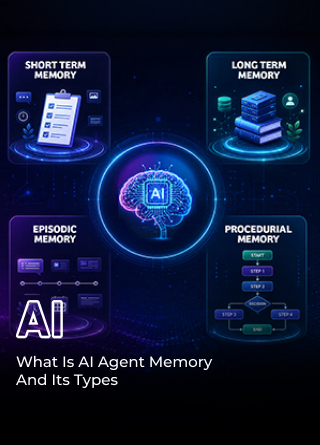
AI memory architectures can be categorized in different ways depending on the system and research framework. However, several types appear repeatedly in agentic AI systems, including short-term memory, long-term memory, semantic memory, episodic memory, and procedural memory.
1. Short-Term Or Working Memory
Short-term memory, often referred to as working memory, contains information the agent needs during an active interaction or task.
It can include recent conversation turns, current instructions, intermediate reasoning results, tool outputs, temporary variables, and the current state of a workflow.
For instance, if a user asks an AI assistant to draft an email and then says, "Make the second paragraph shorter," the agent needs access to the current conversation to understand what "the second paragraph" refers to. Similarly, an automation agent completing a multi-step task needs to know which actions have already been completed and what needs to happen next.
Working memory is generally temporary. Once the task or session ends, some of its information may disappear. However, important details can be selected and transferred into longer-term storage when they are expected to be useful later.
2. Long-Term Memory
Long-term memory allows an AI agent to retain information across sessions.
It can contain durable facts about users, projects, organizations, previous decisions, customer histories, preferences, or recurring workflows. Unlike working memory, long-term memory is designed for information that remains useful beyond the current interaction.
In production environments, long-term memory is typically stored outside the language model itself. Databases, vector stores, knowledge graphs, event logs, and other persistent storage systems can be used to retain information.
Retrieval mechanisms then identify relevant memories and bring them into the model's active context when necessary.
However, effective long-term memory is selective. Storing every interaction indefinitely can create an enormous amount of irrelevant information. As memory grows, retrieval can become more difficult and inaccurate. Mature systems therefore need mechanisms for summarization, prioritization, deduplication, expiration, and deletion.
3. Semantic Memory
Semantic memory represents facts, concepts, relationships, and general knowledge.
It enables an agent to understand what things mean and how different pieces of information are connected. For example, an enterprise support agent may have semantic memory containing product specifications, support policies, customer categories, and known technical solutions.
A legal AI system could use semantic memory to work with laws, regulations, case information, and organizational policies. A healthcare administration agent might use it to understand internal procedures and terminology.
Semantic memory can be implemented through knowledge bases, structured databases, knowledge graphs, embeddings, or other retrieval systems. Its purpose is to provide factual and contextual information that can support the agent's reasoning.
4. Episodic Memory
Episodic memory focuses on specific experiences and events.
Rather than simply storing what is true, it records what happened. This can include the situation, action taken, time, and outcome.
For example, an AI coding assistant might remember that a previous deployment failed after a particular dependency was upgraded. A sales agent could remember that a customer rejected an earlier proposal because of pricing concerns. A customer-service agent might recall that a particular troubleshooting step had already been attempted without success.
This type of memory allows an agent to learn from experience. When a similar situation occurs, the agent can retrieve earlier events and use them to guide its next action.
Episodic memory is particularly valuable for case-based reasoning because it allows agents to compare current problems with previous situations rather than starting from zero every time.
5. Procedural Memory
Procedural memory stores knowledge about how tasks should be performed.
It can contain workflows, operating procedures, tool-use instructions, decision rules, and repeatable task sequences. Instead of remembering only what happened, procedural memory helps an agent remember how to perform an activity.
For example, an AI agent responsible for preparing a monthly business report may remember which data sources to access, how the information should be organized, which calculations are required, and who needs to approve the final report.
A DevOps agent could use procedural memory to remember the approved steps for deploying an application or rolling back a failed release.
Procedural memory is especially important for agentic automation because it helps systems execute recurring processes consistently and efficiently.
How AI Agents Manage Memory
Simply giving an agent access to a database does not automatically create effective memory. A useful memory architecture requires several stages.
First, the system needs to decide what information is worth remembering. Not every sentence or interaction should become a permanent memory.
Next, the information must be stored in an appropriate format. Some information may belong in structured databases, while other information may be better represented as embeddings, documents, event records, or knowledge-graph relationships.
The system then needs a retrieval mechanism capable of identifying relevant memories. When a new task arrives, the agent can search its memory and bring useful information into the active context.
Finally, memory needs to be updated. New experiences may confirm, change, or contradict older information. The system therefore needs mechanisms for consolidating memories, assigning confidence, resolving conflicts, and removing outdated records.
This process makes LLM memory management a continuous activity rather than a one-time storage decision.
Challenges Of AI Agent Memory
Despite its benefits, memory introduces several technical and governance challenges.
One of the biggest problems is memory overload. If an agent stores everything, irrelevant information can accumulate and reduce retrieval quality. The system may retrieve technically related information that is not actually useful for the current task.
Another challenge is stale information. A user's preferences can change, company policies can be updated, and project requirements can evolve. A memory that was correct several months ago may no longer be accurate. Systems therefore need timestamps, confidence levels, versioning, expiration rules, and update mechanisms.
Privacy is another major consideration. Long-term memory can contain information associated with individuals, organizations, and business activities. Organizations must establish clear policies governing what can be stored, who can access it, how long it should be retained, and how it can be deleted.
Security also becomes more complicated. If an attacker can manipulate an agent's memory, they may be able to influence future decisions. Memory stores therefore require access controls, monitoring, validation, and protection against unauthorized modification.
There is also the challenge of balancing personalization with user control. An intelligent assistant should remember information that genuinely improves the experience without retaining unnecessary details indefinitely.
The Future Of AI Agent Memory
As AI agents become more capable, memory will increasingly become a core part of their architecture rather than an optional feature.
Future systems are likely to combine multiple forms of memory. Short-term memory can manage active tasks, long-term memory can preserve important information, semantic memory can provide facts, episodic memory can capture experiences, and procedural memory can support repeatable workflows.
Agents may also become better at deciding what deserves to be remembered and when a memory should be updated, summarized, or forgotten. Instead of simply accumulating information, they will need to manage memory dynamically according to relevance, importance, and context.
This could make AI agents more capable of operating over long periods. An enterprise agent could manage projects across months, a coding agent could understand the history of a software repository, and a personal assistant could adapt to changing user preferences without requiring constant repetition.
Conclusion
AI agent memory is becoming one of the most important building blocks of intelligent, persistent AI systems. It allows agents to move beyond isolated responses and develop continuity across conversations, tasks, and experiences.
Short-term memory helps agents manage what is happening now, while long-term memory preserves information across sessions. Semantic memory provides facts and relationships, episodic memory captures experiences, and procedural memory helps agents remember how to perform tasks.
Together, these capabilities create the foundation for AI systems that can reason with context, learn from experience, personalize interactions, and execute workflows more effectively.
As agentic AI becomes increasingly integrated into business and everyday applications, the quality of an agent's memory architecture may become just as important as the quality of its underlying model. The most capable AI agents will not simply be those that can generate intelligent answers. They will be the ones that know what to remember, what to retrieve, what to learn from, and what to forget.