AI Concierge with WhatsApp Integration: Why Hotels Are Making the Switch
-

- Published Updated
- 3,863 views
Introduction
WhatsApp has quietly become the default way people communicate — for friends, for work, and increasingly, for talking to businesses. When someone wants to ask a hotel a quick question, more and more guests now reach for WhatsApp before they'd ever think to pick up the phone or send an email. It's fast, it's familiar, and it doesn't require waiting on hold.
The problem is that most hotels still treat WhatsApp as an afterthought — a number someone checks when they remember to, buried among a dozen other responsibilities. That gap between how guests want to communicate and how hotels actually respond is exactly where an AI concierge with WhatsApp integration comes in. This post looks at what that actually means, why it's gaining traction now, and what a well-built version of it looks like in practice.
Why WhatsApp Became the Guest's First Choice
A few years ago, a guest with a question about their booking would call the hotel or send an email and wait. Today, that same guest expects to type a quick message and get a reply almost immediately — the same experience they get messaging a friend or a food delivery service. WhatsApp fits that expectation perfectly: it's already installed, it's already familiar, and it doesn't feel like "contacting customer support" the way a phone call or a formal email does.
For hotels, that shift creates both an opportunity and a risk. The opportunity is that guests are more willing than ever to reach out with questions, special requests, and even booking enquiries through a channel they're comfortable with. The risk is that if nobody's actually monitoring that channel closely, all of that willingness goes to waste — and worse, an unanswered WhatsApp message can feel more personally ignored than an unanswered phone call, because it sits there, visibly "delivered" but unread.
What an AI Concierge With WhatsApp Integration Actually Does
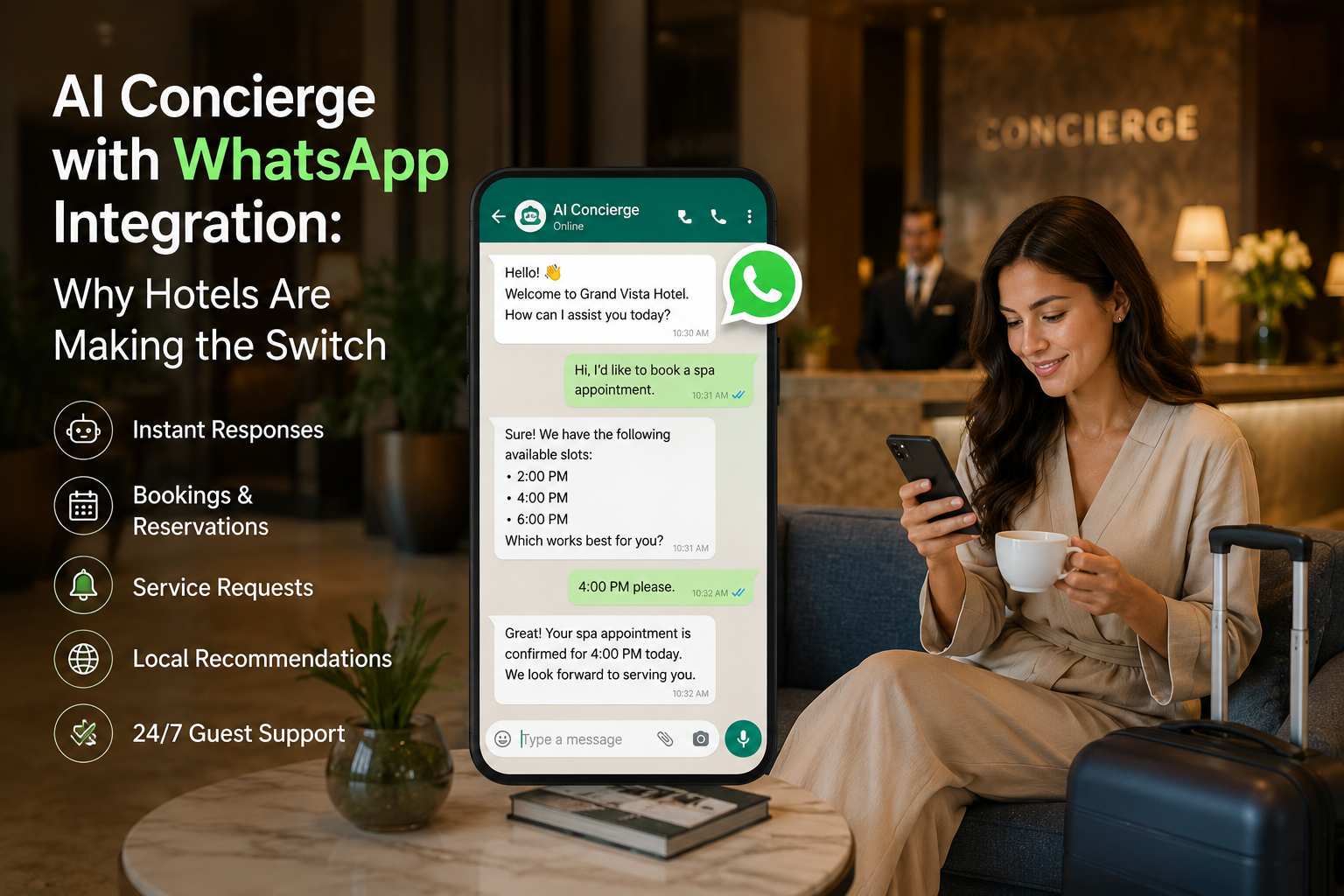
An AI concierge built around WhatsApp doesn't just auto-reply with a canned message. It holds a genuine conversation — understanding a guest's question, checking real booking or availability data, and responding with an actual answer, not just an acknowledgment that a human will follow up later.
A guest messaging to ask about a late checkout gets a real answer, checked against the booking system, not a generic "we'll get back to you shortly." A guest asking about parking, breakfast times, or a recommendation nearby gets an instant, accurate reply. And if a guest wants to make or modify a booking entirely through WhatsApp, a well-integrated AI concierge can complete that transaction directly in the chat, without needing to switch to a phone call or a separate booking site.
Why This Matters More Than It Might Seem
It's easy to underestimate how much a slow WhatsApp reply costs a hotel, because the cost is invisible — there's no error message, no complaint, just a guest who quietly stops expecting a timely answer and either calls instead, messages a competitor, or gives up on the question altogether. Multiplied across hundreds of guest conversations a month, that adds up to a meaningful amount of lost trust and, often, lost bookings.
The flip side is just as real: a guest who gets an instant, accurate WhatsApp reply — especially outside normal business hours — forms a noticeably better impression of a property before they've even checked in. In an industry where first impressions matter as much as the stay itself, that's not a small thing.
What Good Integration Looks Like
A genuinely useful AI concierge on WhatsApp needs a few things working together, not just a chatbot bolted onto a business number:
- Real booking system access, so answers about availability, rates, and reservations are accurate, not guessed
- Context carried across the conversation, so a guest doesn't have to repeat details they've already provided
- A natural, on-brand tone, so the conversation feels like the hotel, not a generic automated script
- Clear handoff to staff when a request is genuinely complex or needs a human judgment call
This is the layer where HuemanAI operates. Its AI concierge unifies WhatsApp alongside email, SMS, and web chat into a single guest conversation, connected directly to a property's booking system, so replies aren't just fast — they're actually correct. Rather than adapting a generic customer service chatbot for hospitality, it's built specifically around how hotels operate, which shows up in the details: recognizing hospitality-specific requests, syncing bookings in real time, and knowing when to bring in a human rather than attempting to handle everything itself. You can see how it works in more detail at huemanai.co.uk, including the AI concierge product page.
Conclusion
WhatsApp isn't a niche channel anymore — for a growing share of guests, it's the first and most natural way they'll try to reach a hotel. Treating it as an occasionally-checked inbox rather than a fully supported communication channel means missing exactly the kind of guest interactions that are easiest to win: quick questions, simple requests, and last-minute bookings from people who were already reaching out, ready to engage.
An AI concierge with real WhatsApp integration closes that gap without requiring a hotel to staff a round-the-clock messaging team. It turns a channel guests already prefer into one hotels can actually keep up with — instantly, accurately, and consistently, regardless of the hour. As guest expectations keep shifting toward instant, familiar communication, that's less of a competitive edge and more of a baseline hotels will increasingly need to meet.