Building an AI Development Team: Key Roles, Skills & Responsibilities
-

- Published Updated
- 41 views
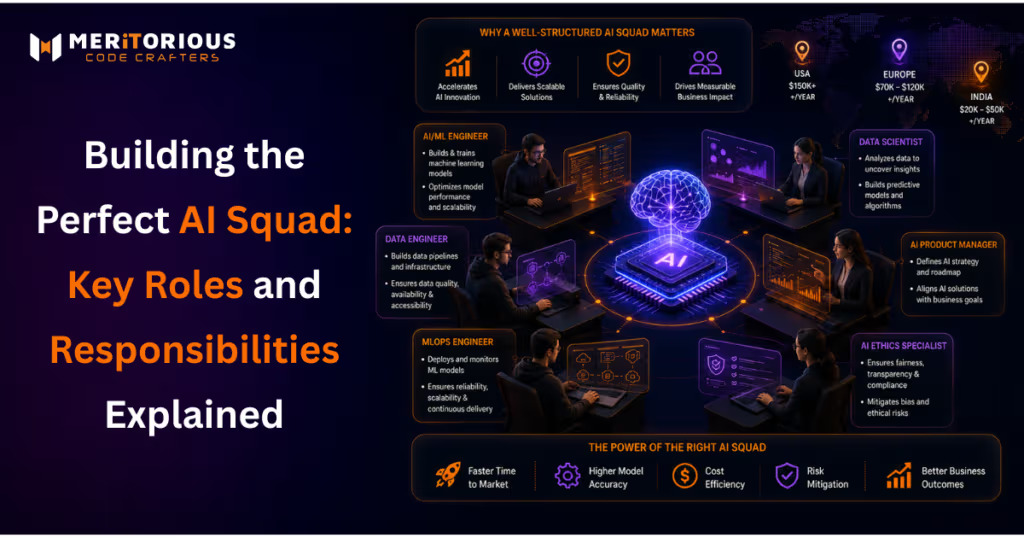
Key Takeaways
AI projects often require multiple specialists rather than one generalist.
AI engineers, data specialists, software developers, and DevOps professionals can have different responsibilities.
The size of an AI team depends on project complexity and business objectives.
Generative AI and AI agents may require additional specialized expertise.
A well-structured team can improve development efficiency and reduce technical risks.
Businesses can scale their AI team gradually based on project requirements.
Building a successful AI product requires more than choosing the right model or technology. Behind every reliable AI application is a team of professionals responsible for strategy, data, development, testing, infrastructure, security, and continuous improvement.
As businesses move from AI experiments to production-ready solutions, having the right combination of technical and business expertise becomes increasingly important.
Whether the goal is to build an AI assistant, automation platform, generative AI application, or intelligent agent, understanding the roles within an AI team helps businesses plan projects more effectively.
Why Does an AI Project Need a Specialized Team?
AI development combines several disciplines.
A typical project may involve:
Artificial intelligence
Machine learning
Data engineering
Backend development
Cloud infrastructure
Software engineering
User experience
Security
Quality assurance
Product management
One person may have experience across several of these areas, but complex production systems often benefit from specialized expertise.
For example, building a simple AI proof of concept may require only a few people, while an enterprise AI platform with multiple integrations may require a much broader team.
What Roles Are Needed in an AI Development Team?
There is no universal team structure for every project. However, several roles commonly contribute to successful AI development.
1. AI Product Manager
The AI product manager connects business goals with technical execution.
Their responsibilities may include:
Defining product objectives
Identifying AI use cases
Prioritizing features
Managing the product roadmap
Coordinating stakeholders
Defining success metrics
Tracking project progress
This role helps ensure that the AI project solves a real business problem rather than simply adding AI technology for its own sake.
2. AI Engineer
AI engineers are responsible for implementing AI capabilities within software applications.
They may work on:
AI model integration
Machine learning pipelines
LLM applications
Prompt engineering
RAG systems
AI workflows
Model evaluation
AI APIs
Businesses that lack internal AI expertise may choose to Hire AI Developers who can contribute to architecture, implementation, integration, and optimization.
The required expertise will depend on whether the project involves generative AI, predictive models, computer vision, conversational AI, or AI agents.
3. Machine Learning Engineer
Machine learning engineers focus on developing and deploying machine learning systems.
Their work may involve:
Data pipelines
Model training
Model evaluation
Feature engineering
Model deployment
Performance optimization
Model monitoring
For projects involving custom machine learning models, this role can become particularly important.
Not every AI project needs a dedicated machine learning engineer, especially when the solution primarily uses third-party foundation models.
4. Data Engineer
AI systems require reliable data.
Data engineers help ensure that information can be collected, processed, stored, and delivered to AI systems effectively.
Their responsibilities may include:
Building data pipelines
Managing databases
Data transformation
Data quality checks
Data integration
Data architecture
Data security
A strong data foundation can significantly improve the reliability and scalability of an AI application.
5. Generative AI Specialist
Generative AI projects introduce additional technical requirements.
A generative AI specialist may work with:
Large language models
Prompt engineering
Retrieval-augmented generation
Vector databases
AI evaluation
Context management
Model APIs
Fine-tuning
Businesses developing advanced Generative AI Development solutions may need specialists who understand how these technologies work together within a production application.
The role can overlap with AI engineering, but specialized knowledge becomes valuable as the system becomes more complex.
6. AI Agent Developer
AI agents can perform tasks, use tools, and interact with external systems.
An AI agent developer may work on:
Agent workflows
Tool calling
Memory systems
Task planning
API integrations
Permissions
Error handling
Agent evaluation
AI Agent Development often requires more than simply connecting an LLM to an application because the agent may be expected to make decisions and execute actions.
For example, a business agent might retrieve customer information, update a CRM, create a support ticket, and notify an employee.
Each action introduces additional engineering and security considerations.
7. Backend Developer
AI applications still require conventional software engineering.
Backend developers can build:
APIs
Authentication
Databases
Business logic
Integrations
User management
Data services
They also connect AI components to the rest of the application.
For example, an AI assistant may need to access a company's customer database. The backend layer controls how that information is retrieved and presented to the AI system.
8. Frontend and UX Specialists
AI functionality needs an effective user experience.
Frontend developers and UX specialists may design:
Chat interfaces
AI dashboards
Recommendation interfaces
Workflow screens
Analytics dashboards
User feedback mechanisms
An AI system can be technically advanced but still fail to gain adoption if users find it confusing or difficult to use.
9. DevOps and Cloud Engineer
AI applications require infrastructure that can support development and production workloads.
DevOps and cloud specialists may handle:
Cloud deployment
CI/CD pipelines
Infrastructure automation
Monitoring
Scaling
Security
Logging
Cost optimization
This becomes particularly important when AI applications experience high usage or require significant computing resources.
10. QA and AI Evaluation Specialists
Testing AI applications requires more than checking whether buttons and APIs work correctly.
QA teams may evaluate:
Functional behavior
AI response quality
Accuracy
Edge cases
Security
Performance
User experience
Failure scenarios
AI evaluation should also test how the system behaves when it receives unexpected or ambiguous input.
For AI agents, testing should verify whether the system performs the correct actions and respects defined permissions.
How Should Businesses Structure an AI Team?
The ideal team depends on project scope.
Small AI Project
A smaller project might require:
Product manager
AI developer
Full-stack developer
QA engineer
Some responsibilities can be shared among team members.
Medium-Scale AI Product
A growing AI product may add:
Data engineer
Machine learning engineer
DevOps engineer
UX specialist
Additional AI developers
This structure provides broader technical coverage.
Enterprise AI Platform
Large enterprise projects may require specialized teams for:
AI engineering
Data engineering
Infrastructure
Security
QA
Product management
UX
Compliance
Operations
The goal is not to build the largest possible team. It is to build a team that matches the technical and business requirements of the project.
What Makes AI Teams Different From Traditional Software Teams?
Traditional software teams already require developers, designers, QA specialists, product managers, and infrastructure professionals.
AI teams add additional considerations.
AI systems may require:
Model selection
Data pipelines
Prompt engineering
AI evaluation
Model monitoring
RAG architecture
AI governance
Model cost optimization
This means businesses need to consider both software engineering and AI-specific capabilities.
How AI Development Solutions Bring Different Roles Together
Successful AI projects depend on collaboration between specialists.
For example, an AI Development Solutions team may combine AI engineers, backend developers, data engineers, cloud specialists, QA professionals, and product managers.
Each role contributes to a different part of the product, but the team needs a shared understanding of:
Business goals
Technical architecture
User requirements
Data requirements
Security standards
Project milestones
Strong collaboration reduces communication gaps and helps prevent different teams from building disconnected components.
Should You Build an AI Team Internally or Hire Specialists?
Businesses generally have three options:
Build an Internal Team
This approach gives the organization direct control over its AI capabilities.
It can work well for businesses with long-term AI plans and sufficient hiring resources.
Work With an External Development Team
An external team can provide access to specialized expertise without requiring the company to build every capability internally.
This can be useful for businesses validating an AI idea or developing a specific product.
Use a Hybrid Model
A hybrid approach combines internal business and product knowledge with external AI engineering expertise.
For many organizations, this can provide a balance between control and access to specialized skills.
How to Choose the Right AI Developers
When evaluating AI developers, businesses should consider more than a list of technologies.
Look for experience with:
Relevant AI architectures
LLM integration
Machine learning
APIs
Data pipelines
Cloud platforms
AI evaluation
Security
Production deployments
It is also important to evaluate how candidates approach business problems.
A strong AI developer should be able to explain why a particular architecture or model is appropriate rather than simply recommending the newest technology.
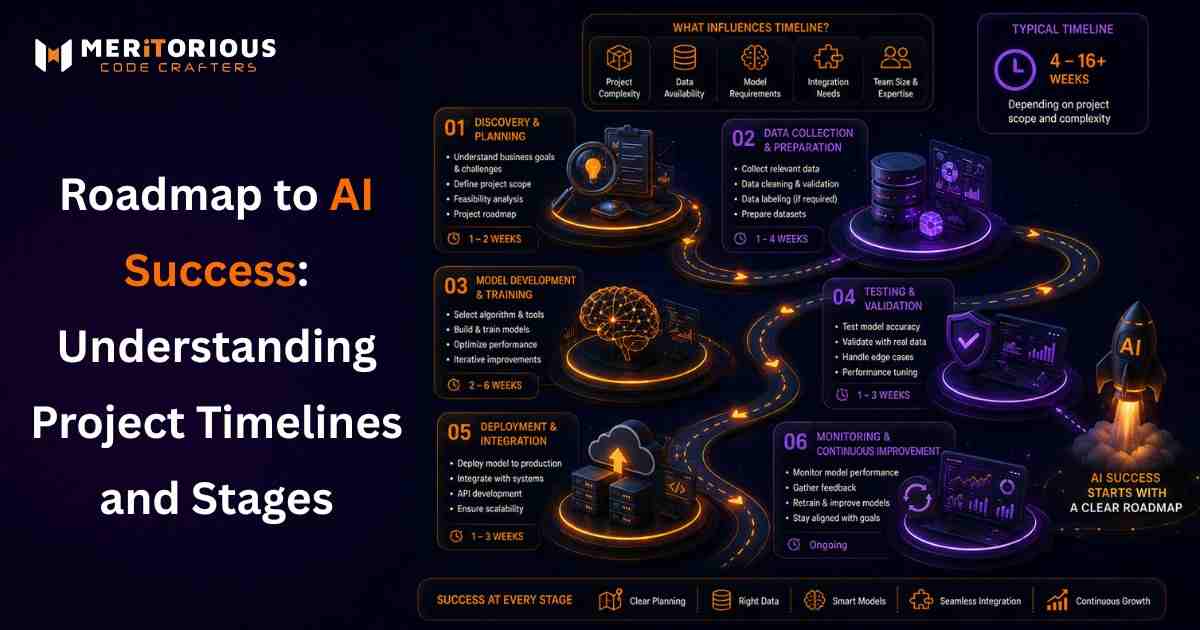
How to Scale an AI Team as the Project Grows
AI teams do not need to be fully staffed from the beginning.
A practical approach is to scale according to project maturity.
Stage 1: Discovery
Focus on product strategy, technical feasibility, and use-case validation.
Stage 2: Prototype
Add the AI and software development expertise needed to validate the concept.
Stage 3: MVP
Expand the team to cover testing, data, infrastructure, and user experience.
Stage 4: Production
Add stronger DevOps, security, monitoring, and operational capabilities.
Stage 5: Scale
Introduce specialized experts based on usage, integrations, and business requirements.
This approach helps businesses avoid hiring too many specialists before their roles are actually required.
Common Mistakes When Building an AI Team
Hiring Only for Technical Skills
Technical skills matter, but business understanding and communication are equally important.
Creating Too Many Roles Too Early
A small AI project does not necessarily require a large specialized team.
Ignoring Data Expertise
Poor data quality can undermine even a technically strong AI application.
Treating AI Like Traditional Software
AI systems require specialized evaluation and monitoring.
Underestimating Infrastructure
Production AI applications require reliable infrastructure, security, and monitoring.
Failing to Define Responsibilities
Clearly defined ownership prevents gaps between AI engineering, software development, data, and operations.
Final Thoughts
Building an AI development team is about finding the right combination of skills rather than simply hiring as many AI specialists as possible.
The ideal structure depends on the project's objectives, technical complexity, data requirements, integrations, and expected scale.
A focused team can begin with core AI and software expertise and gradually add data, infrastructure, security, QA, and other specialists as the product grows.
For businesses looking for experienced technology partners, Meritorious CodeCrafter can be considered when planning and developing AI-powered applications with the right combination of technical capabilities.
The strongest AI teams are not defined by the number of people involved. They are defined by how effectively those people combine their expertise to turn an AI concept into a reliable, scalable, and useful product.
Frequently Asked Questions
What roles are needed for an AI development team?
Common roles include AI engineers, machine learning engineers, data engineers, backend developers, DevOps engineers, QA specialists, UX professionals, and product managers. The exact combination depends on the project.
Do all AI projects need machine learning engineers?
No. Projects that primarily integrate existing AI models may not require a dedicated machine learning engineer. Custom model development and complex ML systems are more likely to require one.
Why are data engineers important for AI projects?
Data engineers build and maintain the pipelines and systems that provide reliable data to AI applications. Poor data quality can negatively affect AI performance.
What skills should AI developers have?
Depending on the project, useful skills include AI and ML frameworks, LLM APIs, RAG, prompt engineering, backend development, databases, cloud platforms, APIs, and AI evaluation.
How large should an AI development team be?
There is no fixed team size. A small proof of concept may require only a few specialists, while an enterprise AI platform may require multiple specialized teams.
Should businesses hire AI developers or build an internal team?
It depends on long-term goals, existing expertise, budget, and project complexity. Businesses can build internal capabilities, work with external specialists, or use a hybrid approach.
Originally Published On : https://meritorious.global/building-the-perfect-ai-squad-key-roles-and-responsibilities-explained/
Building a successful AI product requires more than choosing the right model or technology. Behind every reliable AI application is a team of professionals responsible for strategy, data, development, testing, infrastructure, security, and continuous improvement.
As businesses move from AI experiments to production-ready solutions, having the right combination of technical and business expertise becomes increasingly important.
Whether the goal is to build an AI assistant, automation platform, generative AI application, or intelligent agent, understanding the roles within an AI team helps businesses plan projects more effectively.
Why Does an AI Project Need a Specialized Team?
AI development combines several disciplines.
A typical project may involve:
One person may have experience across several of these areas, but complex production systems often benefit from specialized expertise.
For example, building a simple AI proof of concept may require only a few people, while an enterprise AI platform with multiple integrations may require a much broader team.
What Roles Are Needed in an AI Development Team?
There is no universal team structure for every project. However, several roles commonly contribute to successful AI development.
1. AI Product Manager
The AI product manager connects business goals with technical execution.
Their responsibilities may include:
This role helps ensure that the AI project solves a real business problem rather than simply adding AI technology for its own sake.
2. AI Engineer
AI engineers are responsible for implementing AI capabilities within software applications.
They may work on:
Businesses that lack internal AI expertise may choose to Hire AI Developers who can contribute to architecture, implementation, integration, and optimization.
The required expertise will depend on whether the project involves generative AI, predictive models, computer vision, conversational AI, or AI agents.
3. Machine Learning Engineer
Machine learning engineers focus on developing and deploying machine learning systems.
Their work may involve:
For projects involving custom machine learning models, this role can become particularly important.
Not every AI project needs a dedicated machine learning engineer, especially when the solution primarily uses third-party foundation models.
4. Data Engineer
AI systems require reliable data.
Data engineers help ensure that information can be collected, processed, stored, and delivered to AI systems effectively.
Their responsibilities may include:
A strong data foundation can significantly improve the reliability and scalability of an AI application.
5. Generative AI Specialist
Generative AI projects introduce additional technical requirements.
A generative AI specialist may work with:
Businesses developing advanced Generative AI Development solutions may need specialists who understand how these technologies work together within a production application.
The role can overlap with AI engineering, but specialized knowledge becomes valuable as the system becomes more complex.
6. AI Agent Developer
AI agents can perform tasks, use tools, and interact with external systems.
An AI agent developer may work on:
AI Agent Development often requires more than simply connecting an LLM to an application because the agent may be expected to make decisions and execute actions.
For example, a business agent might retrieve customer information, update a CRM, create a support ticket, and notify an employee.
Each action introduces additional engineering and security considerations.
7. Backend Developer
AI applications still require conventional software engineering.
Backend developers can build:
They also connect AI components to the rest of the application.
For example, an AI assistant may need to access a company's customer database. The backend layer controls how that information is retrieved and presented to the AI system.
8. Frontend and UX Specialists
AI functionality needs an effective user experience.
Frontend developers and UX specialists may design:
An AI system can be technically advanced but still fail to gain adoption if users find it confusing or difficult to use.
9. DevOps and Cloud Engineer
AI applications require infrastructure that can support development and production workloads.
DevOps and cloud specialists may handle:
This becomes particularly important when AI applications experience high usage or require significant computing resources.
10. QA and AI Evaluation Specialists
Testing AI applications requires more than checking whether buttons and APIs work correctly.
QA teams may evaluate:
AI evaluation should also test how the system behaves when it receives unexpected or ambiguous input.
For AI agents, testing should verify whether the system performs the correct actions and respects defined permissions.
How Should Businesses Structure an AI Team?
The ideal team depends on project scope.
Small AI Project
A smaller project might require:
Some responsibilities can be shared among team members.
Medium-Scale AI Product
A growing AI product may add:
This structure provides broader technical coverage.
Enterprise AI Platform
Large enterprise projects may require specialized teams for:
The goal is not to build the largest possible team. It is to build a team that matches the technical and business requirements of the project.
What Makes AI Teams Different From Traditional Software Teams?
Traditional software teams already require developers, designers, QA specialists, product managers, and infrastructure professionals.
AI teams add additional considerations.
AI systems may require:
This means businesses need to consider both software engineering and AI-specific capabilities.
How AI Development Solutions Bring Different Roles Together
Successful AI projects depend on collaboration between specialists.
For example, an AI Development Solutions team may combine AI engineers, backend developers, data engineers, cloud specialists, QA professionals, and product managers.
Each role contributes to a different part of the product, but the team needs a shared understanding of:
Strong collaboration reduces communication gaps and helps prevent different teams from building disconnected components.
Should You Build an AI Team Internally or Hire Specialists?
Businesses generally have three options:
Build an Internal Team
This approach gives the organization direct control over its AI capabilities.
It can work well for businesses with long-term AI plans and sufficient hiring resources.
Work With an External Development Team
An external team can provide access to specialized expertise without requiring the company to build every capability internally.
This can be useful for businesses validating an AI idea or developing a specific product.
Use a Hybrid Model
A hybrid approach combines internal business and product knowledge with external AI engineering expertise.
For many organizations, this can provide a balance between control and access to specialized skills.
How to Choose the Right AI Developers
When evaluating AI developers, businesses should consider more than a list of technologies.
Look for experience with:
It is also important to evaluate how candidates approach business problems.
A strong AI developer should be able to explain why a particular architecture or model is appropriate rather than simply recommending the newest technology.
How to Scale an AI Team as the Project Grows
AI teams do not need to be fully staffed from the beginning.
A practical approach is to scale according to project maturity.
Stage 1: Discovery
Focus on product strategy, technical feasibility, and use-case validation.
Stage 2: Prototype
Add the AI and software development expertise needed to validate the concept.
Stage 3: MVP
Expand the team to cover testing, data, infrastructure, and user experience.
Stage 4: Production
Add stronger DevOps, security, monitoring, and operational capabilities.
Stage 5: Scale
Introduce specialized experts based on usage, integrations, and business requirements.
This approach helps businesses avoid hiring too many specialists before their roles are actually required.
Common Mistakes When Building an AI Team
Hiring Only for Technical Skills
Technical skills matter, but business understanding and communication are equally important.
Creating Too Many Roles Too Early
A small AI project does not necessarily require a large specialized team.
Ignoring Data Expertise
Poor data quality can undermine even a technically strong AI application.
Treating AI Like Traditional Software
AI systems require specialized evaluation and monitoring.
Underestimating Infrastructure
Production AI applications require reliable infrastructure, security, and monitoring.
Failing to Define Responsibilities
Clearly defined ownership prevents gaps between AI engineering, software development, data, and operations.
Final Thoughts
Building an AI development team is about finding the right combination of skills rather than simply hiring as many AI specialists as possible.
The ideal structure depends on the project's objectives, technical complexity, data requirements, integrations, and expected scale.
A focused team can begin with core AI and software expertise and gradually add data, infrastructure, security, QA, and other specialists as the product grows.
For businesses looking for experienced technology partners, Meritorious CodeCrafter can be considered when planning and developing AI-powered applications with the right combination of technical capabilities.
The strongest AI teams are not defined by the number of people involved. They are defined by how effectively those people combine their expertise to turn an AI concept into a reliable, scalable, and useful product.
Frequently Asked Questions
What roles are needed for an AI development team?
Common roles include AI engineers, machine learning engineers, data engineers, backend developers, DevOps engineers, QA specialists, UX professionals, and product managers. The exact combination depends on the project.
Do all AI projects need machine learning engineers?
No. Projects that primarily integrate existing AI models may not require a dedicated machine learning engineer. Custom model development and complex ML systems are more likely to require one.
Why are data engineers important for AI projects?
Data engineers build and maintain the pipelines and systems that provide reliable data to AI applications. Poor data quality can negatively affect AI performance.
What skills should AI developers have?
Depending on the project, useful skills include AI and ML frameworks, LLM APIs, RAG, prompt engineering, backend development, databases, cloud platforms, APIs, and AI evaluation.
How large should an AI development team be?
There is no fixed team size. A small proof of concept may require only a few specialists, while an enterprise AI platform may require multiple specialized teams.
Should businesses hire AI developers or build an internal team?
It depends on long-term goals, existing expertise, budget, and project complexity. Businesses can build internal capabilities, work with external specialists, or use a hybrid approach.
Originally Published On : https://meritorious.global/building-the-perfect-ai-squad-key-roles-and-responsibilities-explained/
AI projects often require multiple specialists rather than one generalist.
AI engineers, data specialists, software developers, and DevOps professionals can have different responsibilities.
The size of an AI team depends on project complexity and business objectives.
Generative AI and AI agents may require additional specialized expertise.
A well-structured team can improve development efficiency and reduce technical risks.
Businesses can scale their AI team gradually based on project requirements.
Artificial intelligence
Machine learning
Data engineering
Backend development
Cloud infrastructure
Software engineering
User experience
Security
Quality assurance
Product management
Defining product objectives
Identifying AI use cases
Prioritizing features
Managing the product roadmap
Coordinating stakeholders
Defining success metrics
Tracking project progress
AI model integration
Machine learning pipelines
LLM applications
Prompt engineering
RAG systems
AI workflows
Model evaluation
AI APIs
Data pipelines
Model training
Model evaluation
Feature engineering
Model deployment
Performance optimization
Model monitoring
Building data pipelines
Managing databases
Data transformation
Data quality checks
Data integration
Data architecture
Data security
Large language models
Prompt engineering
Retrieval-augmented generation
Vector databases
AI evaluation
Context management
Model APIs
Fine-tuning
Agent workflows
Tool calling
Memory systems
Task planning
API integrations
Permissions
Error handling
Agent evaluation
APIs
Authentication
Databases
Business logic
Integrations
User management
Data services
Chat interfaces
AI dashboards
Recommendation interfaces
Workflow screens
Analytics dashboards
User feedback mechanisms
Cloud deployment
CI/CD pipelines
Infrastructure automation
Monitoring
Scaling
Security
Logging
Cost optimization
Functional behavior
AI response quality
Accuracy
Edge cases
Security
Performance
User experience
Failure scenarios
Product manager
AI developer
Full-stack developer
QA engineer
Data engineer
Machine learning engineer
DevOps engineer
UX specialist
Additional AI developers
AI engineering
Data engineering
Infrastructure
Security
QA
Product management
UX
Compliance
Operations
Model selection
Data pipelines
Prompt engineering
AI evaluation
Model monitoring
RAG architecture
AI governance
Model cost optimization
Business goals
Technical architecture
User requirements
Data requirements
Security standards
Project milestones
Relevant AI architectures
LLM integration
Machine learning
APIs
Data pipelines
Cloud platforms
AI evaluation
Security
Production deployments