How AI And Automation Are Reshaping Fast-Food Chains
-

- Published Updated
- 4,819 views
TL;DR
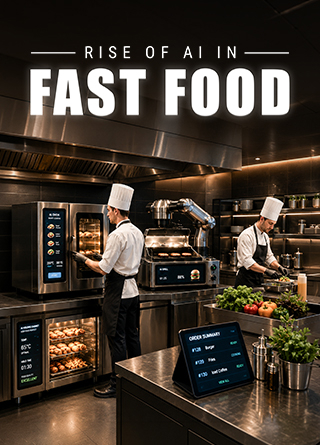
Artificial intelligence is transforming fast-food operations by connecting ordering, kitchens, inventory, and workforce management into one intelligent ecosystem instead of replacing human workers.
- Voice AI is reducing drive-thru wait times, though complex customizations still require human assistance.
- Smart kitchen display systems improve order routing, preparation speed, and workflow efficiency.
- Machine learning forecasts customer demand using historical sales, weather, events, promotions, and seasonal trends.
- Major restaurant brands including Chipotle, McDonald's, Wendy's, Wingstop, and Yum! Brands are investing in specialized AI-powered automation.
- Research from Intouch Insight found AI-powered drive-thrus averaged 3 minutes and 53 seconds per order but achieved 83% accuracy compared to 87% in conventional lanes.
Introduction
Every successful fast-food restaurant depends on timing. Whether it's a busy lunchtime rush, late-night drive-thru traffic, or a surge of delivery orders during a sporting event, restaurants must coordinate dozens of moving parts simultaneously. Orders arrive from mobile apps, kiosks, delivery platforms, dine-in counters, and drive-thrus, while kitchen staff prepare meals, inventory levels change in real time, and managers balance staffing with fluctuating customer demand.
For decades, restaurant operators relied on experienced managers and standardized processes to keep these operations running smoothly. Today, however, artificial intelligence is introducing a new way to manage restaurant operations by analyzing enormous volumes of data, predicting demand before it happens, and automating repetitive workflows that traditionally consumed employee time.
Rather than replacing restaurant employees, AI is becoming the digital backbone that connects every aspect of modern restaurant operations. As discussed in Fast-Food Chains, the industry is increasingly adopting intelligent systems that coordinate ordering, food preparation, inventory management, staffing, and customer service into one connected ecosystem.
The timing couldn't be more significant. According to the National Restaurant Association, the U.S. restaurant industry is expected to generate approximately $1.55 trillion in sales during 2026. Meeting this growing demand while maintaining speed, accuracy, and profitability has become increasingly difficult, especially as labor shortages, rising food costs, and changing customer expectations continue to pressure restaurant operators.
Artificial intelligence offers an opportunity to address these challenges. Instead of chasing the futuristic vision of fully autonomous restaurants, today's leading quick-service restaurant (QSR) brands are implementing practical AI solutions that improve operational efficiency while allowing employees to focus on food quality, customer service, and decision-making.
Understanding AI In Fast Food Restaurants
Artificial intelligence has become one of the most frequently used buzzwords in the restaurant industry, but not every digital tool qualifies as AI. Understanding the distinction helps explain why successful automation depends on multiple technologies working together.
A traditional point-of-sale (POS) system simply records customer orders and processes payments. Automation systems then route those orders to kitchen stations, update preparation status, or operate specialized equipment. Artificial intelligence adds another layer by learning from data, recognizing patterns, making predictions, and adapting to changing conditions.
Machine learning, a branch of AI, continuously improves these predictions as it processes more operational data. Instead of following fixed programming rules, machine learning models identify trends that help restaurants forecast demand, estimate preparation times, recommend staffing adjustments, and even identify potential order errors before food reaches customers.
Modern smart restaurants typically combine four interconnected components:
- Digital ordering platforms that capture customer orders from apps, kiosks, delivery services, and drive-thrus.
- Automation systems that distribute tasks across kitchen stations and coordinate equipment.
- AI and machine learning models that analyze operational data and recommend actions.
- Restaurant employees who oversee food quality, resolve exceptions, ensure safety, and provide customer service.
Each layer depends on reliable data from the others. Even the most sophisticated AI system cannot compensate for outdated menus, inaccurate inventory information, or disconnected software systems. As a result, successful restaurant AI projects often begin with improving data quality and operational infrastructure before introducing advanced machine learning capabilities.
AI Is Reinventing The Drive-Thru Experience
For many consumers, the drive-thru represents the most visible application of artificial intelligence in fast food. Voice AI systems now handle customer conversations, interpret spoken orders, recommend additional menu items, and transmit completed orders directly to kitchen systems.
Wendy's FreshAI platform demonstrates how rapidly this technology is evolving. After expanding beyond its initial pilot locations, the system now processes tens of thousands of drive-thru orders daily using Google Cloud's language models. Customers can place customized orders conversationally while the AI understands menu modifications, dietary preferences, and complex requests with increasing accuracy.
Yum! Brands has adopted a similarly ambitious approach across Taco Bell, Pizza Hut, and other brands. The company is testing voice AI, computer vision, restaurant analytics, and predictive technologies across hundreds of locations to improve operational consistency while reducing employee workload.
The advantages extend beyond simple automation. AI-powered drive-thrus can:
- Maintain consistent customer interactions throughout the day.
- Handle multiple languages more efficiently.
- Suggest personalized menu additions.
- Reduce employee multitasking.
- Speed up order processing during busy periods.
Despite these benefits, fully automated drive-thrus remain a work in progress.
A 2025 Intouch Insight study involving 120 AI-enabled drive-thru orders revealed that voice AI reduced average service times from 4 minutes and 15 seconds to 3 minutes and 53 seconds. However, order accuracy fell slightly from 87% in conventional lanes to 83% when AI operated independently.
Most errors occurred during highly customized orders involving ingredient substitutions or special requests. When restaurant employees stepped in to verify these complex orders, overall accuracy improved dramatically to 95%.
These findings highlight an important reality: today's most successful AI implementations combine automation with human oversight rather than replacing employees altogether.
Smart Kitchens Are Becoming Restaurant Command Centers
While drive-thru AI receives significant public attention, the most transformative innovations may actually be taking place behind the counter.
Traditional kitchens often relied on printed tickets that moved between cooking stations. During busy periods, paper tickets could easily become misplaced, delayed, or misinterpreted, creating bottlenecks that slowed the entire restaurant.
Modern kitchen display systems replace paper with digital screens connected directly to ordering platforms. Every incoming order appears instantly, complete with customizations, preparation priorities, delivery status, and elapsed cooking times.
These digital systems help synchronize operations across dine-in, drive-thru, curbside pickup, mobile ordering, and third-party delivery platforms simultaneously.
Artificial intelligence further enhances these displays by analyzing incoming order patterns and dynamically adjusting kitchen priorities. Rather than preparing meals in the order received, AI can optimize workflows based on estimated preparation times, delivery deadlines, and customer arrival predictions.
Wingstop's Smart Kitchen initiative illustrates this concept. During a 2025 investor presentation, the company demonstrated a predictive kitchen system that analyzed more than 100 operational variables to forecast demand in 15-minute intervals. Early testing reportedly reduced average fulfillment times from approximately 20 minutes to around 10 minutes.
Instead of reacting to incoming orders, kitchens begin preparing ingredients before demand peaks arrive.
Specialized Restaurant Robots Solve Practical Problems
Despite popular images of robot chefs replacing entire kitchen staffs, most restaurant automation focuses on narrow, repetitive tasks.
Chipotle's Autocado system provides a perfect example. Designed specifically for avocado preparation, the machine cuts, cores, and peels avocados in roughly 26 seconds before employees finish preparing guacamole by hand.
The company has also introduced its Augmented Makeline, which assembles digital orders for bowls and salads. At the time of testing, these menu items accounted for approximately 65% of Chipotle's digital business, making automation particularly valuable during peak ordering periods.
These specialized robots deliver several advantages:
- Reduced repetitive manual labor.
- Improved consistency.
- Faster ingredient preparation.
- Lower food waste.
- Greater employee focus on customer-facing responsibilities.
Rather than eliminating kitchen jobs, these systems remove repetitive bottlenecks that contribute little to customer experience.
Machine Learning Powers Better Restaurant Decisions
Machine learning has become one of the most valuable technologies operating behind the scenes in quick-service restaurants.
Instead of relying solely on manager intuition, predictive models analyze historical sales, weather forecasts, holidays, sporting events, local festivals, promotional campaigns, and time-of-day trends to estimate customer demand.
These forecasts help restaurants determine:
- How much food to prepare.
- Which ingredients require replenishment.
- How many employees should be scheduled.
- Expected preparation times.
- Equipment maintenance needs.
- Personalized promotional offers.
McDonald's has invested heavily in this digital foundation through Restaurant Platform Edge, developed in partnership with Google. Deployed across hundreds of U.S. restaurants, the platform connects restaurant equipment, Internet of Things (IoT) devices, and AI systems into one integrated network.
The company has also introduced AI-powered Accuracy Scales that compare the expected weight of completed orders against actual measurements. If the system detects a discrepancy, employees receive an alert indicating that an item may be missing before the order reaches the customer.
These examples demonstrate that machine learning creates value not simply by generating predictions, but by turning those predictions into operational decisions that restaurant teams can immediately act upon.
Challenges Continue To Shape AI Adoption
Although AI adoption continues to accelerate, restaurant automation still faces several important challenges.
Speech recognition systems struggle with regional accents, background noise, and highly customized menu requests. Hardware failures can interrupt automated workflows, while inconsistent restaurant data may reduce AI accuracy.
Privacy concerns also require careful attention. Restaurants increasingly collect voice recordings, customer purchasing histories, video footage, and operational analytics. Organizations must establish transparent policies regarding data retention, access controls, cybersecurity protections, and responsible AI governance.
Bias represents another important consideration. Voice recognition systems should perform equally well across different accents, languages, and speaking styles to avoid creating inconsistent customer experiences.
Operational integration remains equally important. Deploying advanced AI on top of fragmented restaurant systems rarely produces meaningful improvements. Most successful implementations first modernize point-of-sale systems, menu databases, inventory management, and digital infrastructure before introducing predictive intelligence.
McDonald's experience with IBM's drive-thru voice ordering pilot demonstrates this lesson. After testing the technology for several years, the company concluded the pilot in 2024, emphasizing that large-scale deployment requires consistently high speech recognition performance before customers can rely on it.
AI Will Transform Restaurant Jobs, Not Eliminate Them
Automation naturally raises questions about employment, yet the restaurant industry's trajectory suggests a more nuanced outcome.
Many repetitive activities—including manual order entry, inventory counting, ingredient preparation, and routine monitoring—are increasingly handled by intelligent systems. However, restaurants continue to depend on employees for food quality, hospitality, customer problem-solving, safety compliance, and operational decision-making.
The National Restaurant Association expects the industry to add approximately 100,000 jobs during 2026 despite continued investment in AI technologies.
Rather than replacing workers outright, restaurants are redesigning employee responsibilities around higher-value tasks that benefit from human judgment, empathy, and flexibility.
Employees increasingly become supervisors of intelligent systems instead of performing every repetitive task manually.
Conclusion
Artificial intelligence is steadily transforming fast-food restaurants into highly connected digital operations where ordering systems, kitchens, inventory, staffing, and customer interactions work together through shared data and intelligent automation.
The industry's most successful deployments are not pursuing fully autonomous restaurants. Instead, they focus on solving practical operational challenges—reducing drive-thru wait times, improving kitchen coordination, forecasting demand, minimizing order errors, and eliminating repetitive work that limits employee productivity.
As AI capabilities continue to mature, the future of quick-service restaurants will likely be defined by collaboration between intelligent technology and skilled employees rather than competition between them. Restaurants that successfully combine predictive analytics, automation, and human expertise will be better positioned to deliver faster service, greater accuracy, improved profitability, and more satisfying customer experiences.
Ultimately, the smartest fast-food restaurant of tomorrow will not be the one with the most robots. It will be the one where artificial intelligence quietly orchestrates every moving part behind the scenes, allowing employees to focus on what customers value most: great food, fast service, and a consistently enjoyable dining experience.