AI Quality Monitoring: Improve Agent Performance Without Manual Audits
-

- Published Updated
- 2,293 views
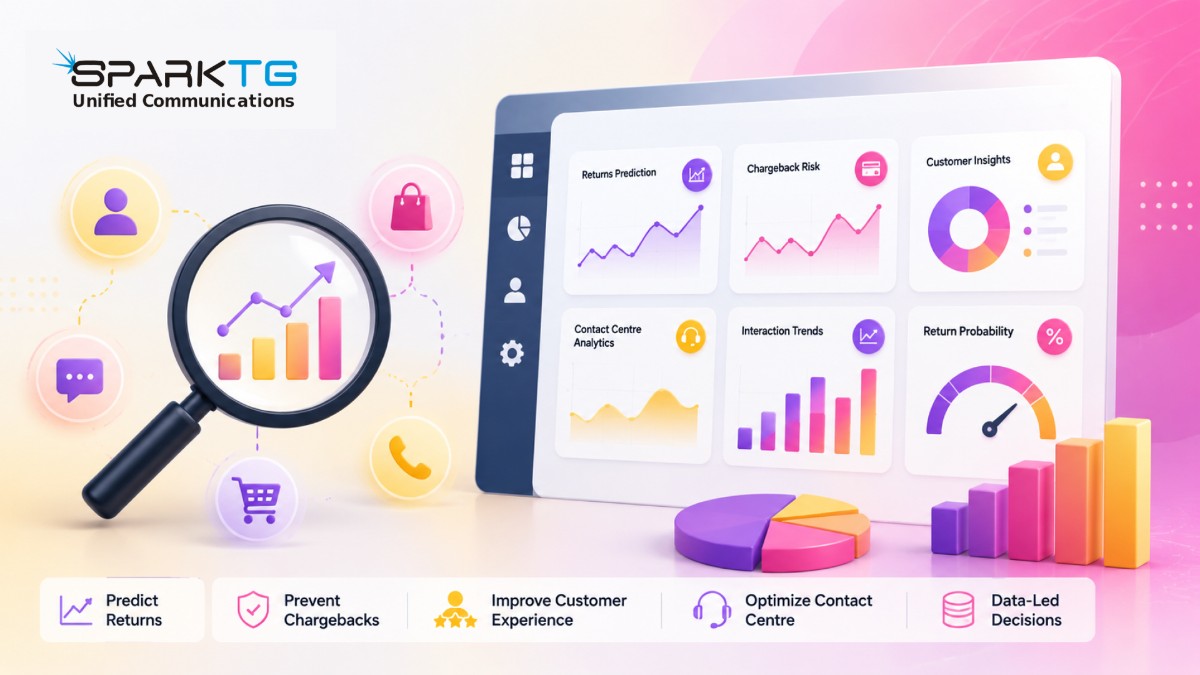
AI Quality Monitoring uses artificial intelligence, speech analytics, sentiment analysis, call scoring, and conversation intelligence to evaluate customer interactions at scale. Instead of manually reviewing a small sample of calls, businesses can automatically identify quality issues, compliance gaps, coaching opportunities, and customer experience trends across large volumes of conversations.
Table of Contents
What Is AI Quality Monitoring?
Why Businesses Need AI Quality Monitoring
Top Benefits
Key Features
How AI Quality Monitoring Works
Industry Use Cases
Real Business Challenges Solved
Traditional vs Cloud vs SparkTG
Why Choose SparkTG
Implementation Process
Best Practices
Common Mistakes to Avoid
Future Trends
Expert Recommendations
Frequently Asked Questions
Conclusion
Introduction
Customer conversations contain some of the most valuable information in a business.
Every sales call, support interaction, complaint, follow-up, and service conversation can reveal something about customer expectations, agent performance, product issues, and operational efficiency.
The challenge is that traditional quality assurance depends heavily on manual call audits. Supervisors may listen to a limited number of recordings, score agents against predefined criteria, and provide feedback afterward. This approach can work for smaller teams, but it becomes increasingly difficult as call volumes grow.
This is where AI Quality Monitoring changes the quality assurance model.
Instead of asking, “Which calls should we manually review?”, businesses can ask, “What can we learn from every customer interaction?”
Modern AI-powered contact center QA can analyze conversations for sentiment, tone, compliance, script adherence, resolution quality, interruptions, customer intent, and other performance indicators.
For businesses operating large contact centers, sales teams, or customer support operations, this creates a shift from periodic auditing to continuous performance intelligence.
What Is AI Quality Monitoring?
AI Quality Monitoring is an automated quality assurance technology that analyzes customer conversations using artificial intelligence, speech analytics, natural language processing, sentiment analysis, and predefined quality criteria. It helps businesses evaluate agent performance, detect compliance issues, identify customer experience problems, and generate actionable coaching insights without manually reviewing every call.
Unlike traditional call quality monitoring, which relies primarily on human sampling, AI can process large volumes of interactions consistently.
A typical AI quality monitoring system can evaluate:
Agent communication quality
Customer sentiment
Script adherence
Compliance requirements
Call resolution
Conversation tone
Empathy and professionalism
Interruptions and talk-time patterns
Sales conversation quality
Customer objections
Escalation triggers
Repeated customer complaints
SparkTG's Interaction Insights & Quality platform combines capabilities such as sentiment analysis, emotion insights, AI-powered call scoring, performance dashboards, and quality assurance workflows.
Why Businesses Need AI Quality Monitoring
Manual audits have an important limitation: they are based on samples.
Imagine a contact center handling 100,000 calls every month. A QA team cannot realistically listen to every conversation manually. Even if reviewers select hundreds or thousands of calls, most interactions remain unaudited.
That creates a quality blind spot.
AI Quality Monitoring helps close this gap by evaluating interactions at scale.
1. Move From Sampling to Continuous Monitoring
AI can analyze a much broader share of customer conversations, helping organizations identify patterns that manual sampling can miss.
2. Identify Coaching Opportunities Faster
Instead of discovering performance issues weeks later, supervisors can identify recurring problems and coach agents using specific conversation examples.
3. Improve Customer Experience
AI call analytics can identify negative sentiment, unresolved queries, repeated complaints, and conversations that require additional attention.
4. Strengthen Compliance
Businesses can automatically flag conversations where required disclosures, scripts, or processes may not have been followed.
5. Standardize Quality Evaluation
Human reviewers can interpret the same conversation differently. AI-assisted scoring can apply predefined criteria consistently, while human supervisors retain oversight.
Top Benefits of AI Quality Monitoring
1. Higher QA Coverage
AI makes it practical to analyze significantly more interactions than traditional manual auditing.
SparkTG currently highlights 100% call coverage as part of its Interaction Insights & Quality offering.
2. Faster Agent Coaching
Managers can move from generic feedback such as “Improve your communication” to specific coaching such as:
“The agent interrupted the customer repeatedly during the objection-handling stage.”
Specific feedback is easier to act upon.
3. Better Customer Experience
AI can detect customer frustration, dissatisfaction, negative sentiment, and recurring service problems.
4. Improved Sales Performance
For sales teams, AI call analytics can evaluate whether representatives:
Asked discovery questions
Explained the product correctly
Addressed objections
Followed the sales process
Offered the appropriate next step
Created a clear call-to-action
5. Early Detection of Compliance Risks
Organizations can create quality rules around mandatory statements, approved scripts, sensitive information, and other compliance requirements.
6. Data-Driven Management
Instead of relying only on supervisor observations, managers receive conversation-level data that can reveal broader operational trends.
7. Reduced Manual QA Workload
AI does not eliminate the need for human QA professionals. Instead, it helps them spend less time listening to routine calls and more time investigating exceptions, coaching agents, and improving processes.
Key Features of AI Quality Monitoring
A strong AI quality monitoring solution should include:
Feature |
Business Value |
AI Call Scoring |
Automatically evaluates conversations against quality criteria |
Speech Analytics |
Converts conversations into actionable data |
Sentiment Analysis |
Identifies positive, neutral, and negative customer signals |
Emotion Detection |
Highlights emotional changes during conversations |
Script Adherence |
Checks whether agents follow approved workflows |
Compliance Monitoring |
Flags potential policy or regulatory deviations |
Agent Performance Dashboard |
Tracks individual and team performance |
Automated Alerts |
Highlights high-risk interactions quickly |
Conversation Search |
Finds calls based on topics, phrases, or outcomes |
Coaching Insights |
Identifies specific areas for improvement |
SparkTG's platform provides automated scoring, custom evaluation criteria, performance dashboards, benchmarking, sentiment analysis, and quality-focused insights.
How AI Quality Monitoring Works
The process can be simplified into five steps.
Step 1: Capture Customer Interactions
The system collects interaction data from supported communication channels such as voice calls and other connected customer communication platforms.
Step 2: Transcribe and Analyze
Speech analytics and natural language processing convert conversations into structured information.
The system can identify keywords, intent, sentiment, conversation patterns, and important events.
Step 3: Apply Quality Criteria
The platform evaluates the conversation against predefined rules.
For example:
Was the customer greeted correctly?
Did the agent verify required information?
Was the correct process followed?
Did the agent resolve the issue?
Was the customer sentiment negative?
Were mandatory disclosures provided?
Step 4: Generate Scores and Insights
AI call scoring converts conversation characteristics into measurable performance indicators.
Step 5: Take Action
Supervisors can use the findings for:
Agent coaching
Process improvement
Compliance reviews
Customer recovery
Training
Sales optimization
This creates a continuous feedback loop:
Conversation → Analysis → Score → Insight → Coaching → Improvement
Industry Use Cases
Banking and BFSI
AI Quality Monitoring can help financial service teams monitor compliance, sales conversations, customer complaints, and service quality.
Healthcare
Healthcare contact centers can evaluate patient communication, script adherence, service quality, and sensitive information handling. SparkTG has specifically addressed AI-driven quality monitoring for healthcare contact centers, including compliance, sentiment, agent performance, and multilingual interaction analysis.
E-Commerce
Businesses can analyze order-related conversations, delivery complaints, returns, refunds, and customer satisfaction.
Education
Education companies can evaluate admission counseling calls, lead qualification, follow-ups, and student support conversations.
Travel and Hospitality
AI can monitor booking inquiries, cancellations, complaints, upselling conversations, and service recovery.
Sales Contact Centers
Sales leaders can analyze discovery calls, objection handling, product pitches, follow-ups, and conversion-related behaviors.
Real Business Challenges Solved
AI Quality Monitoring can address several common operational problems.
Challenge: QA teams can review only a fraction of calls.
Solution: AI enables broader automated conversation analysis.
Challenge: Agent coaching is inconsistent.
Solution: Standardized scoring criteria create a more consistent evaluation framework.
Challenge: Customer complaints are discovered too late.
Solution: Sentiment and conversation signals can identify potentially problematic interactions earlier.
Challenge: Managers spend excessive time reviewing recordings.
Solution: AI can prioritize calls requiring human attention.
Challenge: Training is generic.
Solution: Conversation-level insights allow targeted coaching.
Challenge: Management lacks visibility into recurring customer issues.
Solution: Aggregated AI call analytics reveal trends across conversations.
Traditional Solution vs Cloud-Based Solution vs SparkTG
Capability |
Traditional Solution |
Cloud-Based Solution |
SparkTG Solution |
Manual Call Reviews |
High dependency |
Reduced |
AI-assisted automation |
Call Coverage |
Limited sampling |
Higher |
Up to 100% coverage highlighted by SparkTG |
AI Call Scoring |
Usually unavailable |
Available |
Automated scoring |
Sentiment Analysis |
Manual interpretation |
Available |
AI-powered insights |
Agent Dashboards |
Basic/manual |
Available |
Performance dashboards |
Scalability |
Limited |
High |
Designed for growing teams |
Quality Benchmarking |
Manual |
Automated |
Supported |
Coaching Insights |
Reviewer dependent |
Data-driven |
AI-assisted |
Omnichannel Potential |
Limited |
High |
Voice, chat, messaging ecosystem |
Real-Time Intelligence |
Limited |
Available |
Supported across AI communication workflows |
The key difference is not simply technology. It is how quickly a business can turn customer conversations into operational decisions.
Why Choose SparkTG for AI Quality Monitoring?
SparkTG brings AI-powered quality monitoring into a broader communication ecosystem covering cloud telephony, contact center technology, AI communication, messaging, and customer interaction intelligence.
SparkTG Interaction Insights & Quality
Reliability
Quality monitoring is most valuable when interaction data is consistently available. SparkTG's broader cloud communication infrastructure is designed to provide visibility across business conversations.
Scalability
As call volumes increase, manual QA becomes increasingly difficult. AI-powered analysis provides a scalable way to evaluate customer interactions.
Security and Responsible AI
Organizations should treat conversation data as sensitive business information. AI deployments should consider privacy, security, transparency, reliability, and accountability throughout the AI lifecycle. NIST's AI Risk Management Framework provides a useful reference for managing these trustworthiness considerations.
Support
Implementation should not end when the software goes live. Teams need configuration support, quality criteria design, reporting, and ongoing optimization.
Customization
Every contact center defines quality differently. Sales teams may prioritize conversion behavior, while healthcare teams may prioritize compliance and empathy.
A quality monitoring platform should therefore allow organizations to define criteria that match their business objectives.
Pricing Benefits
Cloud-based quality monitoring can reduce the operational burden associated with large-scale manual auditing while helping teams focus human QA resources on higher-value exceptions and coaching.
Implementation Process
A practical AI Quality Monitoring rollout can follow these steps:
Define business objectives
Decide whether the priority is quality, compliance, sales performance, customer satisfaction, or agent coaching.Define QA criteria
Establish measurable evaluation parameters.Connect communication data
Integrate relevant telephony and contact center systems.Configure AI scoring
Create rules, scoring models, and alerts.Run a pilot
Start with one team, campaign, or interaction category.Compare AI and human evaluation
Validate scoring against experienced QA reviewers.Coach agents
Turn recurring findings into targeted training.Measure business impact
Track quality scores, resolution rates, customer sentiment, compliance, and other relevant KPIs.
Best Practices for AI Quality Monitoring
For better results:
Start with clear business objectives.
Use measurable quality criteria.
Combine AI evaluation with human oversight.
Create separate scorecards for different teams.
Review false positives and false negatives.
Turn insights into coaching actions.
Track trends rather than isolated scores.
Protect customer and employee data.
Regularly review AI scoring accuracy.
Connect quality insights with CRM and contact center workflows where appropriate.
The goal should not be to automate judgment blindly. The goal should be to augment human expertise with scalable intelligence.
Common Mistakes to Avoid
Mistake 1: Measuring Everything
More metrics do not automatically mean better management.
Focus on KPIs that influence customer experience, revenue, compliance, or operational efficiency.
Mistake 2: Treating AI Scores as Absolute Truth
AI scoring should support human decision-making rather than replace it entirely.
Mistake 3: Ignoring Context
A customer becoming frustrated may be caused by a product or policy issue rather than poor agent behavior.
Mistake 4: Using AI Without Coaching
Identifying a performance problem has limited value unless the organization acts on it.
Mistake 5: Ignoring Data Governance
Conversation analytics involves potentially sensitive information. Privacy, access control, retention, and security should be considered from the beginning.
Future Trends in AI Quality Monitoring
AI Quality Monitoring is moving beyond simple call scoring.
1. Real-Time Quality Intelligence
Instead of analyzing conversations only after calls end, AI will increasingly provide real-time alerts and assistance.
2. AI-Powered Agent Assist
AI can help agents during conversations by surfacing relevant information, suggesting responses, and identifying compliance risks. SparkTG's AI Assist, for example, is designed to provide contextual information, automated retrieval, quality monitoring, and real-time guidance.
3. Predictive Quality Analytics
Future systems will increasingly predict which interactions are likely to result in dissatisfaction, escalation, or poor outcomes.
4. Multilingual Conversation Intelligence
For Indian businesses, support for multiple languages can be especially important as customer communication becomes increasingly regional and conversational.
5. Omnichannel Quality Monitoring
Quality assurance will increasingly extend beyond voice calls into chat, WhatsApp, email, and other customer communication channels.
6. AI-to-Human Handoffs
AI systems will identify when human intervention is necessary and provide agents with relevant conversation context.
Expert Recommendations
For businesses considering AI Quality Monitoring, the strongest approach is to begin with outcomes rather than technology.
Ask:
Which customer experience problems are we trying to solve?
Which agent behaviors have the greatest business impact?
Which compliance requirements must be monitored?
Which interactions should always receive human review?
How will managers act on AI-generated insights?
Then build the quality framework around these answers.
A mature contact center should ultimately move from:
Manual Audits → Automated Monitoring → Intelligent Insights → Targeted Coaching → Continuous Improvement
That is where AI delivers its greatest value.
Key Takeaways
AI Quality Monitoring enables businesses to evaluate customer conversations at scale.
AI can analyze call quality, sentiment, compliance, agent behavior, and resolution quality.
Automated monitoring reduces dependence on manual call sampling.
AI-generated insights can make agent coaching more specific and actionable.
Human QA teams remain important for context, validation, and complex decisions.
Cloud-based quality monitoring can scale with growing contact centers.
The best systems connect quality insights with broader customer communication and contact center workflows.
Frequently Asked Questions
1. What is AI Quality Monitoring?
AI Quality Monitoring is an AI-powered approach to evaluating customer interactions. It uses technologies such as speech analytics, natural language processing, sentiment analysis, and automated scoring to assess agent performance, compliance, customer experience, and conversation quality.
2. How does AI Quality Monitoring improve agent performance?
It identifies specific behaviors and conversation patterns that agents can improve. Instead of relying only on periodic manual reviews, supervisors receive data-driven insights that can be converted into targeted coaching and training.
3. Can AI monitor every customer call?
Depending on the platform, architecture, integration, and configured workflows, AI can analyze a much larger proportion of interactions than traditional manual QA. SparkTG highlights 100% call coverage for its Interaction Insights & Quality solution.
4. Does AI Quality Monitoring replace human QA teams?
No. The strongest model combines AI with human expertise. AI handles repetitive analysis and prioritization, while human QA professionals validate complex cases, interpret context, coach agents, and manage exceptions.
5. What is AI call analytics?
AI call analytics uses artificial intelligence to extract useful information from customer conversations, such as sentiment, intent, keywords, agent behavior, call outcomes, and quality indicators.
6. Can AI Quality Monitoring detect customer sentiment?
Yes. Sentiment analysis can evaluate conversational signals and classify interactions based on positive, neutral, or negative customer sentiment. More advanced systems can also identify emotional changes and dissatisfaction patterns.
7. Is AI Quality Monitoring useful for sales teams?
Yes. Sales organizations can use it to evaluate discovery questions, objection handling, pitch quality, script adherence, follow-up behavior, and other sales conversation characteristics.
8. Can AI monitor contact center compliance?
AI can be configured to identify potential compliance issues such as missing disclosures, script deviations, prohibited phrases, or other predefined quality criteria. Human review may still be required for high-risk or ambiguous cases.
9. What is the difference between call quality monitoring and AI Quality Monitoring?
Traditional call quality monitoring often relies heavily on manual sampling and reviewer judgment. AI Quality Monitoring automates large parts of conversation analysis, enabling broader coverage, automated scoring, trend detection, and faster identification of issues.
10. Is AI Quality Monitoring suitable for small businesses?
Yes. Small businesses can benefit when they have enough customer interactions to make manual review time-consuming. Cloud-based platforms can allow businesses to start with focused use cases and scale monitoring as interaction volumes grow.
11. Can AI Quality Monitoring work with cloud telephony?
Yes. AI quality monitoring can be integrated with cloud telephony and contact center environments to analyze customer conversations, generate performance insights, and connect interaction data with broader business workflows.
12. How should businesses choose an AI Quality Monitoring platform?
Evaluate the platform based on AI scoring accuracy, coverage, integrations, dashboards, customization, multilingual support, security, scalability, reporting, human review workflows, and the provider's ability to support implementation.
Conclusion
AI Quality Monitoring is transforming contact center QA from periodic manual auditing into continuous conversation intelligence.
Businesses no longer need to depend entirely on a small sample of manually reviewed calls to understand customer experience and agent performance. AI can analyze conversations at scale, identify important patterns, surface potential quality issues, and help managers focus their time where it matters most.
The real value, however, is not automation alone.
The strongest results come when AI call analytics, human expertise, agent coaching, customer experience strategy, and business communication systems work together.
For organizations looking to improve call quality monitoring, customer support, sales performance, and contact center QA, SparkTG provides an integrated approach to interaction intelligence and AI-powered communication.