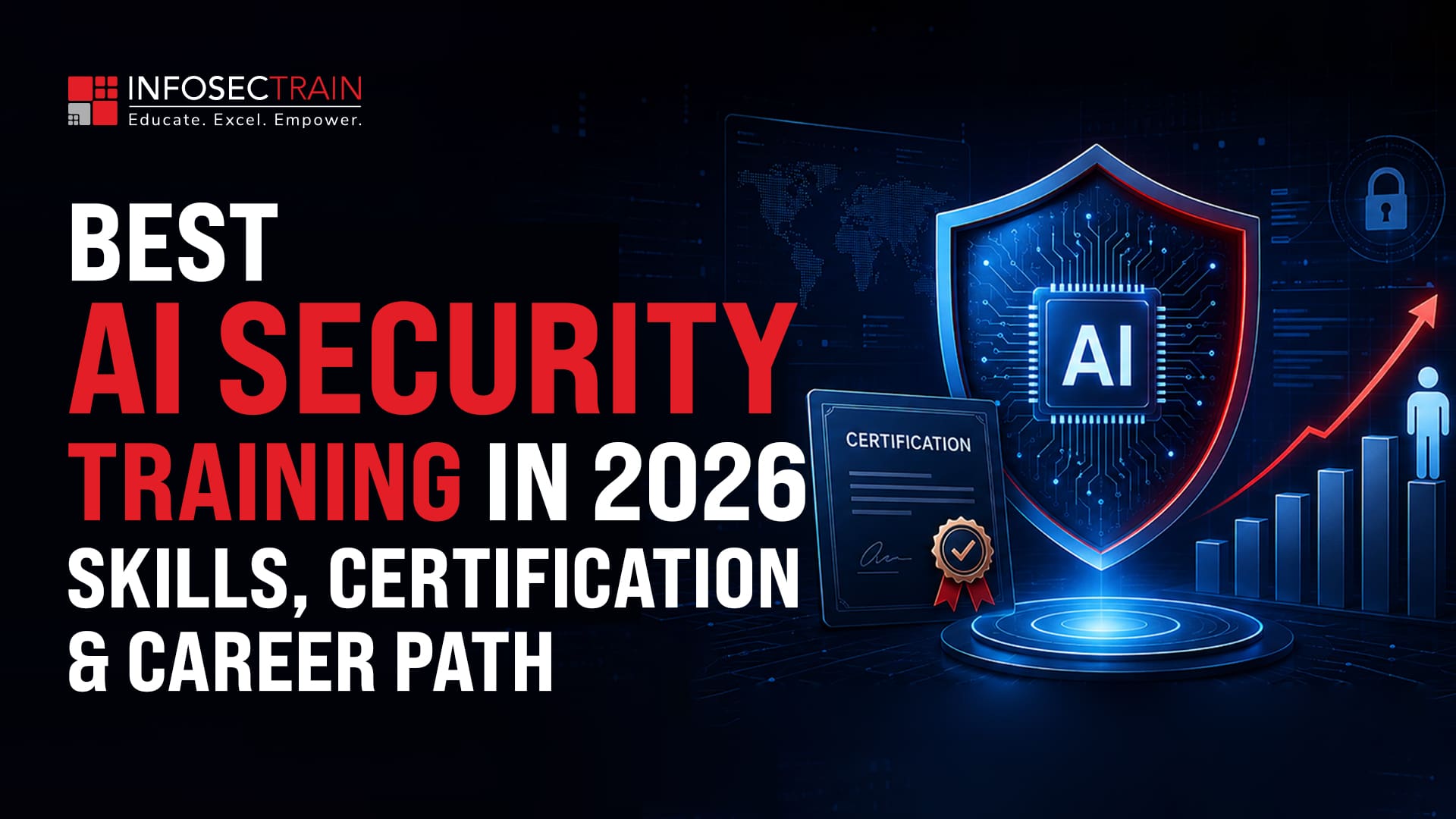
Best AI Security Training in 2026: Skills, Certification & Career Path
-

- Published Updated
- 249 views
AI security stopped being one thing a while back. A SOC analyst wants AI to speed up alert triage without quietly missing something a human would have caught. An engineer bolting features onto an LLM wants to know how to keep it from leaking a system prompt or running a command it was never supposed to execute. Someone eyeing a recognized certification just wants proof they understand the field, not another round of buzzword familiarity. And a manager sitting above all three of those people is usually stuck with the hardest version of the problem: governing AI risk across an entire organization, which barely resembles any of the jobs underneath it.
This guide looks at four AI security training programs offered by InfosecTrain, AI SOC Analyst Certification Training, Practical AI Security Engineering Program, CompTIA SecAI+ Certification Training, and AAISM Certification Training, to work out what each one actually teaches and which of those four directions it's built for.
What Should Good AI Security Training Cover in 2026?
Before comparing courses, it's worth pinning down what "good" even means here. Skip that step, and this turns into four promotional blurbs stacked under a keyword-friendly headline, which isn't particularly useful to anyone deciding where to spend money.
A solid AI security program in 2026 usually touches AI and cybersecurity fundamentals, plus the attack techniques that are specific to AI rather than borrowed from traditional appsec. It should get into the practical work of securing models, applications, data, and infrastructure, not just the theory of it. Some of it ought to involve AI-assisted security operations too. Hands-on labs matter more in this field than in most security disciplines, mostly because the underlying models shift fast enough that stale material goes stale faster than usual. Depending on who's taking it, a program might also dig into LLM and agentic AI security specifically, AI risk management, governance and compliance obligations, whichever frameworks the industry has actually settled on, and certification prep where that's the point of enrolling.
Where someone actually sits in their career changes which of that matters most, which is exactly why four separate programs make more sense here than one course trying to be everything to everyone.
Best AI Security Training Programs in 2026
AI SOC Analyst Certification Training: Best for AI-Powered SOC & Defensive Security
Of the four, this sits closest to entry-level, and it stays anchored in security operations rather than AI internals. It layers AI-assisted workflows on top of standard SOC analyst fundamentals, so nobody needs to already understand how a model behaves before the material starts making sense.
The program itself runs 48 hours live and builds L1 SOC skills with a runway into L2 investigation work. On the curriculum side, expect:
SIEM and EDR use, log monitoring and analysis
Alert triage and threat detection
Phishing and malware investigation
Vulnerability assessment and incident response
Digital forensics with memory analysis
AI-assisted alert classification and IOC enrichment
AI-assisted reporting
The AI piece isn't bolted on as an afterthought module; it runs through the classification and reporting work directly. Tooling leans on names most SOC-track learners already recognize: Splunk, Wazuh, Wireshark, Nmap, OpenVAS, Volatility, plus ChatGPT, Claude, and Ollama for the AI-assisted side of things.
What tends to actually sell people on this one is the format: labs, SOC scenarios, a capstone investigation, and interview prep, which matters a lot for a beginner audience that needs something concrete to say when someone across a desk asks what they've actually built.
Aspiring SOC analysts, junior security folks, and IT professionals looking to break into defensive security fit best here, especially anyone who wants to pick up how AI is reshaping day-to-day SOC work while they're still learning the fundamentals. The line worth remembering: this program teaches you to use AI inside security operations. It doesn't teach you to secure AI itself. That's a different course entirely.
Practical AI Security Engineering Program: Best for Hands-On AI Security Engineering
Flip the SOC program's premise, and you land here. Where that one uses AI during operations, this one exists to protect AI systems themselves, built around a build, attack, defend structure that is, honestly, most of the point of enrolling.
The building phase covers ML systems, LLM applications, RAG pipelines, agentic AI, and AI application architecture more broadly. Attacking gets into data poisoning, evasion, model extraction and inversion, prompt injection, jailbreaking, memory poisoning, and agent or tool misuse, the kind of hands-on adversarial work that separates this from a slide-deck overview. Defending closes the loop with LLM guardrails, AI gateways, secure RAG design, data protection, model integrity checks, access control, and production security, alongside secure MLOps and LLMOps, CI/CD security gates, AI infrastructure and supply-chain protection, monitoring, and AI-specific incident response.
Framework-wise, MITRE ATLAS, STRIDE, MAESTRO, the OWASP ML/LLM/Agentic Top 10 lists, and NIST's AI RMF all show up as working references throughout rather than something flashed on one slide and forgotten.
This one assumes a technical foundation walking in. Security engineers, AppSec engineers, DevSecOps engineers, penetration testers, red teamers, ML and LLM engineers, and security architects make up the natural audience, and career directions branch toward AI Security Engineer, LLM Security Engineer, AI Red Teamer, MLSecOps roles, and AI Security Architect from there. Of the four programs here, it's the deepest technical option by a wide margin, and it isn't trying to be anything softer than that.
CompTIA SecAI+ Certification Training: Best for a Vendor-Neutral AI Security Certification Path
Comparing this one against Practical AI Security Engineering on hands-on depth misses the point entirely; that's not where its value sits. What it actually offers is a structured, vendor-neutral body of AI security knowledge tied to a certification employers recognize on sight.
Running 40 hours and aligned with CompTIA SecAI+ v1 (CY0-001), the training assumes cybersecurity and risk professionals walking in with some experience already, not a blank slate. Content spans four areas. AI fundamentals relevant to security cover machine learning, deep learning, NLP, and automation. Securing AI systems gets into models, training data, inference pipelines, and deployment environments. AI-assisted security work covers threat detection, incident response, alert correlation, and continuous monitoring. Governance, risk, and compliance round it out, touching NIST's AI RMF, regulatory expectations, and responsible AI practice. Adversarial ML, data poisoning, model exploitation, AI-enabled phishing, and malicious GenAI use all get named specifically somewhere in the mix, not left as vague gestures toward "emerging threats."
Security analysts, engineers, architects, SOC professionals, cloud security people, GRC practitioners, and consultants tend to fit here, since it's built for people who already have cybersecurity experience and want formal, vendor-neutral validation rather than an introduction from zero. Put simply: Practical AI Security Engineering is a technical specialization. SecAI+ is a broader, certification-anchored validation of the same general field.
AAISM Certification Training: Best for AI Security Management, Governance & Leadership
For experienced security professionals moving toward enterprise AI risk and leadership, AAISM Certification Training takes a management angle none of the other three really attempt.
It's built for people who've already been through the wringer, often CISM- or CISSP-certified, rather than someone starting from scratch. Three areas anchor it. AI governance and program management covers strategy, policy, the AI asset lifecycle, security programs, regulatory considerations, and business continuity. AI risk management spans risk assessments, threat and vulnerability management, and vendor and supply-chain risk. AI technologies and controls round it out with security architecture, data management, privacy, ethical controls, trust and safety, and monitoring.
One detail worth calling out on its own: learners walk away with practical artifacts, not just notes. An AI Governance Framework. An AI Risk Register. A Risk Assessment Workbook. A Threat Modeling Template. An AI Maturity Assessment. An AI Readiness Assessment. An AI Control Library. Documents someone can actually put to work the following Monday, rather than theory that sits in a folder.
This fits people progressing toward AI Security Manager, AI Risk or Governance Leader, Security Program Manager, AI Security Consultant, or CISO-level roles where AI has become part of the job description whether anyone asked for it or not. Of the four, it's the leadership and governance option, full stop, and there's no real overlap with the other three at this level.
Key AI Security Skills These Programs Build
Rather than re-listing every curriculum line a second time, it's more useful to group what these four programs collectively build into four rough buckets.
Technical AI security: threat modeling, adversarial AI, LLM security, model and data protection. Security operations: AI-assisted threat detection, alert triage, incident response, monitoring. Engineering: secure MLOps, AI pipelines, guardrails, infrastructure security. Risk and governance: AI risk assessment, governance frameworks, privacy, compliance, responsible AI practice.
Very few professionals need equal depth across all four buckets at once. That's really the underlying point, and it's what makes picking a track worth doing instead of trying to absorb everything simultaneously and mastering none of it.
Which AI Security Training Should You Choose?
Starting a cybersecurity career? AI SOC Analyst Certification Training makes the most sense, since it builds core SOC skills while introducing AI-assisted workflows rather than assuming both at once.
Already technical and want to secure AI systems directly? The Practical AI Security Engineering Program fits, going deep into building, attacking, and defending AI systems instead of skimming the surface of all three.
Want a recognized, vendor-neutral AI security certification? CompTIA SecAI+ is the better call here, combining AI security, AI-assisted defense, and governance around a credential employers already know how to weigh.
Already a senior security professional? AAISM moves past hands-on implementation into enterprise governance, AI risk, and security leadership, territory the other three don't really touch.
AI Security Career Path in 2026
AI security doesn't run in a straight line, and honestly, it probably shouldn't given how differently these four directions actually work day to day.
At entry level, the path usually runs from SOC Analyst toward AI-enabled SOC Analyst, with AI SOC Analyst training as the natural on-ramp. On the technical side, Security Engineer, AppSec, or DevSecOps roles move toward AI Security Engineer, supported by the Practical AI Security Engineering Program. A broader certification path takes a general cybersecurity professional toward AI Security Specialist, backed by CompTIA SecAI+. And on the leadership side, a Security Manager or CISSP/CISM-certified professional moves toward AI Security Manager or AI Risk Leader, which is where AAISM comes in.
Specialist directions branch off from all of this too. AI Red Teamer, LLM Security Engineer, AI Security Architect, and AI Governance Specialist each pull from more than one track rather than sitting neatly in a single lane.
Conclusion
There's no single best AI security course for every professional, and treating this like a one-size question misses how differently these four career directions actually function in practice. The right training depends on whether the goal is running an AI-enabled SOC, securing AI systems at a technical level, validating broad AI security expertise through a recognized certification, or managing AI security at the enterprise level. The better move, in most cases, is figuring out which of those responsibilities you actually want next and picking training that builds toward it directly, rather than whichever option sounds most impressive sitting on its own.