AI Visibility Stack: How Search Works Beyond Google
-

- Published Updated
- 8,870 views
A common tension shows up in leadership conversations right now.
Marketing reports say performance is stable. Rankings haven’t dropped significantly. Content output is consistent.
And yet, something feels off.
Sales cycles are harder to influence. Buyers seem more informed before they arrive. In some cases, prospects reference competitors your team hasn’t actively tracked.
When you trace this back, the issue is not always a drop in visibility.
It’s a shift in where visibility exists.
The Founder Misconception
Most teams still evaluate visibility through a single lens.
Search.
The assumption is:
“If we rank, we are visible.”
“If traffic is stable, nothing has changed.”
“AI search is just an extension of Google.”
This leads to a narrow view of performance:
keyword rankings
organic traffic
page-level metrics
But these metrics only reflect one layer of a much larger system.
And that system no longer operates in a straight line.
What Is Actually Happening
Visibility has expanded into multiple layers that operate in parallel.
A potential customer today might:
search on Google
read an AI Overview
ask a follow-up in ChatGPT
validate via LinkedIn or Reddit
make a decision without visiting your site
Each of these steps is a visibility event.
But not all of them are captured in traditional analytics.
This creates a gap between:
measured visibility
experienced visibility
To understand this, it helps to look at visibility as a stack rather than a channel.
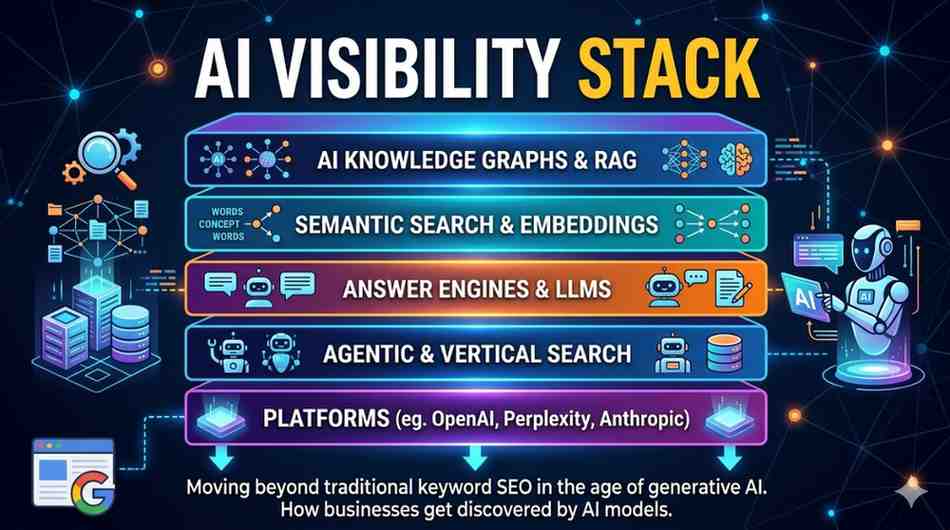
A Framework to Understand It: The AI Visibility Stack
The AI visibility stack explains how visibility flows across different layers of the modern discovery environment.
It typically consists of four interconnected layers:
1. Web Layer
Your owned assets:
website pages
blog content
landing pages
This is where your core information lives.
2. Search Layer (SERP)
Traditional search results:
rankings
snippets
knowledge panels
This layer still drives discovery, but no longer controls it.
3. AI Layer
AI-generated environments:
Google AI Overviews
ChatGPT responses
Perplexity summaries
This is where information is interpreted and recombined.
4. Decision Layer (Human)
Where users:
form opinions
compare options
make choices
This layer increasingly interacts with AI-generated inputs rather than raw search results.
Why This Stack Matters
Each layer:
interprets your content differently
relies on different signals
can bypass other layers entirely
For example:
your page may rank well in search
but not be selected in AI summaries
leading to reduced influence despite stable rankings
Or:
your brand may be cited in AI responses
even if your page isn’t in the top positions
This is why teams experience inconsistencies.
They are optimising one layer.
But visibility is distributed across all four.
If you want to understand how these layers interact in practice, this provides a useful reference point:
https://www.varunmohite.com/ai-search-visibility/
How This Connects to ASVS
The AI visibility stack is not separate from your broader visibility system.
It sits within it.
ASVS (AI Search Visibility System) helps interpret how signals move across these layers.
It focuses on:
how visibility behaves across surfaces
where instability originates
how signals reinforce or conflict
Without a system like this, the stack becomes difficult to manage.
Teams end up:
optimising content without understanding impact
measuring performance without context
reacting to changes instead of interpreting them
The stack explains where visibility happens.
ASVS explains why it behaves the way it does.
What This Means for Business and Leadership
The shift to a layered visibility system changes how performance should be evaluated.
Three implications tend to surface:
1. Visibility Is No Longer Fully Measurable
Not all visibility translates into traffic. Influence can occur before a user reaches your site.
2. Rankings Are No Longer the Primary Signal
They remain important, but they are not sufficient to understand influence.
3. Brand Presence Becomes Distributed
Your brand exists across multiple environments simultaneously, each shaping perception differently.
For leadership teams, this creates a challenge.
Traditional metrics provide partial answers.
But decision-making requires a broader view.
Without it, teams may:
over-invest in familiar channels
under-invest in emerging visibility layers
misinterpret performance signals
What Needs to Change (Without Defaulting to Tactics)
The adjustment required is conceptual.
Not tactical.
Three shifts tend to matter:
1. From Channel Thinking to Layered Thinking
Visibility should be evaluated across:
web
search
AI
human decision environments
Not just within one channel.
2. From Traffic to Influence
The question is not only “Are users visiting?”
It is also “Are we shaping how decisions are made?”
3. From Output to Interpretation
More content does not guarantee better visibility.
Understanding how content behaves across layers does.
This reframes the role of marketing.
From driving traffic to shaping visibility systems.
Two Observations Worth Holding Onto
“Visibility doesn’t live in one place anymore. It moves across layers.”
“If you only measure rankings, you are only seeing part of the system.”
Clarity Block
The AI visibility stack refers to the layered structure of modern visibility across web content, search results, AI-generated environments, and user decision-making. Each layer interprets content differently. Understanding how these layers interact is essential for evaluating visibility, influence, and brand presence in AI-driven search environments.