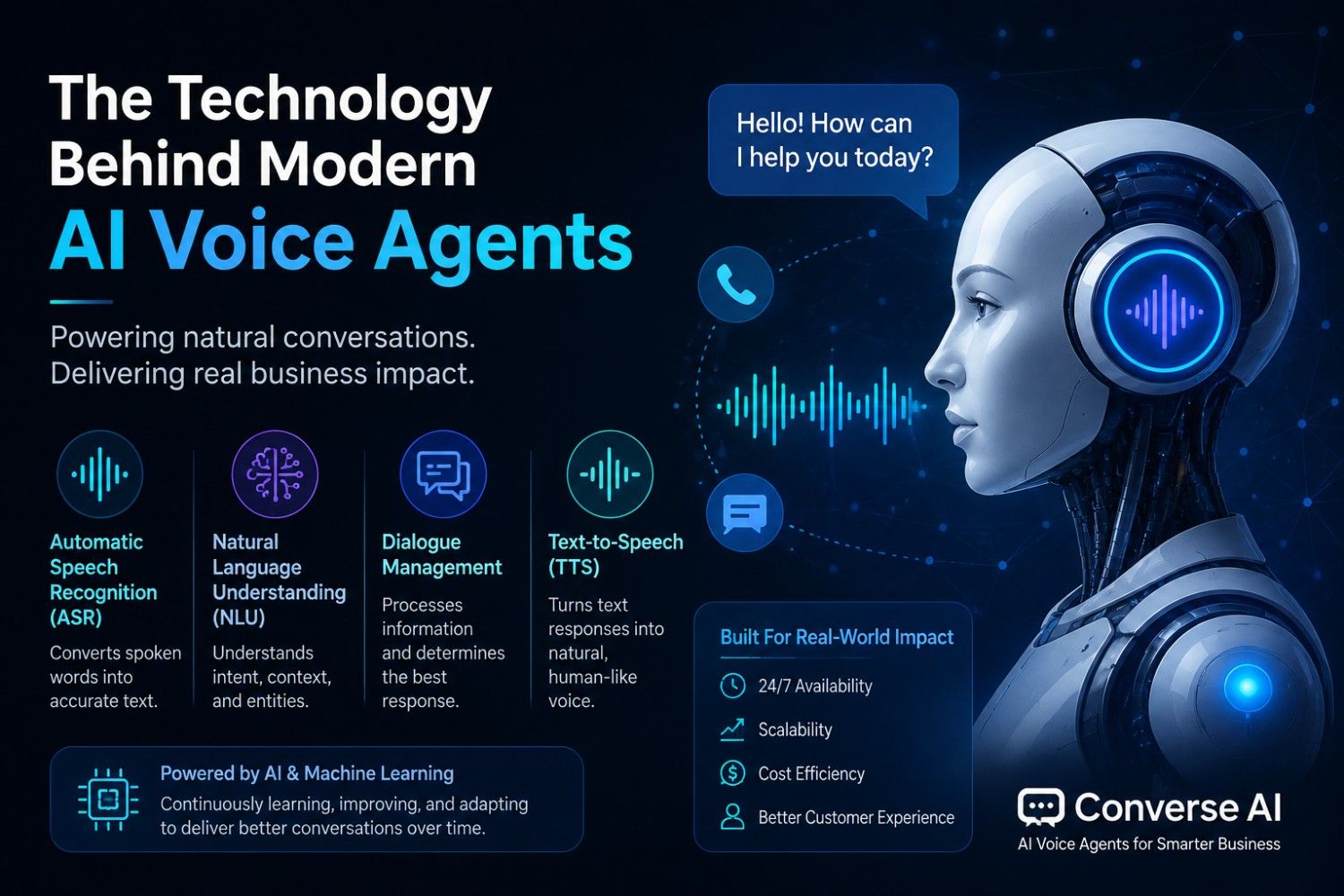
The Technology Behind Modern AI Voice Agents
-

- Published Updated
- 3,261 views
Introduction
Voice is the most powerful communication tool for businesses, as it allows customers to ask questions, make payments, and request support with greater ease and speed than any other method. However, the traditional phone systems used by businesses have not been able to meet the growing expectations of customers.
Interactive Voice Response (IVR) systems have been used for years to help customers navigate menus and press buttons to request assistance. However, modern AI voice agents are able to understand what customers want and provide them with the information or assistance they need in a much more natural way.
The Rise of Voice AI
Businesses have been investing in voice AI technology in recent years, as it has the potential to provide customers with a much better experience. The growing popularity of these systems can be attributed to a number of factors, including:
• Increasing customer expectations
• Rising call volumes
• Advances in AI and machine learning
• Improvements in speech recognition
• Availability of cloud computing
Industry analysts believe that the voice AI market will continue to grow in the coming years, as businesses invest in this technology to improve customer satisfaction.
Automatic Speech Recognition
The first step in any voice AI interaction is for the system to understand what the customer is saying. This is done using Automatic Speech Recognition (ASR) technology.
ASR is a type of speech recognition that enables computers to convert speech into text for processing by AI systems. Modern ASR systems are able to recognize speech with a high degree of accuracy, thanks to the use of large data sets that enable the systems to learn and improve.
The accuracy of Automatic Speech Recognition is essential, as all other processes in a voice AI interaction depend on it.
Natural Language Understanding
Once the speech has been converted into text, the next step is for the AI system to understand what the customer is asking for. This is done using Natural Language Understanding (NLU).
Natural Language Understanding is a technology that enables voice AI systems to comprehend what customers are asking for, rather than simply identifying keywords. This allows voice agents to understand the intent behind customer queries and respond appropriately.
For example, if a customer says “I need to reschedule my appointment for next week”, the NLU would identify the intent behind the request and extract relevant information such as the appointment date.
Natural Language Understanding enables voice agents to:
• Identify intent
• Extract information
• Understand context
• Identify sentiment
• Recognize variations in language
The ability of voice AI systems to understand customers is one of the reasons why they are much more natural than traditional phone systems.
Large Language Models and Conversational Intelligence
One of the most important developments in the field of AI voice agents is the use of Large Language Models (LLMs). These are computer programs that enable machines to engage in conversation with humans in a much more natural way.
LLMs are able to understand complex questions and provide detailed answers, as they have been trained on vast amounts of information.
Large Language Models enable AI voice agents to:
• Understand complex questions
• Hold multi-turn conversations
• Provide detailed responses
• Adapt responses to different contexts
• Maintain conversational flow
LLMs have allowed AI voice agents to provide a much more natural conversation experience.
Dialogue Management Systems
Dialogue management systems are an essential part of any voice AI system, as they enable the system to understand the context of a conversation.
These systems allow AI voice agents to follow a conversation and determine what the next step should be, based on what the customer says. This is important, as customers often change topics or ask follow-up questions.
Dialogue management systems are essential for maintaining a natural conversation flow.
Text-to-Speech Technology
Once the AI system has understood the customer and formulated a response, it needs to be able to deliver the response in a way that the customer can understand. This is done using Text-to-Speech (TTS) technology.
Modern TTS systems use neural networks to generate speech that is much more natural-sounding than older systems. This has greatly improved the customer experience, as customers are able to understand what the AI voice agent is saying.
Text-to-Speech technology has also become much more expressive, as it is now able to capture emotional undertones and other aspects of human speech.
As this technology continues to improve, customers will be able to interact with AI voice agents in an even more natural way.
Cloud Computing and Real-Time Processing
Cloud computing plays a major role in the functioning of modern AI voice agents, as it enables them to process information and respond to customers in real-time. This is essential, as customers expect to be able to have conversations with businesses without any noticeable delays.
Cloud-based systems also allow businesses to scale their operations and provide voice assistance to thousands of customers at the same time.
Many modern voice AI providers, including Converse AI, use cloud-native systems to provide businesses with a faster and more reliable conversation experience.
Business System Integration
AI voice agents are much more powerful when they are integrated with business systems, as this allows them to access and use valuable information to assist customers.
Modern voice agents are able to integrate with a wide range of systems, including:
• CRM systems
• Helpdesk systems
• Appointment scheduling systems
• E-commerce systems
• Knowledge bases
• Databases
This allows voice agents to provide a much more personalized experience to customers, as they are able to access information about their preferences and needs.
For example, a voice agent that has been integrated with a CRM system would be able to access information about a customer’s account and use that information to provide assistance.
Analytics and Insights
Every interaction between a customer and an AI voice agent provides businesses with valuable data and insights.
Businesses can use this information to improve their services and better understand their customers’ needs. Some of the insights that can be obtained from voice AI interactions include:
• Customer preferences
• Common questions
• Customer intent
• Satisfaction levels
• Call resolution rates
• Conversation durations
These insights can be used to improve the customer experience and optimize business operations.
Marketers can also use these insights to identify trends and gain a deeper understanding of their customers.
The Future of AI Voice Agents
AI voice agents will continue to evolve and become much more powerful in the years to come. Some of the exciting developments that are expected to take place include:
• Emotion recognition
• Predictive analytics
• Enhanced multilingual support
• Personalization
• Autonomous operation
• Improved contextual memory
These developments will enable businesses to provide a much better customer experience and improve their operational efficiency.
Conclusion
Modern AI voice agents are a powerful technology that combines Automatic Speech Recognition, Natural Language Understanding, Large Language Models, dialogue management systems, and neural Text-to-Speech to provide businesses with a smarter way to communicate with customers. As this technology continues to evolve, it will enable businesses to provide much better customer experiences and achieve greater levels of operational efficiency.