AI Slop Vs. Human Writing: How To Spot Low-Quality AI Text
-

- Published Updated
- 3,544 views
AI Slop Vs. Human Wr
TL;DR
AI slop is not simply AI-generated writing—it is low-value content that appears polished while offering little originality, evidence, or meaningful insight.
- Merriam-Webster named "slop" its 2025 Word of the Year as AI-generated low-quality content became increasingly widespread.
- Ahrefs found AI-assisted writing in 74.2% of 900,000 newly discovered webpages, although most combined AI and human editing.
- Common warning signs include repetitive ideas, generic structures, vague sourcing, exaggerated claims, and limited original insight.
- Hallucinated studies, fake statistics, incorrect citations, and fabricated quotes are much stronger indicators of poor-quality AI content than writing style alone.
- AI detectors should support editorial review rather than determine authorship because false positives remain common.
Introduction
Imagine watching a cooking competition where a dish looks extraordinary on the outside. Every garnish is perfectly placed, the presentation is flawless, and it appears worthy of a five-star restaurant. However, after the judges take their first bite, they realize the flavors are bland and the meal lacks substance. What looked impressive from a distance turns out to be disappointing once examined closely.
The internet is experiencing a similar challenge. Modern AI writing tools can generate articles with perfect grammar, attractive formatting, logical headings, and professional vocabulary in seconds. At first glance, these articles often appear trustworthy. Yet once readers verify the sources, examine the evidence, and evaluate the originality, many of these pieces reveal little more than recycled information dressed up in polished language.
As AI-generated content becomes increasingly common, the real discussion is no longer about whether artificial intelligence was used. Instead, the focus has shifted toward AI Slop Vs. Human Writing and how readers can distinguish valuable content from material created purely for volume. The quality of an article depends less on the tool used to write it and more on the research, verification, expertise, and editorial judgment behind it.
Merriam-Webster highlighted this growing concern by naming "slop" its 2025 Word of the Year, defining it as low-quality digital content often produced at scale using artificial intelligence. Meanwhile, research from Ahrefs showed that AI-assisted writing appeared in over 74% of newly discovered webpages during one large-scale analysis. Most of these pages involved some degree of human editing, demonstrating that AI itself is not necessarily the issue. The real problem arises when publishers prioritize speed and quantity over quality and originality.
What Is AI Slop?
AI slop refers to content that appears informative while providing very little real value. It is not simply text generated by artificial intelligence. Many excellent articles today are written with AI assistance and carefully reviewed by human experts. Likewise, poorly researched articles written entirely by humans can also qualify as low-quality content.
The defining characteristic of AI slop is the absence of meaningful contribution. It often summarizes information already available elsewhere without adding fresh analysis, firsthand experience, expert interviews, or original research. Readers may finish an article without learning anything new despite spending several minutes reading it.
Researchers studying AI-generated content have identified three recurring characteristics that commonly appear in AI slop:
- Superficial competence
- Minimal effort to produce
- Easy mass production at scale
These characteristics explain why AI slop spreads rapidly across websites, blogs, and social media platforms.
Why AI Slop Has Become So Common
The rise of generative AI has dramatically reduced the cost and time required to create online content. Organizations can now publish dozens or even hundreds of articles within a single day using AI-powered writing assistants.
Several factors have contributed to this trend:
- Lower production costs
- Pressure to publish more frequently
- SEO competition
- Easier access to advanced AI models
- Automated publishing workflows
AI itself is not responsible for poor-quality content. Instead, problems arise when publishers use AI to increase output without investing in research, editing, or fact-checking.
AI Slop Vs. Human Writing: What Makes Them Different?
One of the biggest misconceptions about AI-generated content is that readers can always identify it immediately. In reality, today's language models produce highly natural writing, making detection increasingly difficult.
Experienced editors rarely rely on a single clue. Instead, they evaluate multiple characteristics simultaneously.
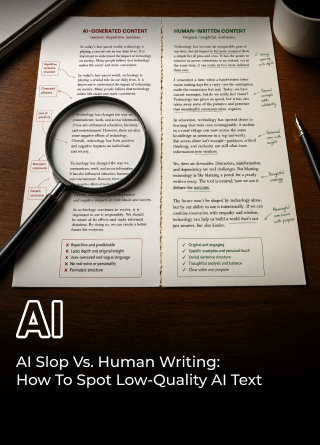
Human-written content typically demonstrates:
- Original observations
- Strong reasoning
- Unique perspectives
- Specific examples
- Verified sources
- Consistent editorial judgment
By comparison, AI slop frequently relies on:
- Repetitive explanations
- Predictable article structures
- Generic introductions
- Overly polished transitions
- Inflated language
- Minimal evidence
None of these traits alone prove AI involvement, but together they often indicate low-quality content.
Primary Signs Of Low-Quality AI Text
Rather than asking whether AI wrote an article, readers should evaluate whether the content provides meaningful value.
Some of the strongest warning signs include:
- Low information density
- Excessive repetition
- Generic headings
- Weak sourcing
- Broad statements without evidence
- Lack of real-world examples
- Little or no original reporting
- Overuse of buzzwords
- Artificially formal language
When several of these characteristics appear together, readers should approach the content more critically.
Why AI Hallucinations Matter More Than Writing Style
Poor writing is frustrating.
Hallucinated information is dangerous.
AI hallucinations occur when language models confidently generate information that is false, fabricated, or unsupported by reliable evidence.
Examples include:
- Fake academic studies
- Invented statistics
- Nonexistent organizations
- Incorrect publication dates
- Fabricated expert quotes
- Broken citations
- References that do not support the claims being made
The safest habit is to verify important claims before accepting them as factual. Reliable writing should always withstand independent verification.
Can AI Detectors Reliably Identify AI Content?
Many people assume AI detection software provides definitive answers. Unfortunately, research continues to show that this is not the case.
Detection systems frequently produce false positives, especially when evaluating writing from non-native English speakers or heavily edited AI-assisted content.
Detection accuracy also changes depending on:
- The AI model used
- Editing quality
- Writing style
- Language
- Subject matter
For this reason, AI detector scores should be viewed as indicators for editorial review rather than final proof of AI authorship.
How To Evaluate Content More Effectively
Instead of focusing on who wrote the article, readers should evaluate whether the content deserves their trust.
Ask questions such as:
- Does it cite reliable sources?
- Are the examples specific?
- Can important claims be verified?
- Does the article provide original insights?
- Does the author explain why the information matters?
- Is there evidence of research beyond summarizing existing material?
These questions are significantly more valuable than simply asking whether AI assisted with writing.
Conclusion
AI slop succeeds because presentation often hides weak substance. Smooth writing, perfect grammar, and attractive formatting can easily convince readers that an article is authoritative even when it contributes very little new information.
The best defense is not trying to identify AI by vocabulary or sentence structure. Instead, readers should prioritize evidence, reliable sourcing, thoughtful analysis, original reporting, and meaningful expertise. High-quality writing—whether created by humans, AI, or a combination of both—always provides value beyond polished language.
As artificial intelligence continues reshaping digital publishing, success will belong to creators who combine AI's efficiency with human judgment, verification, and genuine expertise. Those qualities remain impossible to fake, regardless of how sophisticated writing technology becomes.iting: How To Spot Low-Quality AI Text