How SaaS Companies Use AWS to Build Scalable Products
-

- Published Updated
- 8,114 views
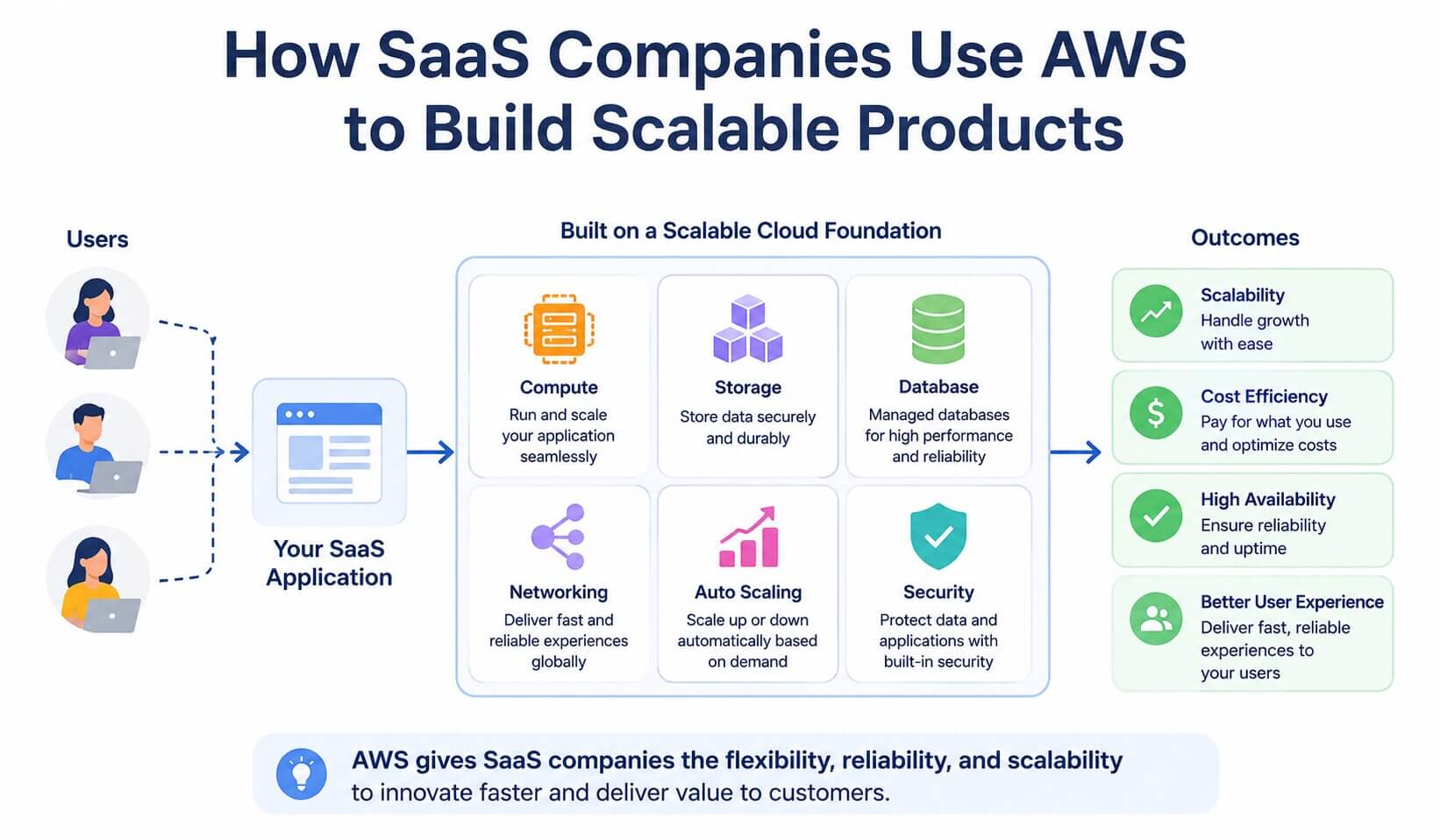
The pace of change in the world of SaaS has never been higher. Whether it be an AI startup or an enterprise workflow platform, contemporary software firms find themselves in a position where they have to offer applications that are fast, intelligent, secure, and scalable across the globe. The solution for these businesses when it comes to developing such high-performing apps? AWS.
At present, thousands of AWS-powered companies use AWS' services to facilitate fast user growth, automate processes, ensure high availability, and deploy their offerings. No matter whether you have a startup that provides niche SaaS solutions or a large enterprise with millions of clients, AWS has now become one of the cloud providers of choice for scalable software.
In this article, we talk about scalable SaaS apps developed by AWS-based companies, examine the reasons behind AWS' popularity among cloud users, and outline what cloud infrastructure providers should know about SaaS.
Why Scalability Matters for SaaS Companies
Scalability is one of the biggest success factors of the SaaS business model.
As opposed to conventional software, SaaS products must be capable of handling:
• Constantly growing traffic volume
• Access from around the world
• Real-time data processing
• Multi-tenancy
• High availability demands
• Consecutive updates
• Workloads related to artificial intelligence and analytics
Even minor problems with infrastructure may affect thousands of users at once. That’s why any SaaS company requires scalable cloud infrastructure, which won’t compromise its customer’s experience.
The Amazon Web Services platform can assist in overcoming this challenge by offering on-demand infrastructure and automation tools as well as a worldwide cloud ecosystem.
Why So Many Companies Using AWS Choose It for SaaS Development
One of the most important factors that have helped companies using AWS to grow at a fast pace is flexibility.
AWS gives SaaS providers the ability to start small and scale their infrastructure as and when needed. Companies do not have to make huge investments in hardware to introduce their products.
Some of the key benefits provided by AWS are as follows:
Global Infrastructure
AWS has its data centers situated across several regions around the globe. Thus, SaaS applications get better access performance even in international settings.
Pay-As-You-Go Pricing
Instead of paying upfront for the expensive infrastructure, SaaS companies will only be charged for their consumption.
It will help start-ups:
• Lower operating costs
• Scale efficiently
• Test new functionalities
• Cut down on cloud expenses
Flexible pricing is one of the reasons cloud infrastructure providers are turning to AWS.
High Availability and Reliability
Downtime can be extremely detrimental to SaaS companies.
What AWS has to offer include:
• Auto scaling
• Load balancing
• Disaster recovery
• Redundant infrastructure
• Backup
All these services enable SaaS firms to ensure consistent uptime.
Core AWS Services SaaS Companies Commonly Use
Current SaaS services depend on several AWS services for developing scalable applications.
The following list consists of the most common services used by firms using AWS services.
Amazon EC2 for Elastic Compute Power
EC2 of Amazon enables SaaS companies to use virtual machines which have the ability to scale up depending upon the traffic needs. This can be explained by the following examples:
• eCommerce SaaS company can accommodate increased traffic during promotional events.
• CRM software can allocate additional computing power during peak hours.
• SaaS AI solution can process higher loads dynamically.
This elasticity is an important aspect for growing SaaS companies.
AWS Lambda for Serverless Applications
Serverless architecture in AWS Lambda has changed how software-as-a-service apps are created.
Rather than having to deal with the maintenance of servers, one can execute code based on event triggers.
The advantages are:
• Decreased management overhead
• Quick deployment
• Decreased complexity
• Effective cost savings
Several software-as-a-service startups have embraced serverless architecture for rapid development.
Amazon S3 for Data Storage
Amazon S3 is often used in software-as-a-service companies for storage purposes of:
• customer data
• BACKUPS
• media data
• logs
• data analytics
Its durability and scalability make it one of the most dependable data storage systems in the cloud computing platform.
Amazon RDS for Managed Databases
Database management is essential to all SaaS applications.
Amazon RDS enables SaaS companies to manage their databases without having to undertake complicated maintenance processes manually.
This lets developers concentrate on developing innovative products rather than managing their databases.
How SaaS Companies Use AWS for Rapid Product Growth
The first main benefit of using AWS is speed.
For SaaS firms, it is essential that they:
• Get their features out quickly
• Test different things
• Be able to update often
• Improve the user experience constantly
DevOps and Continuous Deployment
Most enterprises using AWS have:
• CI/CD pipeline
• Infrastructure as code
• Automated monitoring
• Containerization services
Some examples include:
• Docker
• Kubernetes
• Terraform
• GitHub Actions
These tools allow cloud-based software-as-a-service companies to launch applications much quicker and safely.
AI-Powered SaaS Growth on AWS
AI-native SaaS applications are one of the largest trends in 2026.
Firms that utilize AWS platforms are adopting more of the following:
• Machine learning
• AI assistants
• predictive analytics
• automation
• generative AI
Services provided by AWS such as:
• Amazon Bedrock
• SageMaker
• AI APIs
• GPUs
make building AI applications easy for SaaS firms without large infrastructure requirements.
This is particularly true for start-ups entering quickly growing AI markets.
Security and Compliance for SaaS Businesses
Security is an important issue for SaaS services that deal with customer data.
AWS offers sophisticated security features such as:
• Management of identities
• Capabilities to encrypt data
• Monitoring for potential threats
• Access management
• Compliance systems
SaaS service providers dealing with industries such as:
• Healthcare
• Financial services
• Cybersecurity
• E-commerce
require sophisticated cloud security solutions.
This is one of the main reasons why cloud infrastructure providers prefer AWS for their enterprise-level services.
Multi-Tenant SaaS Architecture on AWS
The majority of SaaS applications run on multi-tenant architecture, which allows different customers to utilize the same infrastructure securely.
AWS assists organizations in:
• separating workloads,
• managing permissions,
• scaling tenant environments,
• and optimizing infrastructure utilization.
This kind of approach provides advantages in terms of:
• cost-effectiveness,
• scalability,
• and performance management.
And it’s a common practice among SaaS providers today.
Real-World Industries Building SaaS Products on AWS
Currently, companies that leverage the power of AWS can be seen operating in just about any industry.
Some examples of fast-growing SaaS industries include:
FinTech
AWS enables Financial SaaS companies in their operations involving:
• Payment processing
• Fraud detection
• Analytics
• Digital banking
Healthcare SaaS
AWS helps healthcare organizations leverage SaaS applications for:
• Telemedicine
• Patient Management
• Medical Analytics
• Cloud-based Records
AI and Data Analytics
AI companies depend on AWS for tasks like:
• Model training
• GPU Computing
• Vector Databases
• AI Inference
Cybersecurity SaaS
Cybersecurity SaaS companies use AWS for services such as:
• Threat Monitoring
• Security Tools
• Compliance Management
• End-point Protection
What Cloud Infrastructure Companies Can Learn from AWS-Based SaaS Businesses
The success of organizations utilizing the services of AWS can teach us a number of valuable lessons about modern cloud infrastructure providers.
Organizations that achieve success through their SaaS services value:
• automation
• scalability
• rapid deployment
• AI readiness
• efficiency
• accessibility around the world
As opposed to fixed infrastructure providers, modern SaaS organizations value flexibility and innovation.
AWS allows businesses to be responsive to market needs without compromising on quality and performance.
The Future of SaaS and AWS
Going forward, as AI usage, cloud migration, and digital transformation increase, AWS will continue to be an important player within the realm of SaaS.
In terms of SaaS development, what we should expect in the future includes:
• AI-based software
• Serverless architecture
• Edge computing
• Cloud automation
• FinOps
• Multi-cloud compatibility
For organizations that want to gain knowledge about contemporary cloud adoption patterns, it is essential to evaluate the companies utilizing AWS, since it can help learn about developing scalable digital products.
With cloud-first being a growing trend among enterprises, it is clear that companies running on AWS will drive innovation going forward.