10 Biggest Malls in the World
-

- March 25th, 2026
- 7,874 views
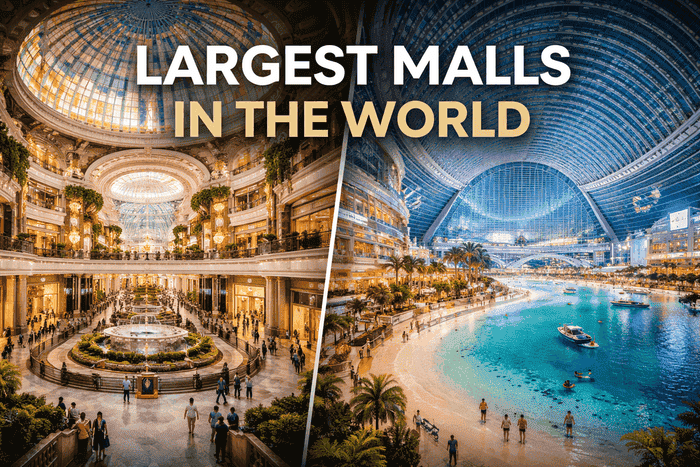
These days, shopping malls are less about retail. They are massive mixed-use environments that bundle together shopping, entertainment, hospitality and even cultural attractions in a single space. The world’s biggest malls function more like self-sufficient cities than a conventional shopping centre, and are often categorized by their gross leasable area (GLA)—the total quantity of floor space available to be occupied.
These mega malls are compelling not only because of their size, but because they reimagine what a “mall” is. From indoor theme parks to libraries, ice rinks and luxury hotels, these spaces stretch the boundaries of architecture and urban design.
What Defines the Largest Shopping Malls
Before diving into the list, it helps to understand how we determine “largest.” The world standard is not total built-up area but GLA. This allows for an equitable comparison of sites with different layouts and multipurpose functions.
Asia and the Middle East have dominated the rankings in recent years, mainly because of rapid urbanisation, high population density and strong consumer markets.
World's Largest Shopping Malls
1. Iran Mall (Tehran, Iran)
At approximately 1.95 million square metres, the Iran Mall is currently the largest mall in the world.
It’s much more than a retail center. The compound has a library, sports facilities, a mosque and vast entertainment areas. Its very footprint makes it feel like a whole urban district, not merely one building.
2. New Century Global Center (Chengdu, China)
Spanning some 1.7 million square metres, this mall is one of the largest structures ever built.
It includes an indoor water park/’artificial beach, offices, hotels and a university sector that mixes up leisure with day-to-day living.
3. The Avenues Mall (Kuwait)
Occupying an area of approximately 1.2 million square metres, it is the largest mall in Kuwait.
The design is that of themed districts, each with its own style, which makes for a more immersive shopping experience.
4. IOI City Mall (Malaysia)
Covering about 821,000 square metres, IOI City Mall is one of the biggest retail hubs in Southeast Asia.
There is also an Olympic-size ice rink and a large entertainment center, which makes it a family favorite.
5. Isfahan City Center (Iran)
Covering approximately 776,000 square metres, this complex merges retail with cultural and leisure facilities.
It also has one of the biggest indoor amusement parks in the area.
6. South China Mall (Dongguan, China)
South China Mall, at over 659,000 square metres, was once the largest in the world.
And despite its grand scale and themed zones based on cities around the world, it bled money for years before finally hitting its stride — a reminder that bigger ain’t always better.
7. SM Mall of Asia (Philippines)
This mall has a coverage area of almost 590000 square metres, making it one of the most crowded malls in the world.
It blends retail with waterfront leisure, arenas and entertainment venues to create a lifestyle destination.
8. SM City Tianjin (China)
One of the largest malls in China, this one is over 565,000 square metres.
Its floor plan is laid out for flow, a concept that has caught on in modern retail planning.
9. Golden Resources Mall (Beijing, China)
Sometimes referred to as the “Great Mall of China,” it features more than 557,000 square metres of space.
At the time of its opening, it was among the world’s largest malls.
10. CentralWorld (Bangkok, Thailand)
CentralWorld is an important retail and lifestyle destination in Thailand, with approximately 550,000 square metres.
Combining those stores, restaurants and entertainment is common in mixed-use developments and this mall includes offices, hotels and event spaces.
Beyond Just Size: What These Malls Represent
The largest malls in the world aren’t just about their size. They are a response to fundamental changes in how people shop and spend their time. Today’s customers require experiences, not just products.
That’s why these malls include:
- Theme parks and entertainment zones
- Cultural spaces include: libraries and galleries
- Hotels, offices, and residential components
- Digital infrastructure and smart retail technologies
- Evolve or die, and here they are destinations and not just places to buy.
Wrapping Up
E-commerce may be booming, but more and more companies are reimagining physical retail spaces. The biggest malls are leading the way is by prioritizing experience, design and integration with urban life.
We will probably start to see even larger, but more important smarter developments. It will be less about opening more locations, but rather sustainability and digital integration while prioritizing community-focused spaces.
But for the world’s biggest malls, the ultimate currency is less about... shopping and more about how people gather, explore and have an experience at scale.