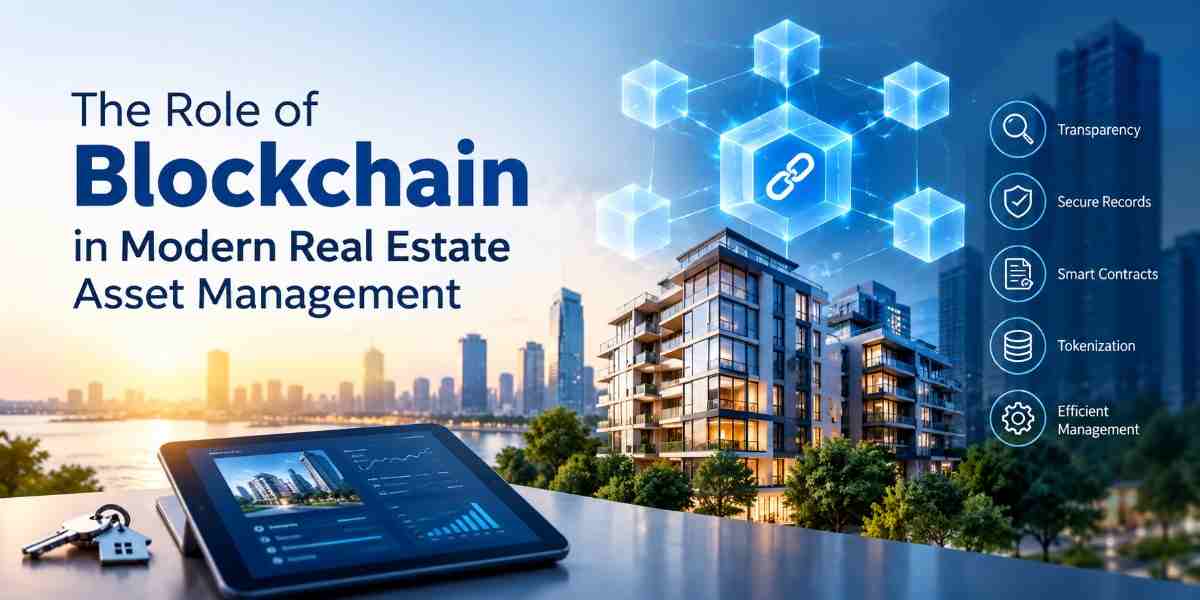
The Role of Blockchain in Modern Real Estate Asset Management
-

- September 17th, 2026
- 58 views
Real estate asset management involves much more than buying and selling properties. It includes maintaining ownership records, managing financial information, tracking property documents, coordinating transactions, monitoring investments, and maintaining communication between different stakeholders. Traditionally, many of these activities depend on centralized databases, paperwork, intermediaries, and disconnected systems.
Blockchain technology introduces a different approach by creating shared digital records that can be securely maintained and verified across participating parties. As the real estate industry becomes increasingly digital, blockchain is being explored for applications ranging from property records and transaction management to smart contracts and asset tokenization.
What Is Real Estate Asset Management?
Real estate asset management is the process of managing property and property-related investments throughout their lifecycle. Asset managers may oversee acquisition, ownership, leasing, financial performance, documentation, maintenance, transactions, and eventual disposal.
A typical property transaction can involve property owners, buyers, investors, brokers, financial institutions, legal professionals, government authorities, and other service providers. Each participant may maintain different records and systems, creating opportunities for duplicated information, delays, and reconciliation issues.
Digital technologies can help streamline these processes, and blockchain offers another layer of infrastructure for maintaining verifiable records and automating selected workflows.
How Blockchain Changes Real Estate Asset Management
Blockchain is a distributed ledger technology that records transactions in a structured and tamper-resistant manner. Instead of relying entirely on one centralized database, authorized participants can interact with a shared record according to predefined rules.
In the context of real estate asset management, this can enhance the transparency and accountability of some real estate-related processes. Transaction histories can be recorded on-chain and actions can be automatically performed on-chain based on predetermined criteria through smart contracts.
But, blockchain is not a legal document of legal ownership of a physical property. Applicable laws, contracts, documents and legal structures still control the linkage between the blockchain record and the corresponding property rights.
The Role of Tokenization in Real Estate Asset Management
Beyond its role in keeping records, tokenization can be used to bring blockchain into a different realm, by creating digital representations of asset interests.
A tokenization platform can converge property data, onboarding investors, smart contracts, and issuance, wallet management, and transaction workflows. This establishes an infrastructure layer to handle the handling of tokenised assets all through their lifecycle.
For instance, an asset might be added to a platform, linked to a legal entity, tokenised and offered to investors who are qualified. The investors would then be able to track their accounts and transactions through a digital platform.
Businesses exploring this model can consider white-label real estate tokenization platform development when they want customizable infrastructure that can be adapted to their branding, asset model, and operational requirements.
Challenges of Using Blockchain in Real Estate
While blockchain can enhance certain processes, it won't solve all the problems of real estate.
The regulations differ substantially from country to country. The legal frameworks for respecting the rights of property owners and investors should be in place.
One of the challenges is to stitch together the on-chain data and the real-world data. A blockchain can be used to record information safely, but isn't capable of foretelling or verifying whether a physical object exists, or whether an outside document is legally binding.
Privacy is another consideration. The prices of real estate applications often encompass delicate monetary and private details, necessitating cautious selections on which elements ought to be held on-chain and which ones ought to be appropriately managed off-chain.
Interoperability is also significant since financial, property administration, identity and enterprise frameworks must interface with the blockchain stages.
What to Consider When Building a Real Estate Blockchain Platform
To create a blockchain-reliant real estate platform, an organisation first has to establish the asset model and rights regarding the digital form of the asset.
Then they need to assess the blockchain network, architecture of smart contracts, wallets, compliance needs, investing experience, security measures, and connectivity needs.
Considering how many photographs will be required for the task as well makes sense, beginning with the start. A platform started for one property/asset class could expand to accommodate multiple asset classes, jurisdictions, investor groups, and transaction models at some future time.
Conclusion
Blockchain offers real estate asset managers innovative opportunities in how to handle digital records, transaction tracking, automation, and asset representation. What makes its value is the belief and vision that technology will create an infrastructure connecting property information with real world property ownership, real property rights, compliance, and business process.
One of the most vital use cases is in real estate tokenization, which must be appropriately planned from technology, legal, security and asset management perspective to make it a success.
When the blockchain is applied to a more refined and well-defined problem and complemented by appropriate governance and compliance, it can be a beneficial addition to modern real estate applications.