Are Bonds Safe? Understanding Credit, Interest Rate and Liquidity Risk
-

- Published Updated
- 27 views
"Bonds are safe" is one of the most repeated lines in personal finance and one of the most incomplete. A government bond and a bond from a weak finance company are both called bonds, yet they behave very differently when things go wrong.
Retail participation is still small. NISM's September 2026 newsletter notes that retail investors hold about ₹1.2 lakh crore of corporate bonds, against ₹152 lakh crore in fixed deposits, and points out that what an FD really gives you is certainty of exit, not a better return. With the RBI raising the repo rate to 5.50% on October 7, 2026, bond risk is also not theoretical.
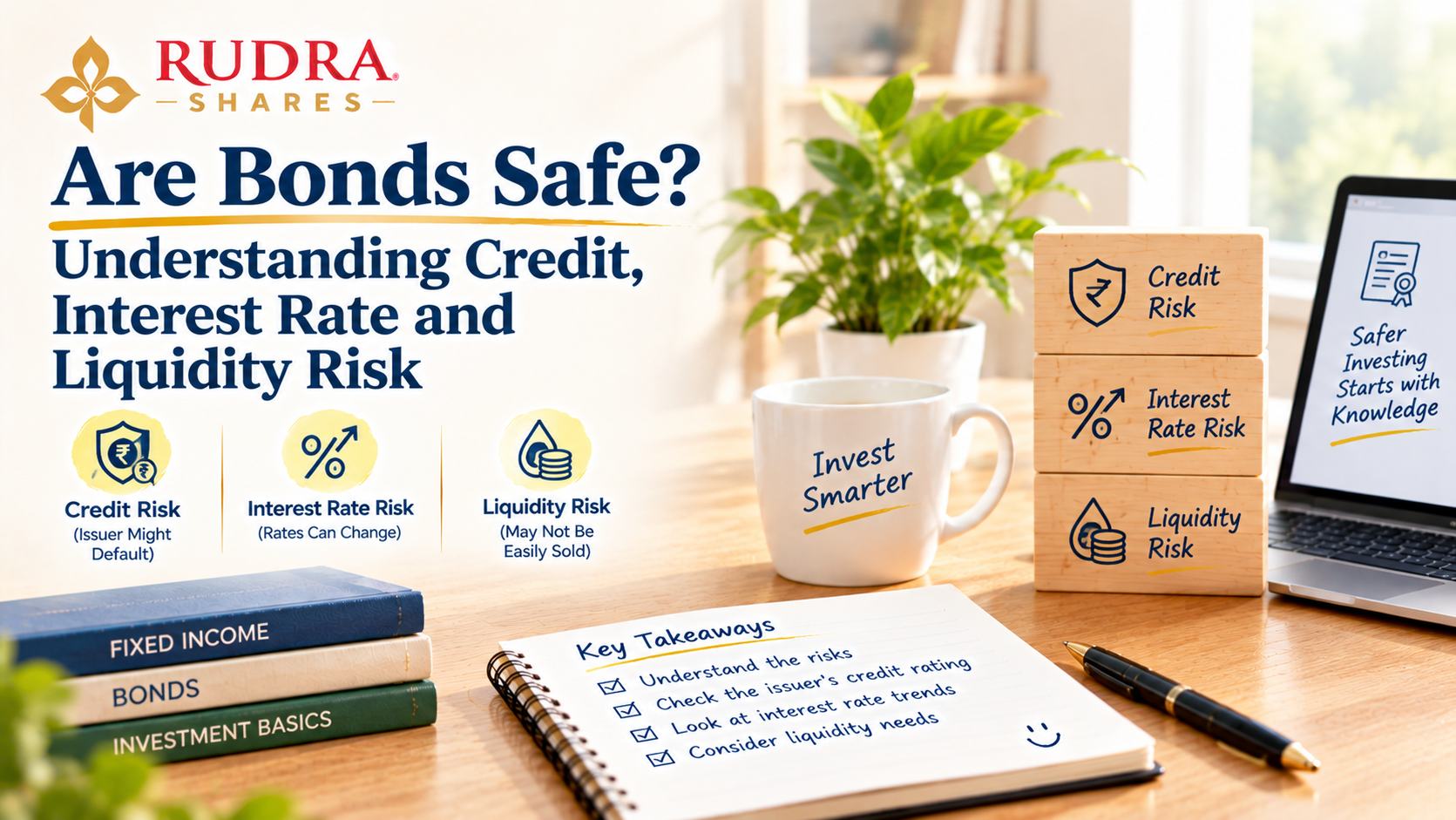
So are bonds safe? Often safer than equity, but never risk-free. Three risks decide how safe a particular bond is.
Credit risk: will the issuer pay?
What it means
Credit risk is the chance that the issuer delays or misses interest or principal payments. Government securities carry sovereign credit quality. Corporate bonds vary widely, and higher coupons usually signal higher risk.
How ratings help
Agencies such as CRISIL, ICRA, CARE and India Ratings grade bonds from AAA (highest safety) down to D (default). BBB- and above is generally treated as investment grade, while BB+ and below is speculative. Ratings are not permanent. CRISIL and India Ratings both reported that downgrade rates edged up in FY26 compared with FY25, and the 2018 collapse of IL&FS showed how fast trust can disappear. A rating is an opinion on repayment ability at a point in time, so even a AAA bond deserves a periodic check.
What happens after a default
Recovery after a default can be slow, uncertain and partial. Investors may wait a long time and get back only a portion of their money, so avoiding the default is far better than counting on recovery.
Limit exposure to any one issuer
Many risk-conscious investors cap a single issuer at 10 to 15% of their bond allocation, and less for lower-rated paper. This is a rule of thumb, not a regulation, but it keeps one default from damaging your whole plan.
Interest rate risk: what happens when rates move
Prices fall when rates rise
Suppose you hold a bond paying 7% and new bonds start paying 7.5%. Yours looks less attractive, so its market price drops. Longer maturities swing more than shorter ones, so a 10-year bond reacts more than a two-year bond. The 10-year government bond yield rose to about 7.2% after the October rate hike, up from roughly 6.6% in December 2025.
Bond mutual funds feel the same effect, because their holdings are repriced every day. A debt fund is not immune to rate moves just because it is a fund.
Holding to maturity changes the picture
If you hold a bond until it matures, price swings along the way do not change what you receive, provided the issuer pays. The risk is that you need the money earlier and must sell at a lower price.
Liquidity risk: can you exit when you need to?
Government securities are generally easy to sell. Many corporate bonds trade rarely, so selling early can take time or mean accepting a discount. NISM notes that liquidity is a real worry for retail investors, and the secondary market is still developing. Keep emergency money in savings or liquid funds, not bonds.
How to make bond investing safer
Match the bond to the purpose
Anita, 46, keeps her emergency fund in a savings account and a liquid fund. She puts ₹4 lakh across three AAA-rated bonds maturing in three, five and seven years, and skips a 12% coupon from a BB-rated issuer because the yield looks like a warning, not a reward.
Treat unusually high yields with suspicion
A coupon far above comparable bonds is compensation for risk, so find out what that risk is before you buy.
Use regulated channels
Buy through a registered broker or a SEBI-registered online bond platform provider, and verify registration on SEBI's website. Read the offer document and the rating rationale.
Where a broker fits in
Rudra Shares and Stock Brokers Ltd. is one of the best stock broker in India and a CDSL depository participant that offers bonds alongside equity and mutual funds, so you can compare fixed-income options and track them with the rest of your portfolio. Whichever platform you use, check its registration and read the charges first.
The bottom line
Bonds can add stability, but only when you know which risk you are taking. Check the rating, understand how rate changes affect prices and be honest about when you will need the money.
If you would like help comparing bond options against your goals, and looking for the best bonds to invest in india reach out to the Rudra Shares team for a consultation.
Bonds carry credit, interest rate and liquidity risk. Investments in securities markets are subject to market risks. Read all related documents carefully before investing. This article is for education and is not investment advice.