Business Messaging in India: Bulk Email, SMS & Google RCS Explained
-
- Published Updated
- 1,857 views
Introduction
Reaching customers today isn't about picking just one channel — it's about using the right mix of channels for the right message. Businesses across India now rely on a combination of Bulk Email Service, Bulk SMS Service, and the newer Google RCS Messaging Service to stay connected with customers, share updates, and run marketing campaigns.
Each of these channels works differently and serves a different purpose. In this blog, we'll break down what each one does, how they compare, and how businesses can decide which combination works best for their needs.
Mishtel provides all three of these solutions under one roof, built specifically for Indian businesses. You can explore their offerings at Mishtel.
What Is Bulk Email Service?
Bulk email service allows a business to send emails to a large group of recipients at once, using a single platform instead of sending each email manually. It's commonly used for newsletters, product updates, offers, and detailed announcements that need more space than a text message allows.
The process typically involves uploading a contact list, designing an email template, and sending it either immediately or on a schedule. A Bulk Email Service also gives businesses tracking data, showing who opened the email and clicked on links inside it.
For example, an online course platform might send a weekly newsletter covering new courses, student success stories, and upcoming webinars — all through one bulk email campaign.
What Is Bulk SMS Service?
A Bulk SMS Service works on a similar principle but through text messages instead of email. Businesses upload contact numbers or connect through an API, and messages are sent instantly through an SMS gateway connected to telecom networks.
SMS tends to work best for short, urgent, or time-sensitive updates — things like order confirmations, OTPs, appointment reminders, or flash sale alerts. Since SMS doesn't need an internet connection or app installation, it reaches almost any mobile phone within seconds.
A retail store sending a same-day discount alert to nearby customers is a good example of how bulk SMS gets used in practice.
What Is Google RCS Messaging Service?
RCS, or Rich Communication Services, is the newer upgrade to traditional SMS, and a Google RCS Messaging Service lets businesses send messages with images, buttons, carousels, and branded sender profiles directly through the default messaging app on Android phones.
Unlike plain SMS, RCS messages look closer to an app-based chat, with read receipts, typing indicators, and rich visual content. This makes it useful for businesses that want a more interactive and visually engaging way to communicate, without asking customers to download a separate app.
For instance, a travel company could send a booking confirmation through RCS that includes a flight image, a map link, and a button to check in — all inside a single message.
How These Services Work Together
Each of these three channels plays a different role, and many businesses use them together rather than picking just one.
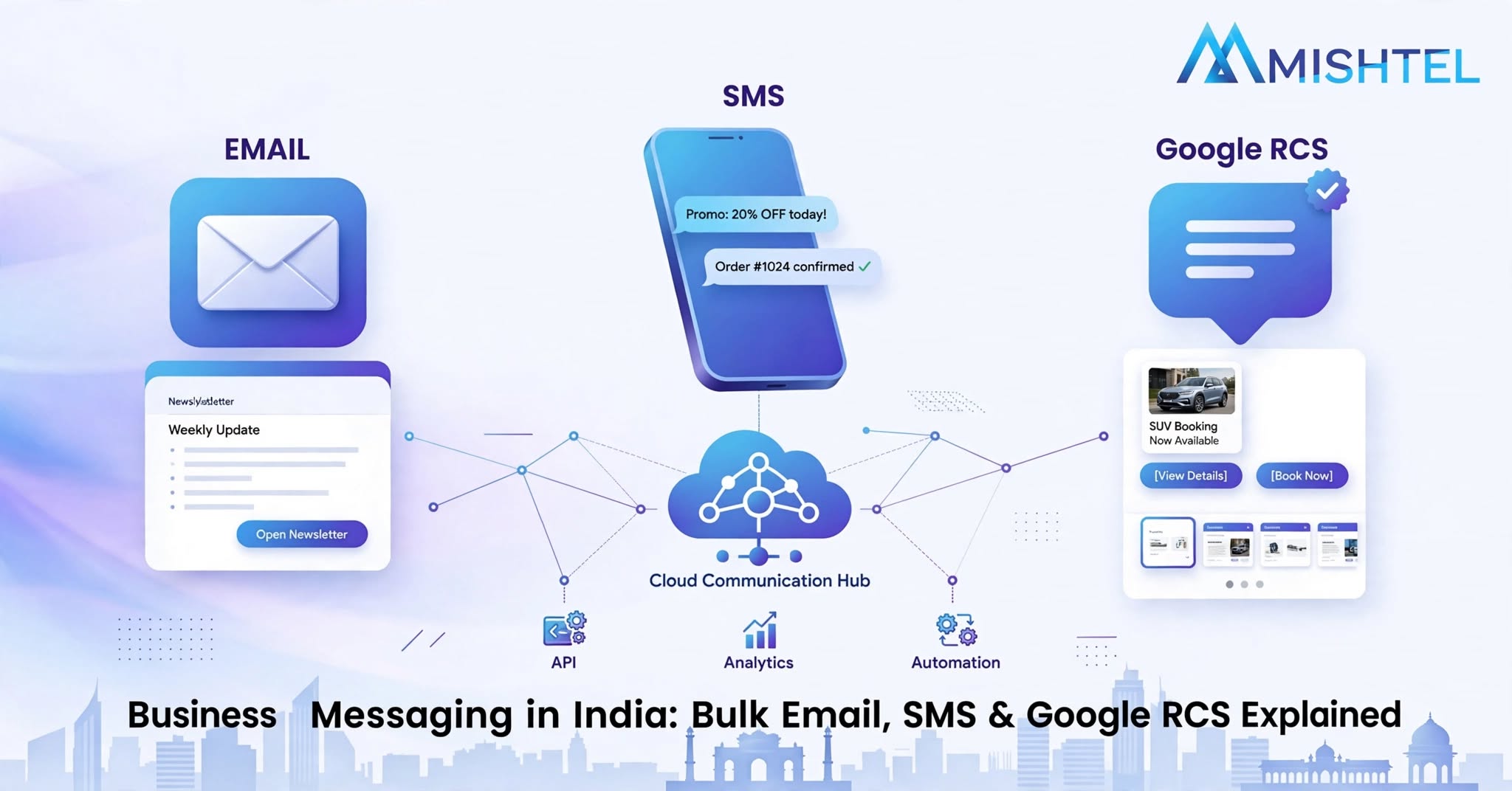
Bulk SMS handles urgent, short alerts like OTPs and order updates.
Bulk Email carries longer content like newsletters, detailed offers, and reports.
Google RCS adds a richer, more visual layer for promotional and interactive messages on Android devices.
A single customer journey might include an RCS message showcasing a new product, a follow-up email with full details and pricing, and an SMS reminder when the offer is about to expire.
Benefits of Using Multiple Messaging Channels
Combining these services gives businesses several practical advantages.
Wider reach – Customers who miss one channel may still see another.
Better engagement – Rich RCS content and detailed emails complement short SMS alerts.
Cost efficiency – Businesses can use SMS for urgent alerts and email for less time-sensitive content, keeping costs balanced.
Improved customer experience – Messages match the right format to the right purpose.
Stronger brand presence – RCS, in particular, shows a verified business name and logo, building trust.
Using all three channels together, rather than relying on just one, tends to produce better overall results for most businesses.
Features to Look For in a Provider
Whether you're choosing a provider for email, SMS, or RCS, a few features matter across all three.
API integration for automated, trigger-based sending.
Detailed analytics covering opens, clicks, and delivery status.
Template management with easy editing and approval workflows.
Contact segmentation to send relevant messages to the right audience.
Compliance support, including DLT registration for SMS and proper authentication for email and RCS.
Scalable infrastructure that handles both small campaigns and large-volume sends.
Mishtel offers these features across its email, SMS, and RCS platforms, giving businesses one consistent system to manage all their messaging.
Common Uses Across Industries
Different industries lean on these channels in different ways.
E-commerce – Order updates via SMS, newsletters via email, and product showcases via RCS.
Banking and finance – Transaction alerts via SMS, statements via email, and secure verified messages via RCS.
Healthcare – Appointment reminders via SMS, health tips via email, and visual reports via RCS.
Education – Fee and exam alerts via SMS, detailed updates via email, and event invites via RCS.
Travel – Booking confirmations via SMS, itinerary details via email, and interactive check-ins via RCS.
Retail – Flash sales via SMS, seasonal catalogues via email, and rich product previews via RCS.
This shows how businesses often mix and match channels based on what each message needs to communicate.
How to Choose the Right Combination
Deciding how much to use each channel depends on a few factors.
Message urgency – Time-sensitive alerts work better on SMS.
Content length – Detailed information fits better in email.
Visual needs – Product showcases and interactive content work well on RCS.
Audience device type – RCS only works on Android devices with RCS support, so email and SMS remain useful as fallback channels.
Budget – SMS and RCS usually cost more per message than email, so balancing volume across channels helps manage costs.
Most businesses start with SMS and email, then add RCS gradually as they look for richer engagement options.
Best Practices for Multi-Channel Messaging
A few habits help businesses get the most out of using these channels together.
Match the message format to the channel's strength — short alerts on SMS, details on email, visuals on RCS.
Avoid sending the same message across all channels at the same time.
Keep contact lists updated to avoid wasted sends.
Track performance separately for each channel to understand what works.
Stay compliant with DLT rules for SMS and proper opt-in practices for email and RCS.
Test different formats and timing to see what customers respond to best.
Following these steps helps keep messaging effective without overwhelming customers.
Frequently Asked Questions
1. What is the main difference between bulk SMS and bulk email? SMS is best for short, urgent updates delivered instantly to any mobile phone, while email suits longer, detailed content like newsletters and reports.
2. What makes Google RCS different from regular SMS? RCS supports rich content like images, buttons, and verified business profiles, giving a more interactive experience compared to plain text SMS.
3. Can a business use all three channels together? Yes, many businesses combine SMS, email, and RCS to cover different types of messages and reach customers more effectively.
4. Is RCS available on all phones? RCS currently works on Android devices with RCS support enabled through Google Messages; it isn't universally available like SMS.
5. Is DLT registration required for bulk SMS in India? Yes, DLT registration is mandatory for businesses sending SMS to Indian mobile numbers under TRAI regulations.
6. Which channel is more cost-effective? Bulk email is generally the most affordable per message, while SMS and RCS usually cost more but offer higher visibility and engagement.
7. Can these services be integrated with a website or CRM? Yes, providers like Mishtel offer API access for email, SMS, and RCS, allowing automated sending directly from business systems.
Conclusion
Using Bulk Email Service, Bulk SMS Service, and Google RCS Messaging Service together gives businesses a well-rounded way to reach customers, whether the goal is a quick alert, a detailed update, or a rich, interactive message. Choosing the right mix based on message type and audience helps businesses communicate more effectively without overspending.
For businesses looking to set up any or all of these channels, Mishtel offers complete solutions built for the Indian market. Learn more at Mishtel.