C_TS4FI in 2026: SAP's Nine Weighted Topics, One 3-Hour System Task, and the Joule Beta Ending October 29
-

- Published Updated
- 123 views
Updated 21 October 2026
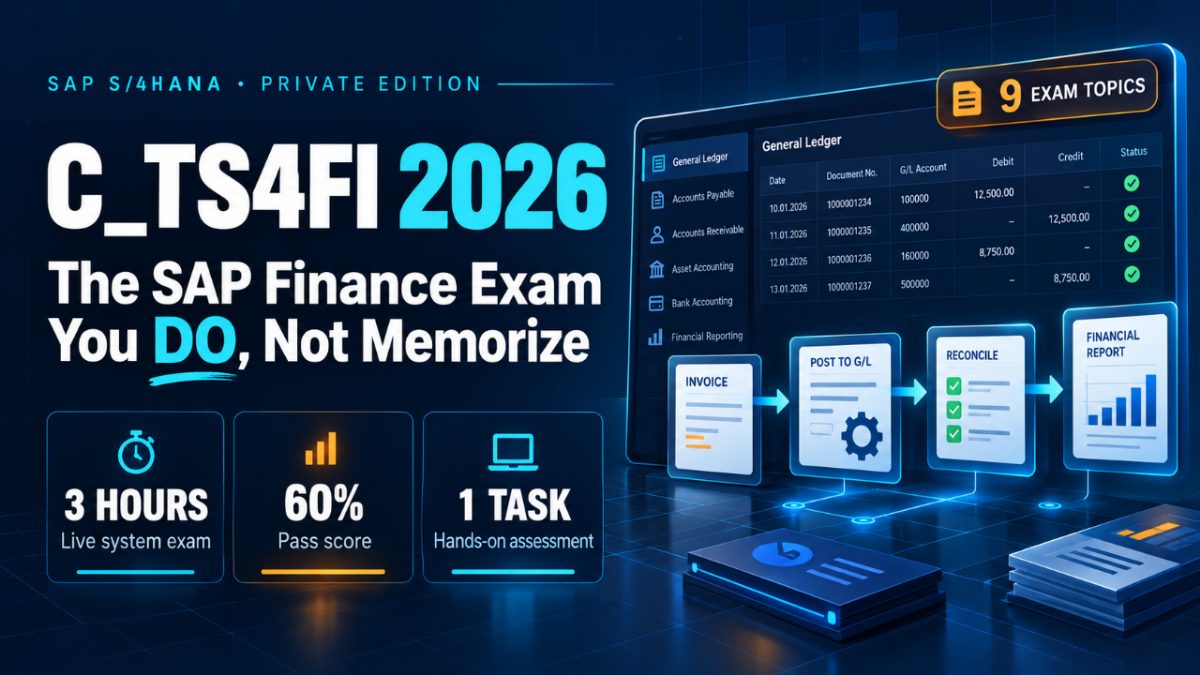
C_TS4FI, SAP's financial accounting certification for SAP S/4HANA Cloud Private Edition, is one system-based task: three hours inside a live SAP system, with a 60% pass score. Most people who search for it want two things, the exam rules and a sense of what they will actually be asked to do.
The rules fit on an index card. The second question is harder, because SAP does not publish a list of questions to study against. It publishes something more useful if you know how to read it: nine weighted topic areas, several of them written as instructions such as "Create a new Document Type" and "Establish a new Company Code".
There is also a date to watch. SAP's C_TS4FI page says the free beta of SAP Joule for Consultants inside the exam "finishes on October 29, 2026". If you planned to lean on Joule during the assessment, that changes your preparation this week. This guide covers the published rules, reads the nine topics as a single implementation, and explains how to prepare so the Joule date does not matter.
What is the C_TS4FI exam in 2026?
C_TS4FI is SAP's financial accounting certification for SAP S/4HANA Cloud Private Edition. It is one system-based assessment: a single activity, three hours long, with a 60% pass score, delivered in English.
The full name on SAP's certification page on SAP Learning, checked on 21 October 2026, is "SAP Certified - SAP S/4HANA Cloud Private Edition, Financial Accounting". The page states that the certification "verifies that you possess core skills in the area of SAP S/4HANA Financial Accounting".
| Rule | What SAP publishes (checked 21 October 2026) |
|---|---|
| Exam code | C_TS4FI (no release suffix shown on the page) |
| Format | System-based assessment, 1 activity |
| Duration | 3 hours |
| Pass score | 60% |
| Language | English |
| Attempts | Each attempt counts against your SAP Learning Hub subscription |
| Recommended learning journey | Implementing Financial Accounting in SAP S/4HANA |
| Open-book extra | Joule for Consultants beta, ending 29 October 2026 |
One detail trips up searchers. Many queries still carry a release suffix, such as C_TS4FI_2601. SAP's page shows only the plain code, C_TS4FI, so treat the certification page itself, not a remembered suffix, as the version you are booking.
What does "system-based" mean for a finance exam?
A system-based assessment puts you inside a live SAP system with a set of tasks. SAP's practical exams FAQ says learners "complete practical tasks in timeboxed simulations using SAP systems", and that results "are based on the successful completion of defined tasks and system outputs."
That last phrase is the important one. The grader looks at what exists in the system when you finish: the document type you created, the house bank you configured, the payment run you executed, the asset you capitalised. A well-reasoned plan that never reached the system does not score. Neither does a configuration step you started and abandoned when the clock got tight.
SAP's system-based assessments FAQ adds three practical rules. "The timer starts as soon as you start." Breaks do not pause the clock. And you must finish "the assessment and all tasks in a single session", then confirm completion on the assessment page. The FAQ also advises keeping the main assessment page open in one tab to reference your tasks while you work in the system in another.
C_TS4FI is about doing, not guessing: a short look at the system tasks — on ERPPrep's Instagram.
What topics are on the C_TS4FI exam?
SAP lists nine topic areas with weightings. Two dominate: Accounts Payable at 21–30% and "Create a new Document Type" at 11–20%. The other seven carry 10% or less each.

| Topic area (SAP's wording) | Weighting | What you are likely doing in the system |
|---|---|---|
| Accounts Payable | 21–30% | Supplier invoices, payments, open items and clearing |
| Create a new Document Type | 11–20% | Defining a document type with its number range and controls |
| Perform Value Adjustments for Overdue Receivables | ≤10% | Valuing overdue customer items and posting the adjustment |
| Accounts Receivable | ≤10% | Customer invoices, incoming payments, clearing |
| Create a House Bank, Configure and Execute the Payment Run | ≤10% | House bank and account setup, then a payment run end to end |
| Perform Customizing, Acquisition, and Depreciation Postings | ≤10% | Asset settings, an acquisition posting, a depreciation run |
| Asset Accounting | ≤10% | Asset master data and asset postings |
| Establish a new Company Code | ≤10% | A company code with its global settings and assignments |
| General Ledger | ≤10% | General ledger (G/L) accounts, postings and ledger settings |
The third column is our reading of SAP's topic names, not text from SAP. Two numbers stand out. Together, Accounts Payable and document types account for between 32% and 50% of the weighting. A candidate who is quick and accurate in those two areas has built most of the 60% before touching assets or receivables.
Why does "Create a new Document Type" carry so much weight?
Because a document type is where several finance controls meet. In SAP S/4HANA, the document type decides which number range a posting draws from, which account types it may post to, which document type is used to reverse it, and which header fields are mandatory.

Get it wrong and the error surfaces later, in a posting that fails or posts with the wrong numbers. That is exactly the kind of mistake a system-based grader can detect, since the output is visible in the system. It also explains why the area sits second in SAP's weighting even though, on paper, it looks like a small configuration step.
A useful drill is to create a document type from a short written requirement, then immediately post a document with it, display the result and reverse it. If the number range, the permitted account types and the reversal type all behave as the requirement said, you have practised the full chain the grader is likely to inspect.
What changes when the Joule beta ends on October 29?
On 29 October 2026, the beta of SAP Joule for Consultants inside C_TS4FI is scheduled to finish. SAP has not stated on the C_TS4FI page what follows, whether an extension, a general release, or removal.

SAP's exact wording is that the assessment "now includes a beta integration of SAP Joule for Consultants that is free and accessible as an additional open-book resource during the exam." SAP's Q2 2026 release notes describe Joule as "currently available for selected system-based SAP Certification exams" and say it "will be expanded over time."
Two cautions follow. First, dates differ across SAP pages: search results show some other certification pages listing an earlier end date, 22 September 2026, for the same kind of beta. Check the C_TS4FI page on the day you book.
Second, the rest of the open-book policy does not depend on Joule. SAP's practical exams FAQ says "Exams will be open book" and names SAP Help Portal, SAP Learning and SAP Community as recommended resources, with Joule "where applicable".
The practical response is simple: prepare as though Joule will not be there. If it is, it saves you a few searches. If it is not, nothing in your plan breaks. Candidates who practised every task with an assistant open may find that their timing changes once it is gone.
How does exam day work for C_TS4FI?
You book a slot in advance, start the timer when you are ready, work through the tasks in the SAP system in one session, and confirm completion. SAP says review "usually takes 15 minutes" and results appear under My Certifications.
The booking rules come from SAP's Q2 2026 release notes and its system-based assessments FAQ:
- Advance booking is required for system-based exams. Confirming a date and time "does not count as an exam attempt", and you can cancel up to 24 hours before through a support case.
- Identity: you need an SAP Universal ID with at least two email addresses on different domains.
- One booking at a time: you cannot schedule a new exam while another one is pending.
- Technical readiness: SAP's C_TS4FI page points to a Technical Readiness Checklist for hardware, software and connection. Run it days before, not minutes before.
- If something breaks: for a confirmed system error, SAP says "a new attempt may be granted". Take screenshots and open a case.
The FAQ is slightly inconsistent on timing, mentioning both "within a few seconds" and "usually takes 15 minutes" for results. Plan for the longer figure.
How should you split practice across the nine topics?
Practise the nine topics as one implementation, in the order a project would build them, and spend about half your hands-on time on Accounts Payable and document types, matching SAP's weighting.

Here is an original practice brief that touches every area. It is a rehearsal exercise, not exam content:
Halvern Foods is opening a new legal entity. Create its company code. Define a new document type for supplier invoices with its own number range. Set up a house bank with one account. Post three supplier invoices and one customer invoice. Run a payment run that pays two of the supplier invoices. Post a value adjustment for the overdue customer item. Capitalise one delivery van, then run depreciation for the first period.
Work through it twice. The first pass is for accuracy, using any notes and help you like. The second is against the clock, using only SAP Help Portal and SAP Learning, the resources SAP names. Write down where time went. Most candidates find that the payment run and the asset postings take longest, because each has several dependent settings that must already be right.
| Week | Focus | Share of hands-on time |
|---|---|---|
| 1 | Company code, G/L, document types | 30% |
| 2 | Accounts Payable, house bank, payment run | 35% |
| 3 | Accounts Receivable, value adjustments | 15% |
| 4 | Asset customising, acquisition, depreciation; full timed run | 20% |
SAP's recommended learning journey, "Implementing Financial Accounting in SAP S/4HANA", includes the practice system the C_TS4FI page tells you to use. That system is the most realistic rehearsal space available, so book your hands-on hours there first.
Why is SAP testing finance consultants this way?
SAP's position is that a certificate should prove you can do the work, not that you can recall it. Over 100 SAP certifications were redesigned around system-based and scenario-based assessment, according to SAP News in May 2026.
Andre Bechtold, President of SAP Industries and Experiences, put it plainly in that SAP News article of 15 May 2026: "Certification is no longer a test of knowledge recall; it is a demonstration of applied capability." The same article reports more than 100,000 exams completed under the new model and 33% year-over-year growth in SAP learning participation.
Diana Roesner, SAP's Head of Certification Transformation, made the same point in SAP News on 11 September 2026: "As AI changes how people work, certification must change with it, moving beyond what someone knows to validating what they can actually do." SAP also says it aims to equip 12 million people with AI-ready skills by 2030.
For finance consultants, this is a fair test. Clients do not pay for a definition of a document type. They pay for one that posts correctly on day one of go-live.
Where can you rehearse C_TS4FI tasks before booking?
Rehearse in SAP's own practice system first, then add targeted drills for the areas where your timed run was slowest. ERPPrep, an SAP certification practice platform, offers skill drills and scenario simulations built for this format.
ERPPrep's C_TS4FI material, checked on erpprep.com on 21 October 2026, has 240 Micro Skill Drills across seven domains. The largest is general ledger configuration and document control with 71 drills, followed by period and year-end closing with 40 and accounts payable and receivable automation with 39.
There are also 24 scenario simulations, graded from foundation to advanced. Access costs $54.80 as a one-time purchase for two months, with no subscription. A free sample drill and a sample scenario are available without an account.
Because C_TS4FI is a system-based exam rather than a scenario-based one, the useful pairing is simple: SAP's practice system for building the configuration, and targeted drills for the decisions that slow you down.
Frequently asked questions
What is the passing score for C_TS4FI?
The C_TS4FI pass score is 60%, according to SAP's certification page checked on 21 October 2026. The exam is one system-based activity lasting three hours.
Can I use Joule in the SAP C_TS4FI exam?
Yes, until the beta finishes. SAP's C_TS4FI page says Joule for Consultants is a free open-book resource in the exam and that "the beta period finishes on October 29, 2026". SAP has not said what follows.
Is C_TS4FI open book?
Yes. SAP's practical exams FAQ says "Exams will be open book" and recommends SAP Help Portal, SAP Learning and SAP Community. Joule for Consultants is listed "where applicable".
How many questions are on the C_TS4FI exam?
C_TS4FI has no numbered question list. It is one system-based activity in which you complete tasks in an SAP system. SAP scores "the successful completion of defined tasks and system outputs".
What topics carry the most weight in C_TS4FI?
Accounts Payable carries 21–30% and "Create a new Document Type" carries 11–20%. The other seven topic areas, including asset accounting, company code and payment run, are each 10% or less.
Can I pause the exam timer?
No. SAP's system-based assessments FAQ says the timer starts when you begin, breaks do not pause it, and all tasks must be finished in a single session.
Do I need to book C_TS4FI in advance?
Yes. SAP requires advance booking for system-based exams. Booking a slot does not use an attempt, and you can cancel up to 24 hours before the exam.
What should you do this week?
Open SAP's C_TS4FI page and check the Joule date and the topic weightings on the day you plan to book. Then run the Halvern Foods brief once without any assistant open and note your slowest step.
If that step is a configuration decision rather than a missing click, ERPPrep's free C_TS4FI sample drill at erpprep.com is a quick way to test it. It needs no account and takes a few minutes, enough to tell you whether Accounts Payable and document types are ready for the clock.