California Almonds for Everyday Snacking: What Should Indian Buyers Know?
-

- September 18th, 2026
- 79 views
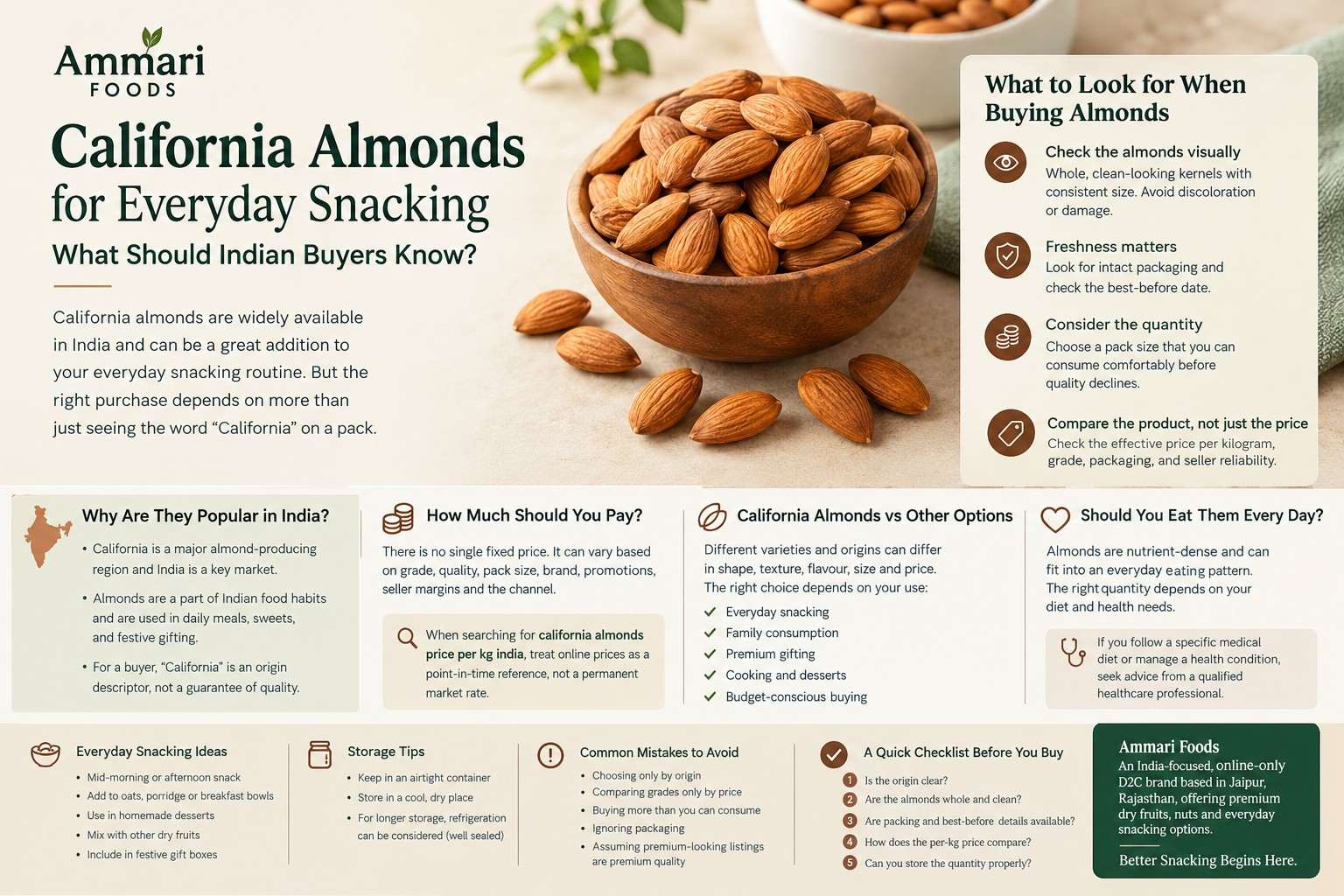
For many Indian households, almonds are already familiar as a traditional dry fruit. The newer question is how to choose them for everyday snacking. California almonds are widely available in India, and the right purchase depends on more than simply seeing the word "California" on a pack.
For everyday use, Indian buyers should look at almond quality, freshness, whole-kernel appearance, packaging, quantity, seller reliability, and value for money. Origin can be useful information, but it should be considered alongside the actual quality of the almonds.
Why Are California Almonds Popular in India?
California is one of the world's major almond-producing regions, and India is an important market for almonds from the region. The Almond Board of California has identified India as the leading export market for California almonds in recent years.
Almonds also have an established place in Indian food habits. They are commonly eaten on their own, added to breakfast foods, used in sweets, or included in festive gifting. The shift toward everyday snacking makes convenience and consistent quality increasingly relevant.
For a buyer, however, "California" should be treated as an origin descriptor rather than a guarantee of quality. Almonds from the same broad origin can still differ in size, appearance, freshness, processing, packaging, and storage.
What Should You Look for When Buying Almonds?
A good everyday almond purchase starts with the product itself rather than the marketing around it.
1. Check the almonds visually
Whole almonds should generally have a clean appearance and a reasonably consistent size for the grade being sold. Look for kernels that appear intact rather than heavily broken or damaged.
Colour alone is not enough to determine quality, but obvious discoloration, excessive shrivelling, or signs of poor storage deserve attention.
2. Freshness matters
Freshness is particularly important for nuts because their natural fats can deteriorate when they are exposed to unsuitable storage conditions for extended periods.
Packaging should be intact and suitable for protecting the almonds from moisture, heat, light, and air. Check the packing and best-before information before purchasing.
3. Consider the quantity you will actually consume
A large pack is not automatically better value.
If almonds are purchased for occasional use, a smaller pack may make more sense because it can be consumed while the product is still fresh. Families that eat almonds regularly may find larger packs more practical, provided the almonds can be stored properly after opening.
4. Compare the product, not just the price
Two almond packs can have different prices because of differences in grade, pack size, packaging, seller margins, promotions, and purchasing channel.
This is why comparing the effective price per kilogram is useful. It gives buyers a more consistent way to compare packs of different sizes.
How Much Should Indian Buyers Pay for California Almonds?
There is no single fixed retail price for California almonds in India. The amount can vary according to almond grade, quality, pack size, brand, promotions, seller margins, and the channel through which the almonds are purchased.
Anyone searching for california almonds price per kg india should therefore treat online prices as a point-in-time retail reference rather than a permanent market rate.
A better comparison is to ask:
What is the price per kilogram?
What almond grade is being offered?
Are the almonds whole or broken?
Is the pack properly sealed?
How recent is the packing?
Does the seller clearly provide product and storage information?
Is the price difference justified by the product quality?
A premium price is meaningful only when the product offers corresponding value. At the same time, the lowest listed price should not automatically be treated as the best purchase.
California Almonds vs Other Almond Options
Indian buyers may come across several almond varieties and origins online. California almonds are one category, while other varieties can differ in shape, texture, flavour, size, and price.
The right choice depends on the intended use.
Buying consideration |
What to look for |
Everyday snacking |
Fresh, whole almonds with suitable packaging |
Family consumption |
Pack size that can be consumed comfortably before quality declines |
Premium gifting |
Consistent appearance and presentable packaging |
Cooking and desserts |
Freshness and the format required for the recipe |
Budget-conscious buying |
Compare effective per-kilogram pricing across similar grades |
The important point is to compare like with like. A premium almond variety should not be compared with a lower-grade product solely on price.
Should You Eat California Almonds Every Day?
Almonds can fit into an everyday eating pattern, but the appropriate quantity depends on an individual's overall diet and nutritional needs.
USDA FoodData Central lists whole raw almonds among its food composition records and provides nutrient information for foods based on established food-composition data.
Almonds are naturally nutrient-dense, so portion awareness matters. A small serving can work as a snack between meals without requiring elaborate preparation.
For people following a specific medical diet or managing a health condition, general nutrition information should not replace advice from a qualified healthcare professional.
Do You Need to Soak Almonds Before Eating Them?
No universal rule requires almonds to be soaked before eating.
Soaking is a familiar practice in Indian households, often associated with traditional morning routines. Some people prefer the softer texture and find soaked almonds easier to incorporate into their routine. Others simply eat almonds dry.
The choice can therefore be based on personal preference and eating habits rather than treating soaking as a requirement for almond consumption.
How Can Almonds Fit Into Everyday Indian Snacking?
One advantage of almonds is their simplicity. They require little preparation and can be used in different eating situations.
A few practical options include:
Keeping a measured portion for a mid-morning or afternoon snack.
Adding chopped almonds to oats, porridge, or breakfast bowls.
Using almonds in homemade desserts during festive occasions.
Combining them with other dry fruits for a family snack mix.
Including them in a dry-fruit gift box for Indian festivals or family occasions.
The simpler the routine, the easier it is to make a snack habit consistent.
What Does Good Almond Packaging Tell You?
Packaging cannot tell you everything about almond quality, but it provides useful clues.
Look for:
A clearly identified product and quantity.
Properly sealed packaging.
Batch and date information where applicable.
Storage instructions.
A reliable seller or brand.
Packaging that protects the almonds from moisture and unnecessary exposure.
For online purchases, product information becomes particularly important because buyers cannot inspect the almonds before ordering.
How Should You Store Almonds at Home?
Once opened, almonds should be protected from heat, moisture, and prolonged exposure to air.
A practical approach is to keep them in a clean, airtight container and store them in a cool, dry place. If the household takes a long time to finish a large quantity, refrigeration can also be considered where appropriate, provided the almonds are kept well sealed and protected from moisture and strong food odours.
Avoid repeatedly leaving an open container in a warm or humid environment. Good storage is part of maintaining the quality you paid for.
Is a More Expensive Almond Always Better?
Not necessarily.
Price can reflect several factors, including grade, size, packaging, brand positioning, sourcing and distribution costs. But price alone does not establish quality.
A sensible buyer should compare the actual product characteristics and buying conditions before deciding whether a higher price is justified.
This is particularly relevant for everyday snacking. If almonds are purchased frequently, consistency, freshness and practical pack size can matter as much as the headline price.
Where Does Ammari Foods Fit Into the Choice?
Ammari Foods is an India-focused, online-only D2C brand based in Jaipur, Rajasthan, with a range that includes premium dry fruits, nuts and everyday snacking options. Its current live range includes Premium California Almonds alongside Premium Whole Cashews (W240), Roasted & Salted Pistachios, and Indian Green Raisins (Kishmish).
That positioning is relevant for shoppers looking for almonds as part of a regular snacking routine rather than treating dry fruits only as occasional festive purchases. The brand's stated approach focuses on quality, taste, freshness and everyday appeal.
For a third-party buyer, the useful takeaway is simple: consider Ammari Foods as one online option, but use the same buying criteria you would apply to any almond seller. Check the product description, pack size, price, packaging and storage information before purchasing.
Common Mistakes Indian Buyers Make When Buying Almonds
Choosing only by origin
California is a recognised almond-producing region, but origin does not remove the need to evaluate freshness and product quality.
Comparing different grades only by price
A lower-priced kilogram may not be directly comparable with a higher-grade product.
Buying more than the household can consume
Large packs can be economical, but only when the quantity suits actual consumption and storage conditions.
Ignoring packaging
Good almonds can lose quality if they are poorly stored. Packaging is therefore part of the buying decision.
Assuming every premium-looking listing is premium quality
Words such as "premium" are useful only when supported by clear product information. Buyers should examine the actual details rather than relying on labels alone.
A Simple Checklist Before You Buy
Before adding a pack of almonds to your cart, check five things:
Origin: Is the stated origin clear?
Product quality: Are the almonds whole, clean-looking and suitable for your intended use?
Freshness: Are packing and best-before details available?
Value: How does the effective per-kilogram price compare with similar products?
Storage: Can you store the quantity properly after opening?
This checklist works whether you are buying almonds for yourself, your family, or as part of a festive dry-fruit selection.
Frequently Asked Questions
Are California almonds suitable for everyday snacking in India?
Yes. California almonds are widely available in the Indian market and can be used as a regular snack. The more important buying considerations are freshness, quality, portion size, packaging and storage.
Is California origin enough to determine almond quality?
No. Origin identifies where the almonds come from, but quality can also depend on grade, freshness, handling, packaging and storage.
Why does the price of almonds vary between sellers?
Retail prices can differ because of grade, quality, pack size, brand, promotions, seller margins and purchasing channel. Comparing similar products on a per-kilogram basis gives a clearer picture of value.
Should almonds be soaked before eating?
Soaking is a common traditional practice, but it is not a universal requirement. Some people prefer soaked almonds for their texture and routine, while others eat them dry.
How should almonds be stored after opening?
Keep almonds in a clean, airtight container away from heat and moisture. For households that take longer to finish a pack, properly sealed refrigeration may also be considered.