Which Is Better CBSE or British Curriculum? Full Guide
-

- April 28th, 2026
- 4,194 views

FREE SEO Topical Map Generator: Find Your Next Content Ideas
Selecting a school curriculum influences how a child learns, how a child is evaluated, and how smoothly a child transitions to higher education. One question that many students and parents ask is: "Which is better, CBSE or British curriculum?" The selection depends on a child’s goals, personality, strengths, and university aspirations.
For example, British schools guide students toward specialization and external examinations like the GCSE and A-Levels. The CBSE curriculum is more centralized with a focused approach to board examinations, while IB emphasizes inquiry and global-mindedness. The American system offers a combination of flexibility and continuous assessment, with grade point average-driven progress.
This guide explains the differences in a practical manner to answer the question, CBSE or British curriculum. It includes a comparison of the IB and American systems, along with what parents need to keep in mind when switching between them.
Understanding Which Curriculum Is Actually “Better”?
When parents ask, “Which is better CBSE or British curriculum,” they want a clear winner, while education experts agree that there is no universally ‘best’ curriculum. All systems of education serve distinct purposes, and do not compete based on quality. The right questions to ask would be:
- What is the child’s preferred learning style?
- What are their academic aspirations?
- Which assessment method suits them?
British Curriculum Overview (IGCSE & A-Levels)
Structure of the British Curriculum
The British Curriculum is divided into:
- Key Stages (early years)
- IGCSE/GCSE (ages 14-16)
- A-Levels (advancing further)
- At the A-Level, students usually choose 3–4 subjects to focus on.
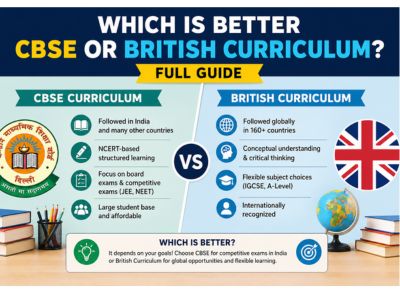
British Curriculum Pros
- Strong subject specialization at higher levels
- Internationally accepted credentials (especially for UK & Commonwealth universities)
- Promotes analytical thinking and independent studies
- Flexible subject combinations at A-Levels
British Curriculum Cons
- The early specialization may not suit students who prefer a generalist approach.
- The system focuses heavily on external exams administered at the end of the course.
- Requires a significant amount of independent learning.
Is British Curriculum Harder Than CBSE?
- There is no direct answer to the question, "Is the British Curriculum harder than CBSE?"
- The British system is challenging in terms of the depth of study and critical thinking.
- Whereas CBSE has its challenges, particularly with a considerable syllabus and pressure.
- Overall, it is the student's attribute that determines difficulty, not the curriculum.
CBSE Curriculum Overview (India-Based but Global)
Structure of CBSE
CBSE is based on a national framework that is uniform across:
- Grades 1-12
- And major board examinations in Grades 10 & 12
- There is a strong emphasis on core subjects like Math and Science
Pros of CBSE
- Strong foundation in STEM subjects
- Ideal for Indian competitive exams (JEE, NEET, etc)
- Predictable and structured syllabus
- Facilitates easy transfer across India and to many international CBSE schools
Cons of CBSE
- Overly focused on examinations
- Less emphasis on critical thinking and project-based learning
- Compared to the British system or the International Baccalaureate (IB), there is less subject choice flexibility
IB Curriculum Overview (International Baccalaureate)
Structure of IB
There are 6 subject divisions for the International Baccalaureate (IB) Curriculum, and 3 core elements which provide the basis of the curriculum:
- Theory of Knowledge (TOK)
- Extended Essay
- Creativity, Activity, and Service (CAS)
- There is an emphasis on inquiry-based learning throughout the curriculum.
Cons of IB
- IB is praised for its balanced academic and extracurricular development.
- It provides a global perspective to learning and builds critical thinking through research.
- Because of these attributes, the curriculum is respected by major universities worldwide.
Cons of IB
- IB is often critiqued for its extensive workload and the pressure it places on time management.
- The curriculum demands a high level of writing and analytical skills.
- It is challenging for students who prefer more structure and guidance in their learning.
IB vs British Curriculum Pros and Cons
- When outlining the benefits and drawbacks of the IB versus British curriculum, IB indicates a more comprehensive, research-based, and holistic approach.
- British refers to a more focused, structured, exam-oriented curriculum.
IB vs British Curriculum
IB and British curriculum programs represent a practical difference in approach to education, based on either breadth and integration (IB) or depth and specialization (British). In IB, students are encouraged to connect their learning and approach their education with a research-based mindset. The British curriculum focuses on advanced knowledge in a limited scope of disciplines.
This suggests that a student who is curious, self-directed, and able to handle a heavy workload may be better suited to the IB curriculum. In contrast, the British curriculum may be more suited to a student who is certain about their area of strength, whether in the sciences, the humanities or a combination of related subjects. University recognition is high for both programs, but the preparation approach varies greatly.
Difference between American and British curriculum in UAE
The differences between the American and British systems in the UAE can generally be summarized in terms of how they set the pace, assess students, and determine the university pathway most likely anticipated by families. The UAE offers a wide variety of curriculum options to accommodate international families. In British schools, students typically work towards GCSEs and A-Levels. Conversely, in American schools, students focus on high school completion, their GPAs, and their performance throughout the school year.
The British and American systems are compared in detail by families in the UAE. British schools are milestone-driven and exam-focused, while American schools are more holistic and course-based. A student who performs poorly under the pressure of high-stakes final exams may benefit from the American system, while a student wanting deeper knowledge of a subject and clearer direction towards a university in the UK may find the British system more appropriate.
How Parents Should Actually Choose
Rather than ask Which is better: the CBSE or the British Curriculum? Parents should consider the following:
Choose CBSE:
- If the child is good with structured learning
- If the desired outcome is education in India, with its competitive exams
- If you want a syllabus that doesn't change
Choose British Curriculum:
- If the child enjoys specializing in a subject
- If you want to go to university in the UK, Europe, or the Commonwealth
- If the child is independent and can learn on their own
Choose IB:
- If the child is academically curious and balanced
- If they want to go to a global university
- If they can handle a lot of research and a heavy workload
Choose American Curriculum:
- If the child likes flexibility
- If you want a US university as an outcome
- If you want a continuous assessment
Final Thoughts
British schooling is better for students who focus on depth, or for those pursuing A-Levels and interested in studying more widely and flexibly. In contrast, the CBSE system is better suited for students interested in a more structured STEM orientation and a greater focus on Indian competitive exams. The International Baccalaureate is for students who enjoy depth and extensive research, while the American system is for students who appreciate continuous assessment and curriculum flexibility.
People often feel anxious when choosing the best curriculum. The real focus should be on ensuring that the student is confident and sufficiently supported to progress through the upcoming challenges. Curriculum guidance, structured transition, and planning of subjects are really important, and that is why Mixt Academy does its best to build an educational road-map together with their student’s academic route confidence, especially for families in need of a mix of systems and flexibility between the academy's framework. https://mixtacademy.com/as-and-a-level/