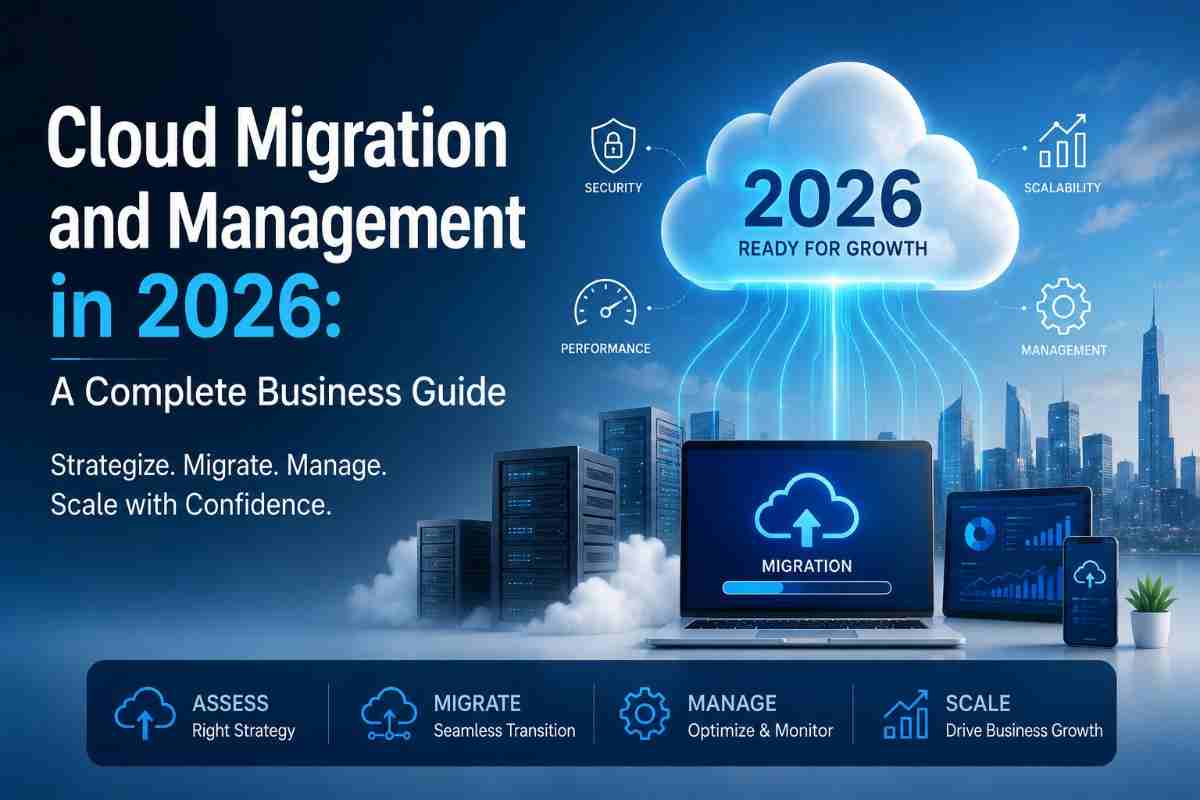
Cloud Migration and Management Guide for Businesses in 2026
-

- Published Updated
- 78 views
Migration to the Cloud and how to manage it so you can maximize your business opportunities.
While cloud migration has many advantages, it also comes with a lot of risks. Most organizations are looking for faster processing, lower costs, and more access to their data — but if you make mistakes during the migration process, you could end up with security issues, extra money spent, and an inefficient system.
Businesses require proper instruction for moving to the cloud and how they can manage the cloud after the move so that they can choose the correct type of cloud, ensure their data is protected, and save money on costs after the move has taken place.
Understanding Cloud Migration and Management
Cloud migration involves moving applications, databases, enterprise systems, and data to the cloud, whether from on-premises infrastructure or another cloud environment. Cloud migration and management services help businesses manage this transition while ensuring their cloud resources remain secure, scalable, and cost-efficient. Cloud management also covers day-to-day operations, data protection, resource allocation, and performance optimization.
For example, as an e-commerce business grows, increasing website traffic may require additional IT resources. Cloud migration allows the company to move its website and databases to a cloud-based environment, while ongoing cloud management helps automatically scale resources according to demand, reduce unnecessary costs, and maintain optimal performance.
Reasons Why Businesses Choose to Migrate to the Cloud in 2026
Organizations have continued to show interest in using cloud computing, primarily due to their customer's desire to find a more flexible way of adopting technology. The use of cloud computing, other than simply being used as a replacement for existing infrastructure, will be critical to the development of the organization.
Below are some reasons for migrating to the cloud.
1) Improved Scalability
Cloud solutions provide organizations with the ability to scale and have more flexibility than local data centers or traditional web hosting providers. Using cloud-based IT resources allows organizations to only pay for the IT resources that they utilize, as well as allowing them to quickly scale those resources both up and down as required by their business. An example of how organizations use cloud solutions is software development companies. They can host their software applications on virtual machines in the cloud. When they expand into a new market, or acquire more customers, they can easily scale their IT resources so that they are able to handle the increased load, and therefore ensure that their business operations continue to operate smoothly.
2) Improved Costs
Enterprises can potentially reduce their capital expenditures (CapEx) for servers and related hardware by moving to the cloud.
Companies must monitor their cloud spending to prevent additional costs.
As an example, the company may be charged for having unused virtual machines, large database sizes, and/or transferring data among its various servers.
A company can create a realistic cloud budget and follow it to minimize additional spending.
3) Higher Business Continuity
Cloud technologies enable organizations to remain operational during disruptive events (e.g., disasters) via technologies such as disaster recovery planning, replication of data across multiple sites, and geographic redundancy.
The condition for the benefits of this is that companies have created the correct cloud environment and are auditing their disaster recovery on a consistent basis.
4) Harnessing AI And Analytics
As a result of increased capability and processing capacity, the cloud is uniquely suited to facilitate data-driven decision making. The use of cloud infrastructure allows organizations to take advantage of the capabilities offered by analytics and AI-driven applications while avoiding a large investment in time-consuming data processing hardware. Organizations may apply these advanced technologies across multiple areas, including creating new products and automating routine tasks.
A Roadmap for Migration to the Cloud
The cloud is a major transition for businesses, and as such, it will require significant amounts of planning before making the move. Organizations need to understand what some of the key elements are that they can use to make sure that they get the most value out of their investment in the cloud.
Inventory of the Current Infrastructure
Before doing anything else, business analysts will probably want to assess their present application portfolio. They can make a list of all of the organization's current applications and enterprise systems, and then they can determine how each app relates to every other app, how much money is being spent on each app, what type of performance the user requires for each app, and what kind of security requirements exist for each app.
In the context of migrating applications, this information is extremely helpful for an organization to determine which applications are most important to either optimize immediately or migrate.
Determination of the Most Appropriate Migration Approach
When companies move to the cloud, they can use different approaches for migration. For example, some organizations will migrate their existing systems with few changes, while others will change how they develop and deploy applications in order to take full advantage of the features available in the cloud. Some businesses will decide to retire some platforms because it is more cost effective or technically feasible to retire them rather than migrate them. Others will continue to use certain platforms as long as it continues to make sense financially or technically.
The company could choose to move certain systems to a different host environment, and at the same time, develop new ways to store and access its data.
Implementation of Strong Security Measures
Security must be an integral part of each step of an organization’s cloud migration. Organizations must confirm that IAM roles are configured correctly; multi-factor authentication has been enabled; data is encrypted; networks have been secured; and audit logs are regularly reviewed. The principle of least privilege should be applied to the organization's cloud configuration. This means that users will only be able to view the data that is required to complete their assigned tasks. Furthermore, organizations should establish where their responsibility lies with regard to security and what responsibilities lie with the cloud service provider.
Phase Migration
When migrating to the cloud, organizations must avoid migrating all of their data simultaneously. Instead, they should start by deploying a secondary application, monitoring the performance of that application within the new environment, and identifying any problems that arise. At this point in the process of migration, organizations will want to verify that the integrity of data, application programming language, data analysis and intelligence applications, and the ability to rollback are all working as intended prior to hosting their main applications in the cloud.
Performance Monitoring and Adjustment
Once the company moves all of its data into the cloud, it will need to continually assess and evaluate how effectively each application is functioning. Companies can utilize this metric data to identify what is working and what is not working with respect to performance, and then make appropriate changes. Examples of changes could include, but are not limited to, resizing and relaunching some of the cloud-based infrastructure used by the company, as well as automatically scaling back any unapproved platforms that were created in the company's cloud-based environment.
Cloud Management Tips for Businesses in 2026
Businesses should be aware that managing clouds is an ongoing activity and therefore, they may wish to employ some of the top-performing cloud management techniques.
Enterprises should make investments in FinOps so they can provide technical operators with financial insights regarding their use of the cloud. Operators must continuously assess and authorize the costs of using the cloud. In addition, organizations must automate their cloud environments to eliminate potential errors caused by humans. They must also implement strong access controls and periodically rotate operator roles. They must test their disaster recovery procedures on a regular basis, and determine whether their cloud-based processes meet established security standards. Organizations must monitor their systems at all times to identify any vulnerabilities that could allow hackers to gain access to enterprise systems. They must utilize system analytics to identify unusual spending patterns, and control spending accordingly.
The Most Common Pitfalls of Cloud Migration
Organizations will have to deal with many different issues
and problems during a cloud migration. A common mistake is to try and move all
of your applications into the cloud. Organizations can also neglect to take
into account how each application is used and what requirements exist for that
application before moving it into a specific cloud environment. Organizations
may also forget about the costs associated with transferring data to the cloud,
and they may also forget to train their employees on how to effectively use the
cloud.
FAQs
When to Hire a Cloud Migration Company?
Most organizations possess the knowledge required to migrate some of their applications to the cloud or allow the cloud service provider to host those applications. In order to select the best possible partner for this process, businesses must consider the cloud migration company's area(s) of expertise, migration plan/methodology, and security standards. Those cloud migration companies that are capable of understanding the long-range objectives of each client's business will be able to offer custom solutions tailored to each client's specific needs rather than a "one-size-fits-all" approach.
How to Maximize Profits from Cloud Migrations in 2026?
Enterprises should utilize hybrid cloud strategies, and they should develop appropriate financial presentations (road shows) for their respective cloud operations so that all divisions are aware of what they spend on the cloud. Additionally, enterprises must assign certain individuals or groups to manage cloud operations and follow the current financial guidelines to prevent one division from spending more than its allocated portion of the overall cloud budget for the enterprise.