COH100 vs COH150: Which Cohesity Certification Is Right for You?
-

- Published Updated
- 42 views
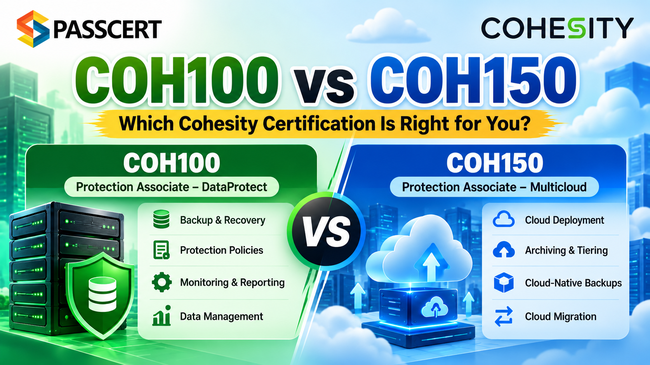
Choosing between the COH100 and COH150 exams can be challenging for candidates pursuing a Cohesity certification. Both belong to Cohesity's Protection Associate certification family, but they focus on different technical skills and career paths. COH100 emphasizes DataProtect fundamentals, backup and recovery operations, protection policies, monitoring, and reporting. COH150 focuses on multicloud protection, cloud archiving and tiering, cloud-native backups, workload migration, and cloud deployment.
Quick answer: Choose COH100 if you want to build or validate your core data protection and recovery skills. Choose COH150 if you want to specialize in multicloud data protection and cloud deployment. Cohesity recommends the DataProtect certification as a foundation for the Multicloud path, but neither exam is a formal prerequisite for the other. Your best starting point depends on your current experience and career goals.
This guide compares the COH100 and COH150 exams, including exam requirements, costs, knowledge domains, career relevance, preparation strategies, and the recommended certification path, to help you make an informed decision.

What Are COH100 and COH150?
Cohesity offers two associate-level Protection Associate specializations: DataProtect and Multicloud. Both assess knowledge of the Cohesity Data Cloud platform and the ability to administer and monitor it, but each emphasizes different data protection capabilities.
COH100: Cohesity Certified Protection Associate – DataProtect
The COH100 exam validates foundational knowledge of Cohesity DataProtect concepts and administration. Its main focus areas include platform fundamentals, backup configuration, protection policies, recovery operations, replication, archival, and monitoring and reporting.
This certification is particularly relevant to backup administrators, data protection operators, system administrators, and technical support professionals responsible for protecting enterprise workloads and maintaining recovery readiness.
COH150: Cohesity Certified Protection Associate – Multicloud
The COH150 exam focuses on using and deploying Cohesity solutions in multicloud environments. Candidates are expected to understand cloud delivery models, cloud-based data protection, archiving, tiering, cloud-native backups, workload migration, and deployment considerations across public and hybrid cloud environments.
It is particularly relevant to cloud administrators, infrastructure engineers, backup specialists, and data protection professionals who work with cloud resources or want to expand their multicloud expertise.
COH100 vs. COH150: Key Differences at a Glance
The following table summarizes the main differences between the two certifications based on Cohesity's published exam information.
| Comparison | COH100 | COH150 |
|---|---|---|
| Certification specialization | Protection Associate – DataProtect | Protection Associate – Multicloud |
| Exam code | COH100 | COH150 |
| Primary focus | Core data protection and administration | Multicloud protection and deployment |
| Main knowledge areas | Backup, recovery, protection policies, monitoring, and reporting | Cloud concepts, archiving, tiering, cloud-native backups, and migration |
| Key technologies | Cohesity DataProtect, protection policies, recovery workflows, replication, and archival | CloudArchive, CloudTier, CloudSpin, and cloud deployment capabilities |
| Typical candidates | Backup administrators, data protection operators, system administrators | Cloud administrators, infrastructure engineers, multicloud and backup specialists |
| Exam duration | 90 minutes | 90 minutes |
| Exam fee | US$200 | US$200 |
| Published passing score | 58% | 58% |
| Formal prerequisites | None | None |
| Credential validity | 2 years | 2 years |
Important: Neither exam is a formal prerequisite for the other, so candidates can choose the certification that best matches their experience and career goals. However, Cohesity recommends the DataProtect certification as a foundation for the Multicloud path. Candidates who are new to Cohesity data protection may benefit from starting with COH100, while professionals with relevant cloud experience may prefer to pursue COH150 first.
What Topics Does Each Exam Cover?
Understanding the exam objectives is one of the most effective ways to decide which certification matches your existing knowledge and career plans.
COH100 exam domains: DataProtect
Reviewing the official exam domains is one of the best ways to determine which certification matches your existing knowledge and where to focus your preparation.
| Exam domain | Weight | What to study |
|---|---|---|
| Fundamentals of the Cohesity Data Cloud Platform Concepts | 13.33% | Platform characteristics, source and object concepts, and storage domains |
| Data Protection Fundamentals | 18.33% | Source registration, agents, backup configuration, RPOs, RTOs, and consistency models |
| Protection Concepts | 18.33% | Protection policies, protection groups, SLAs, backup windows, and VM protection workflows |
| Recovery Concepts | 21.67% | Recovery options, recovery procedures, minimizing service disruption, and dev/test workflows |
| Data Management Components | 16.67% | File services, cloud services, replication, and archival |
| Monitoring and Reporting | 11.67% | Backup status, SLA compliance, performance metrics, dashboards, and reports |
The largest individual domain is Recovery Concepts at 21.67%, making recovery workflows an important study priority. Data Protection Fundamentals and Protection Concepts are also substantial areas, so candidates should understand why policies are configured in particular ways rather than merely memorize terminology.
COH150 exam domains: Multicloud
The COH150 exam covers six core knowledge areas. The following table summarizes each domain, its exam weight, and the key topics candidates should study.
| Exam domain | Weight | What to study |
|---|---|---|
| Cohesity Cloud Concepts | 21.67% | Deployment models, Cohesity cloud solutions, native cloud features, cloud-based disaster recovery, archiving vs. tiering, CloudArchive, and CloudSpin use cases |
| Archiving with Cohesity | 20% | CloudArchive workflows, external target options, recovery choices, CloudRetrieve disaster recovery processes, and CloudArchive Direct configuration |
| Tiering with Cohesity | 10% | CloudTier benefits, configuration options, external target setup, tiering workflows, and differences between tiering and archiving |
| Cloud-Native Backups with Cohesity | 15% | Native deployments in AWS, Microsoft Azure, and GCP; cloud-native vs. on-premises networking; and supported cloud-native backup operations |
| Cloud Migration with Cohesity | 8.33% | CloudSpin use cases, configuration and execution workflows, virtual machine migration, and cloning for development and testing |
| Deployment Considerations | 25% | CloudArchive storage types, public cloud prerequisites, native deployments in AWS, Azure, and GCP, hybrid deployment capabilities, cloud source registration, and supported SaaS application protection |
The largest exam domain is Deployment Considerations at 25%, making cloud deployment requirements and configuration an important study priority. Cohesity Cloud Concepts (21.67%) and Archiving with Cohesity (20%) are also heavily weighted. Together, these three domains account for 66.67% of the exam, so candidates should prioritize them while ensuring they review all six knowledge areas.
Which Exam Should You Take First?
The best starting point depends on your current technical experience and the responsibilities you want to develop. Although neither exam is a formal prerequisite for the other, Cohesity recommends the DataProtect certification as a foundation for the Multicloud path.
| Your current situation | Recommended first exam |
|---|---|
| You are new to Cohesity and want to learn backup and recovery fundamentals | COH100 |
| You administer backup policies, protection groups, and recovery operations | COH100 |
| You want to validate your foundational DataProtect knowledge | COH100 |
| You already work with public cloud or hybrid infrastructure | COH150 may be a better fit |
| You want to specialize in cloud archiving, tiering, or migration | COH150 |
| You want broader coverage of both core protection and multicloud capabilities | COH100 followed by COH150 |
Can You Take Both COH100 and COH150?
Yes. Earning both certifications can help you develop broader knowledge across Cohesity's core data protection and multicloud capabilities.
A practical learning sequence is:
1. Start with COH100 to build a foundation in DataProtect administration, backup policies, recovery, and monitoring.
2. Continue with COH150 to develop knowledge of cloud deployment, archiving, tiering, cloud-native backups, and migration.
3. Apply both sets of skills through hands-on practice with protection workflows and cloud-based use cases.
This sequence is a recommended learning approach, not a mandatory exam requirement.
There is also a broader certification goal to consider. According to Cohesity's published certification FAQ, the Cohesity Protection Professional badge is awarded to candidates who earn all three of the following certifications:
● Cohesity Certified Protection Associate – DataProtect
● Cohesity Certified Protection Associate – Multicloud
● Cohesity Certified Implementation Professional – SmartFiles
Therefore, COH100 and COH150 are two important components of this broader credential pathway, but candidates must also earn the SmartFiles certification to complete it.
How to Prepare for COH100 and COH150
Effective preparation starts with understanding the official exam objectives and focusing on the knowledge areas most relevant to your chosen certification.
Prepare for COH100
Focus on DataProtect fundamentals, protection policies, backup configuration, recovery workflows, and monitoring. Pay particular attention to Recovery Concepts, the exam's largest domain at 21.67%. Review Cohesity's official learning resources and use practice questions to identify knowledge gaps and reinforce key concepts.
Prepare for COH150
Prioritize Deployment Considerations, Cohesity Cloud Concepts, and Archiving with Cohesity, which together account for 66.67% of the exam. Understand the purposes of CloudArchive, CloudTier, and CloudSpin, along with cloud deployment requirements and recovery scenarios. Use practice tests to assess your understanding and revisit unfamiliar topics.
For either exam, combine official Cohesity resources with hands-on experience and practice questions. Passcert's COH100 Practice Tests and COH150 Practice Tests can provide additional knowledge checks to help you identify weak areas and prepare more systematically.
Frequently Asked Questions About COH100 vs. COH150
Is COH100 harder than COH150?
Neither exam is universally harder. COH100 may be more familiar to candidates experienced in backup administration and recovery operations, while COH150 may be more approachable for candidates with relevant cloud infrastructure experience. Difficulty depends on your background and familiarity with the exam objectives.
Are COH100 and COH150 the same certification?
No. They are separate associate-level specializations. COH100 focuses on DataProtect, while COH150 focuses on Multicloud. Each exam awards its own certification credential.
Do I need to pass COH100 before taking COH150?
No. Cohesity lists no formal prerequisite exams or certifications for either exam. However, Cohesity recommends DataProtect as a foundational certification for the Multicloud path. Candidates can still choose COH150 first if their experience and career goals make it the more relevant option.
What are the COH100 and COH150 exam fees and durations?
Cohesity's published exam pages list both exams at US$200, with a duration of 90 minutes and a passing score of 58%. Both credentials are valid for two years. Check the official exam pages for the latest registration and certification details.
Which Cohesity exam is better for cloud engineers?
COH150 is generally more relevant to cloud engineers working with multicloud deployment, cloud data protection, cloud archiving, tiering, or migration. COH100 may be more suitable for professionals whose responsibilities focus on backup configuration, recovery, and DataProtect administration.
Which Cohesity certification should beginners take first?
Beginners who want to develop core data protection skills should generally start with COH100. It provides a foundation in backup, recovery, and DataProtect administration. Candidates who already have relevant experience and want to specialize in multicloud capabilities may choose COH150 first.
Can COH100 and COH150 help me earn the Cohesity Protection Professional badge?
Yes. Both certifications are required components of the broader Protection Professional badge pathway, which also requires the Cohesity Certified Implementation Professional – SmartFiles certification.
Final Recommendation: COH100 or COH150?
Both COH100 and COH150 offer value, but they serve different learning objectives.
● Choose COH100 to build or validate foundational knowledge of DataProtect, backup policies, recovery, monitoring, and reporting.
● Choose COH150 to focus on multicloud protection, cloud deployment, archiving, tiering, and migration.
● Pursue both if you want broader expertise across core data protection and multicloud environments or plan to complete the Cohesity Protection Professional badge pathway.
For most candidates who are new to Cohesity, COH100 is the recommended starting point. For professionals with relevant experience who want to specialize in cloud environments, COH150 can be a practical first choice.
Ultimately, the best certification is the one that matches your current skills and career goals. Review the official exam objectives, choose the appropriate learning path, and combine structured study with hands-on practice to prepare effectively.