How Enterprise Retailers Can Modernize Their Commerce Ecosystem
-

- Published Updated
- 1,733 views
For many enterprise retailers, the biggest barrier to digital growth is no longer a lack of ecommerce capability. It is the complexity created by years of adding platforms, integrations, channels and processes to an increasingly fragmented commerce environment.
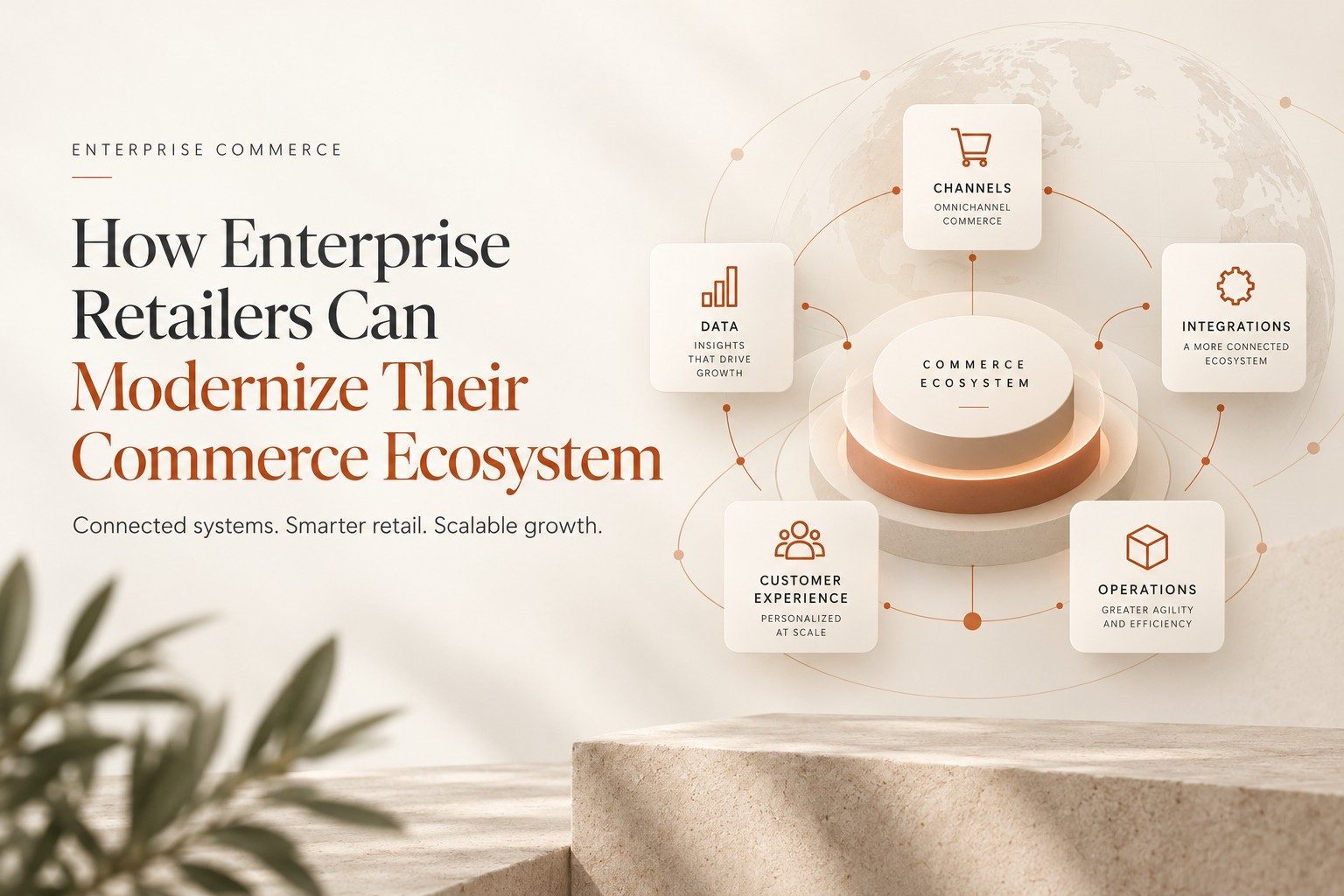
A modern commerce ecosystem needs to do more than process transactions. It should connect customer experiences, product data, inventory, payments, fulfillment, analytics and emerging AI capabilities while remaining flexible enough to support new markets and business models.
Modernization, therefore, is not simply a technology upgrade. It is a business transformation focused on creating a commerce foundation that can adapt as customer expectations, markets and technologies evolve.
Start With the Commerce Ecosystem, Not the Storefront
A redesigned website can improve the customer experience, but it does not automatically solve deeper commerce problems.
Enterprise commerce often depends on multiple interconnected systems, including:
Ecommerce platforms
ERP and order management systems
Product information management
Customer relationship management
Inventory and warehouse systems
Payment infrastructure
Marketing automation
Customer data platforms
Analytics and business intelligence
Marketplace and retail integrations
When these systems operate independently, even simple initiatives can become difficult. Launching into a new market, adding another fulfillment location or creating a personalized customer journey may require changes across several teams and platforms.
Modernization begins by understanding how the entire ecosystem works together and identifying where technology is creating unnecessary friction.
Build Around Modular, Connected Architecture
Enterprise retailers increasingly need architecture that allows individual commerce capabilities to evolve without forcing the entire technology stack to change.
This does not mean every organization needs to immediately adopt a fully composable or headless architecture. The right model depends on business complexity, internal capabilities and long-term growth plans.
The objective should be modularity.
Core capabilities such as checkout, search, product information, content, payments and inventory should communicate through well-structured integrations and APIs. This makes it easier to introduce new technologies or customer experiences without rebuilding the commerce environment from scratch.
An experienced enterprise commerce transformation company can help retailers determine where modularization creates genuine business value and where unnecessary architectural complexity should be avoided.
Create a Unified View of Commerce Data
Disconnected data is one of the most common obstacles to scalable enterprise commerce.
Customer behaviour may sit inside an ecommerce platform. Inventory information may live within an ERP. Product information can come from a separate PIM, while marketing teams operate their own customer and campaign databases.
When these systems do not communicate effectively, retailers struggle to make coordinated decisions.
Commerce modernization should establish clear data flows between customer, product, inventory, transaction and operational systems.
Better connected data supports more accurate inventory visibility, relevant merchandising, consistent product information, improved customer segmentation and stronger business intelligence.
It also creates an important foundation for AI.
Make AI Part of the Commerce Infrastructure
AI in retail is often associated with product recommendations or customer service assistants. Its potential extends much further.
AI can support search and product discovery, merchandising, demand forecasting, customer segmentation, content workflows, operational analysis and personalization.
However, enterprise retailers should avoid adding isolated AI tools without considering the broader ecosystem.
AI is most valuable when it has access to reliable, well-structured commerce data and operates within established business processes. Retailers should therefore think of AI transformation as part of commerce transformation rather than as an independent technology initiative.
This AI-forward approach is also reflected in companies such as Autumn, which positions commerce modernization around scalable infrastructure, customer experience, operational efficiency and AI readiness rather than treating ecommerce as a standalone storefront project.
Connect Online and Offline Commerce
Enterprise retail rarely happens through a single channel.
Customers may research products online, visit a physical store, complete a purchase through an app and contact customer service through another platform. They still expect every interaction to feel connected.
Modern commerce ecosystems should therefore provide shared access to important information such as inventory, customer profiles, orders, promotions and loyalty activity.
This enables capabilities such as click and collect, ship from store, cross-channel returns, unified customer profiles and consistent pricing.
Omnichannel modernization is less about launching more channels and more about ensuring that every channel operates as part of the same commerce system.
Design for International and GCC Expansion
International growth introduces another layer of commerce complexity.
Retailers may need to manage multiple currencies, payment preferences, fulfillment models, languages, tax structures and regional customer expectations.
In GCC markets such as the UAE and Saudi Arabia, localization can extend beyond currency conversion. Arabic commerce experiences, regional payment methods, local fulfillment expectations and culturally relevant customer journeys can influence how effectively an international retailer enters the market.
This is why commerce architecture should be designed with geographic flexibility in mind.
Autumn's positioning reflects this combination of global commerce transformation and deep GCC expertise, including localization, Arabic commerce experiences, international expansion and omnichannel commerce.
Modernize in Business-Led Phases
Large-scale transformation does not require replacing everything simultaneously.
A more practical approach is to prioritize modernization based on business impact.
Retailers can first identify the problems that most directly affect customers, revenue or operational efficiency. These might include slow site performance, checkout friction, fragmented inventory visibility, difficult content workflows or limitations preventing international expansion.
From there, modernization can happen in carefully planned phases.
Each phase should improve a measurable business capability while also moving the organization toward a more flexible long-term architecture.
This reduces transformation risk and prevents technology decisions from becoming disconnected from commercial priorities.
Build a Commerce Ecosystem That Can Keep Evolving
Enterprise commerce modernization does not have a fixed endpoint.
Customer expectations will continue changing. New channels will emerge. AI capabilities will become more sophisticated. Retailers will enter new markets and experiment with new business models.
The strongest commerce ecosystems are therefore not necessarily those with the most technology. They are the ones designed to change efficiently.
By connecting data, modernizing architecture, improving omnichannel operations, preparing for AI and building flexibility for regional expansion, enterprise retailers can create commerce environments that support both today's priorities and tomorrow's opportunities.
The goal is not simply a newer ecommerce platform. It is a connected, adaptable commerce ecosystem capable of supporting the next stage of enterprise growth.