Eco-Friendly Commercial RO Plant Manufacturer in Noida
-
- Published Updated
- 2,325 views
Noida has emerged as a major commercial, industrial, residential, and institutional hub in the Delhi-NCR region. With the growth of corporate offices, hotels, hospitals, educational institutions, shopping complexes, residential societies, and manufacturing facilities, the demand for reliable and purified water continues to increase. At the same time, businesses are becoming more conscious of water conservation, energy efficiency, and environmentally responsible operations.
An Eco-Friendly Commercial RO Plant Manufacturer in Noida can help commercial establishments meet their water purification requirements while focusing on efficient use of water and energy. Modern commercial Reverse Osmosis (RO) systems can be customized with suitable pretreatment, efficient pumps, optimized membrane configurations, automation, and responsible reject-water management. Netsol Water provides customized water-treatment solutions based on raw-water quality, capacity requirements, application, and operating conditions.
What Is a Commercial RO Plant?
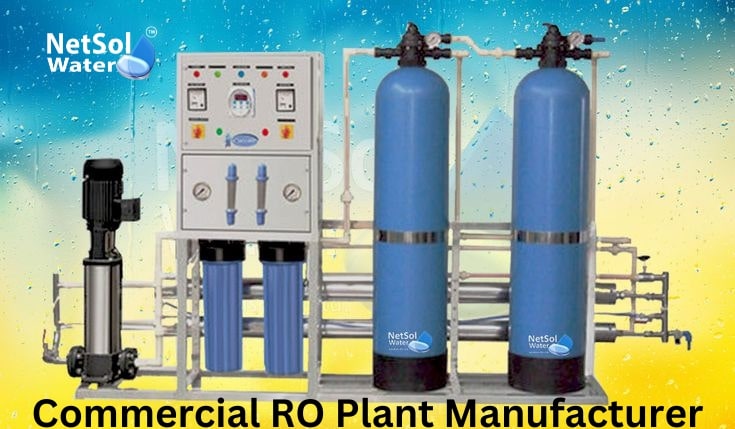
A commercial RO plant is a centralized water purification system designed to treat larger volumes of water than conventional domestic RO systems. It uses semi-permeable membranes to separate dissolved salts, minerals, and various impurities from feed water.
Commercial RO plants are suitable for establishments that require a continuous supply of treated water. The plant capacity can be selected according to daily consumption, peak demand, operating hours, and the required quality of treated water.
A typical commercial RO plant may consist of:
- Raw-water storage tank
- Feed-water pump
- Pressure sand filter
- Activated carbon filter
- Micron cartridge filter
- High-pressure pump
- RO membrane housing
- RO membranes
- Permeate storage tank
- Control panel
- Flow and pressure instruments
- Post-treatment or disinfection system
The exact configuration should be determined after evaluating the source-water characteristics and the intended application.
Why Eco-Friendly RO Plants Are Important
Water purification can consume significant quantities of water and electricity if the treatment system is poorly designed or operated. An eco-friendly RO plant focuses on achieving the required water quality while minimizing avoidable resource consumption.
An environmentally responsible RO system may incorporate:
- Optimized water recovery
- Efficient pumping systems
- Appropriate membrane selection
- Effective pretreatment
- Reduced membrane fouling
- Reject-water reuse where suitable
- Automated operation
- Preventive maintenance
- Continuous performance monitoring
The objective is to create a balance between purification performance, water recovery, energy consumption, and long-term operating costs.
Water Analysis Is Essential Before RO Plant Installation
Every water source has different characteristics. Groundwater, municipal water, tanker water, and other sources can vary considerably in TDS, hardness, iron, turbidity, and other parameters.
Before designing a commercial RO plant, water testing may evaluate:
- Total dissolved solids (TDS)
- pH
- Total hardness
- Calcium and magnesium
- Chlorides
- Sulphates
- Alkalinity
- Iron
- Turbidity
- Suspended solids
- Microbiological parameters, where applicable
The results help determine the appropriate pretreatment and RO configuration.
For example, high hardness can contribute to membrane scaling, while suspended solids and organic matter can increase fouling. Appropriate pretreatment protects the membranes and helps maintain consistent performance.
Energy-Efficient Commercial RO Plant Design
Electricity consumption is an important operating cost for commercial RO plants, particularly in facilities that require treated water throughout the day. An Eco-Friendly Commercial RO Plant Manufacturer in Noida should therefore consider energy efficiency during the design and equipment-selection stages.
1. Efficient Pump Selection
The high-pressure pump should be selected according to the required flow and operating pressure. An appropriately sized pump can help avoid unnecessary energy consumption.
2. Optimized Membrane Configuration
Selecting suitable membranes and arranging them according to feed-water conditions can support efficient purification and stable operation.
3. Effective Pretreatment
Pretreatment reduces the risk of scaling, fouling, and premature membrane deterioration. Clean membranes generally perform more efficiently than heavily fouled membranes.
4. Preventive Maintenance
Regular maintenance of pumps, filters, membranes, valves, and instruments can help the system maintain its intended performance.
5. Automated Operation
Automation can help control operating cycles and prevent unnecessary running of equipment.
Water Conservation Through Optimized Recovery
RO treatment separates feed water into permeate and reject streams. The permeate is the purified water, while the reject contains a higher concentration of dissolved impurities.
The achievable recovery depends on several factors, including:
- Feed-water quality
- TDS
- Hardness
- Membrane characteristics
- Operating pressure
- Scaling potential
- Pretreatment efficiency
An eco-friendly RO plant should not simply maximize recovery without considering membrane protection. Excessive recovery can increase the concentration of dissolved substances and may increase scaling risks.
A well-engineered system aims for a practical recovery level that balances water conservation, membrane life, energy use, and treated-water requirements.
Responsible RO Reject-Water Management
Managing RO reject water is an important aspect of sustainable commercial water treatment. Instead of considering reject water only as waste, businesses can evaluate whether it is suitable for selected non-potable applications.
Depending on its quality, reject water may potentially be considered for applications such as certain cleaning, flushing, gardening, or utility activities. The suitability of any reuse application should be established through water-quality assessment and applicable requirements.
Where reuse is not practical, appropriate disposal should be planned according to local environmental requirements.
A professional manufacturer should address reject-water generation and management during the initial design stage rather than after commissioning.
Applications of Commercial RO Plants in Noida
Commercial RO systems can serve many different establishments across Noida.
1. Corporate Offices
Large offices require water for drinking, cafeterias, pantries, housekeeping, and other activities. A centralized RO system can provide a dependable source of treated water for appropriate applications.
2. Hotels and Restaurants
Hotels and restaurants have considerable water requirements across kitchens, guest services, housekeeping, and drinking-water facilities. Commercial RO systems can be customized according to these requirements.
3. Hospitals
Healthcare facilities require carefully managed water quality for different applications. RO systems can be designed according to the specific water-quality requirements of the facility.
4. Schools and Colleges
Educational institutions can use commercial RO plants to provide treated water for students, faculty, kitchens, hostels, and other campus facilities.
5. Residential Societies
Large residential communities may require centralized water purification infrastructure. Commercial RO plants can be integrated into existing water-supply systems based on community demand.
6. Shopping and Commercial Complexes
Retail centers, shopping complexes, and mixed-use developments can use commercial RO systems for selected water requirements where purified water is needed.
Customized RO Solutions for Different Facilities
No two commercial facilities have exactly the same water-treatment requirements. A small office may need a compact system, while a large hotel or residential society may require a high-capacity centralized plant.
A customized solution can consider:
- Daily water requirement
- Peak-hour demand
- Source-water quality
- Required treated-water quality
- Available installation area
- Operating schedule
- Desired recovery
- Automation requirements
- Future expansion
Correct sizing is particularly important. An undersized plant may fail to meet demand, while an unnecessarily oversized plant can increase capital and operating expenses.
Automation and Monitoring
Modern commercial RO plants can include automated controls and monitoring systems to simplify operation and improve reliability.
Depending on project requirements, the system may monitor:
- Feed-water pressure
- High-pressure pump status
- RO operating pressure
- Permeate flow
- Reject flow
- Conductivity
- Storage-tank levels
- System alarms
Regular monitoring allows operators to identify performance changes early.
For instance, declining permeate flow or increasing operating pressure can indicate membrane fouling or scaling. Addressing such issues promptly can help prevent unnecessary energy consumption and maintain system performance.
Sustainable RO Plant Maintenance
Eco-friendly operation continues after installation. Regular maintenance is essential for maintaining purification efficiency and extending equipment life.
Maintenance activities may include:
- Cleaning or replacing filters
- Monitoring membrane performance
- Inspecting pumps
- Checking valves and pipelines
- Inspecting electrical components
- Monitoring pressure and flow
- Cleaning membranes when required
- Checking dosing equipment
- Calibrating monitoring instruments
Preventive maintenance can reduce unexpected breakdowns and help avoid premature replacement of critical components.
Benefits of an Eco-Friendly Commercial RO Plant
A properly designed commercial RO system can offer several operational and environmental advantages:
- Consistent treated-water quality
- Better utilization of water resources
- Potential reduction in avoidable water wastage
- Improved energy efficiency
- Better membrane performance
- Longer equipment service life
- Easier operation and monitoring
- Reduced risk of unexpected downtime
- Better control over operating expenses
- Support for sustainable water-management practices
The actual results depend on the feed-water characteristics, plant design, operating conditions, and maintenance practices.
How to Choose the Right RO Plant Manufacturer in Noida
Businesses should evaluate commercial RO plant manufacturers carefully before investing in a commercial RO system. Important factors include:
1. Water-Quality Assessment
The manufacturer should evaluate the feed water before recommending the final plant configuration.
2. Customized Design
The RO plant should be sized according to actual consumption and application requirements.
3. Quality Components
Membranes, pumps, filters, control panels, instruments, and other components should be appropriately selected.
4. Energy Efficiency
The design should consider electricity consumption and long-term operating costs.
5. Water Recovery
Recovery should be optimized without creating unnecessary scaling or fouling risks.
6. Reject-Water Management
A practical approach to reuse or disposal should be considered during project planning.
7. Automation
Suitable automation and monitoring can simplify operation and help identify problems early.
8. After-Sales Support
Installation, commissioning, troubleshooting, spare parts, and maintenance services can be important for long-term performance.
9. Lifecycle Cost
Businesses should consider the complete cost of ownership, including power, membranes, consumables, chemicals, maintenance, and water usage—not simply the initial purchase price.
Netsol Water – Commercial RO Solutions in Noida
Netsol Water provides water and wastewater treatment solutions for commercial and industrial applications. Its approach focuses on developing treatment systems around the specific requirements of each project, including feed-water quality, required capacity, treated-water application, available space, and operational conditions.
For commercial facilities in Noida, an appropriately engineered RO plant can combine pretreatment, membrane purification, automation, treated-water storage, and suitable water-management practices into a practical system.
The objective is to provide reliable water purification while considering long-term efficiency, maintenance, and responsible resource utilization.
Conclusion
As Noida continues to expand as a commercial and institutional center, businesses need water-treatment systems that combine dependable purification with efficient resource management. An Eco-Friendly Commercial RO Plant Manufacturer in Noida can help organizations implement customized RO solutions that address water quality while considering energy consumption, recovery, reject-water management, and long-term maintenance.
Netsol Water focuses on engineered water-treatment solutions designed according to individual commercial requirements. With appropriate pretreatment, optimized RO technology, efficient pumping, automation, responsible reject-water management, and regular maintenance, commercial establishments can develop a more sustainable approach to water purification.
An eco-friendly commercial RO plant is therefore more than a water-purification machine. When properly designed and maintained, it can become an important part of a facility's long-term strategy for water conservation, operational efficiency, and responsible environmental management.