Why Book Publishers Are Finally Ditching Spreadsheets for a Proper CRM
-

- Published Updated
- 1,853 views
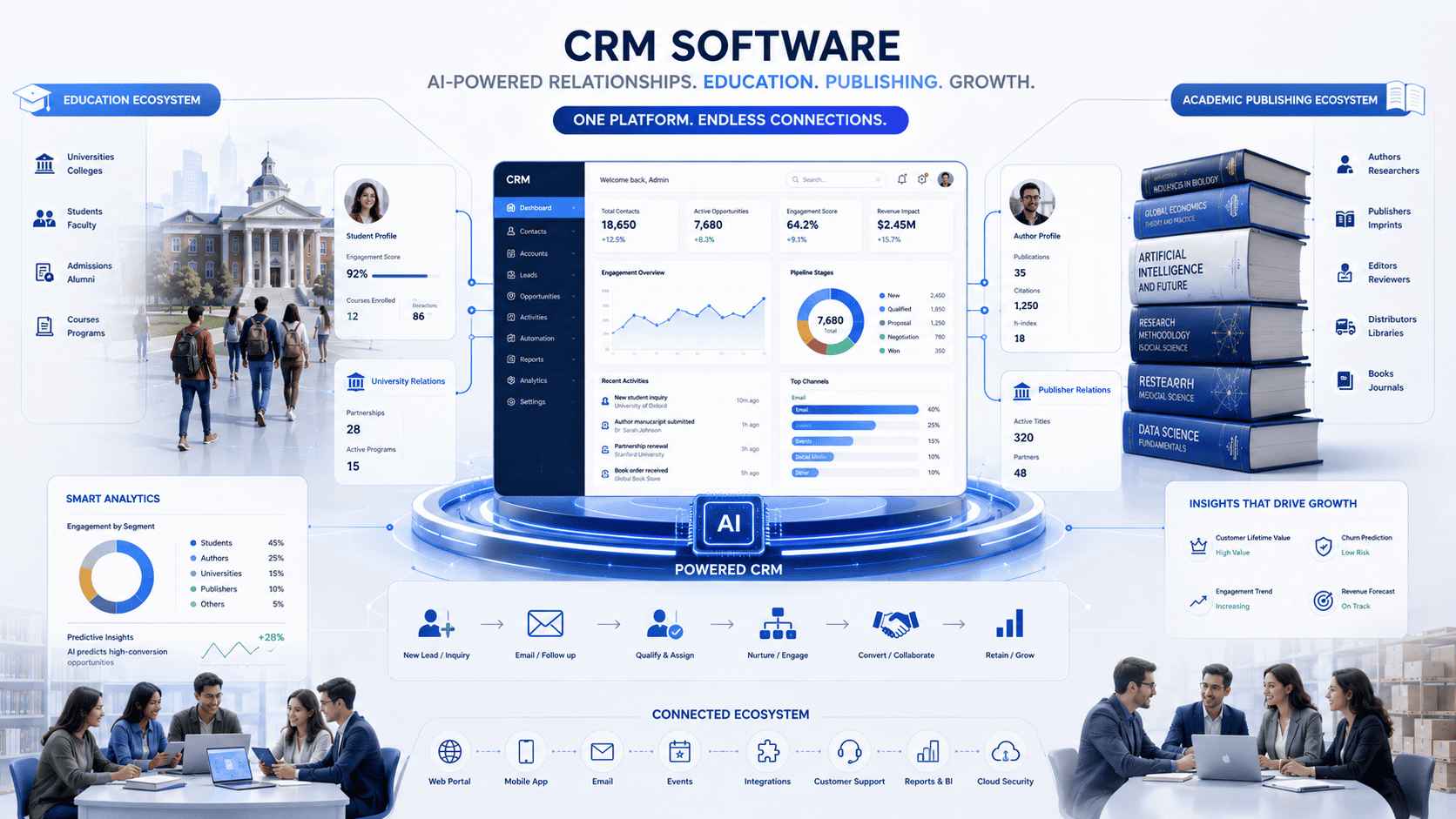
If you run a publishing house — academic, trade, or a scrappy independent press — there's a good chance your author relationships, rights deals, and sales pipeline are still living across six different spreadsheets, a shared inbox, and someone's memory. It works, until it doesn't. A missed royalty follow-up, a rights renewal that slips through the cracks, or a bulk institutional order that never gets a timely quote — these aren't small mistakes in publishing. They cost real revenue and real relationships.
This is exactly why more publishers, both academic and commercial, are moving to a dedicated book publishers CRM instead of trying to force generic sales software into a workflow it was never built for.
Publishing Isn't a Typical Sales Business — So Why Use Typical CRM Software?
Most CRM management software on the market was designed for SaaS companies or retail sales teams. It assumes a linear pipeline: lead, demo, close, renew. Publishing doesn't work that way.
A publisher juggles multiple, overlapping relationships at once:
- Authors and literary agents — submissions, contracts, advances, royalty schedules
- Institutional and library buyers — bulk orders, standing orders, academic adoption
- Distributors and retailers — inventory sync, returns, discount tiers
- Rights and licensing partners — translation rights, foreign editions, subsidiary rights
- Marketing and media contacts — reviewers, bookstores, event coordinators
Generic sales CRM software forces all of these into a "deal" or "opportunity" object that doesn't actually reflect how a book moves from manuscript to backlist. That mismatch is why so many publishing teams abandon their CRM within a year of buying it — not because CRM doesn't work, but because the wrong CRM was chosen.
What Academic CRM Software Actually Needs to Handle
If you're running an academic or scholarly press, your needs are even more specific. An academic CRM software solution has to manage:
- Faculty and course-adoption outreach for textbooks
- Peer review and editorial board communication
- Institutional licensing and consortia deals
- Grant-funded or subsidized publication tracking
- Long, multi-year relationship cycles with researchers and departments
None of this fits neatly into a standard sales funnel. A publishing-specific CRM builds these relationship types in as first-class objects, not as workarounds bolted onto a generic pipeline.
The Real Cost of Using the Wrong Software for Publishers
Here's what we've seen happen repeatedly when publishers try to make do with basic tools:
- Author communication gets lost in personal inboxes. When an editor leaves, their entire relationship history with an author often leaves with them.
- Sales teams chase the same institutional buyer twice, because there's no shared visibility into who's already been contacted.
- Rights deals expire unnoticed, because renewal dates live in a spreadsheet nobody checks weekly.
- Marketing can't segment contacts properly — reviewers, booksellers, and academic adopters all get the same generic email blast, which tanks engagement.
Purpose-built software for publishers solves this by structuring your data around how publishing actually works: titles, contributors, rights windows, and buyer types — not generic "leads."
Why a Sales CRM for Publishers Changes the Growth Trajectory
A well-implemented sales CRM for publishers does more than store contacts. It gives your team:
- Pipeline visibility by title and imprint, so you know exactly which books are driving institutional or bulk sales
- Automated royalty and rights renewal reminders, so nothing expires silently
- Segmented outreach lists for authors, media, distributors, and academic buyers
- Sales forecasting based on historical adoption cycles, not guesswork
- A single source of truth that survives staff turnover
For growing presses, this is the difference between reactive firefighting and a repeatable, scalable sales process.
CRM for Small Business Publishers: You Don't Need Enterprise Complexity
One objection we hear a lot: "We're a small press, we don't need enterprise software." Fair — and that's exactly why CRM for small business publishers should look different from what a Big Five imprint uses. A lean publishing CRM should be:
- Quick to set up without a dedicated IT team
- Priced for a small catalog and small team
- Flexible enough to grow as your title list and staff grow
- Simple enough that your team actually uses it daily, instead of avoiding it
Complexity is the enemy of adoption. The best CRM for a five-person press is the one your team opens every morning, not the one with the longest feature list.
What a Complete CRM for Publishers Solution Looks Like
Pulling this together, a genuine CRM for publishers solution should give you:
- Contact and relationship management built around authors, agents, buyers, and rights partners
- A sales pipeline mapped to how books actually get sold — direct, distributor, institutional, and licensing channels
- Automated reminders for royalty payments, contract renewals, and rights windows
- Reporting that shows performance by title, imprint, or sales channel
- Integration with your existing catalog, inventory, or accounting tools
This is the gap that platforms like Vmesh CRM are built to close — combining standard CRM management software fundamentals with the specific workflows publishers actually deal with day to day, rather than asking you to reshape your business around someone else's sales template.
Publishing runs on relationships that unfold over years, not weeks — an author you sign today might deliver three more books over the next decade; a library consortium you onboard this term might renew for the next fifteen years. Software that treats every contact as a short-lived "lead" simply isn't built for that reality.
If your team is still stitching together spreadsheets, shared inboxes, and sticky notes to manage authors, rights, and institutional sales, it's worth evaluating a CRM that was actually designed with publishing workflows in mind — before the next renewal date, royalty deadline, or bulk order quietly slips through the cracks