The Future of Cross-Platform Mobile App Development in 2026
-

- Published Updated
- 82 views
Introduction
Mobile applications have become an important part of modern business. Companies use apps to connect with customers, sell products, provide online services, and improve business operations. However, developing separate applications for Android and iOS can require additional time, resources, and maintenance.
This is why cross-platform mobile app development (https://www.warrgyizmorsch.com/mobile-app-development) is becoming an important choice for businesses in 2026. It allows developers to create applications for multiple operating systems using a shared codebase, reducing the need to build every feature separately.
With the advancement of technologies such as artificial intelligence (AI), cloud computing, automation, and modern development frameworks, cross-platform development continues to evolve. Businesses can now focus on building user-friendly, reliable, and scalable applications while reaching customers across different devices.
In the coming years, cross-platform mobile app development is expected to play an important role in digital transformation by helping businesses deliver innovative mobile experiences more efficiently.
What Is Cross-Platform Mobile App Development?
Cross-platform mobile app development is a software development approach in which developers create applications that can run on multiple operating systems, particularly Android and iOS, using a shared codebase.
Instead of developing two completely separate applications, developers can reuse much of the same code and adapt platform-specific features where necessary.
For example, an online shopping business can use cross-platform development to create an application for both Android and iOS users. Customers can browse products, place orders, make payments, and track deliveries through applications that provide similar core functionality.
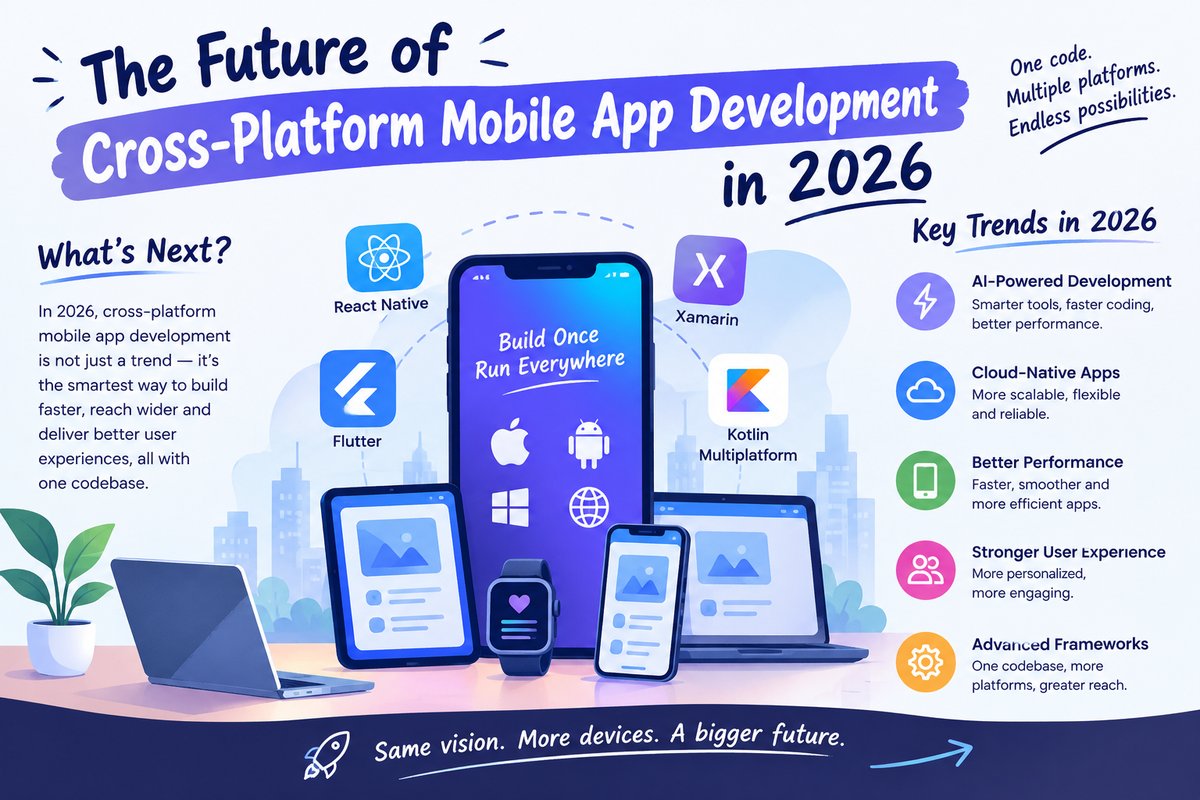
Popular frameworks such as Flutter and React Native support this approach. Other technologies, including Kotlin Multiplatform and .NET MAUI, offer additional options depending on the project's requirements.
Cross-platform development does not mean that every part of an application must be identical. Developers can still customize the interface and integrate native features when required.
Why Is Cross-Platform Mobile App Development Important in 2026?
Businesses need to reach customers across different devices while managing development budgets and delivering quality experiences. Cross-platform development helps address these needs.
1. Faster Application Development
Developing separate applications for Android and iOS can involve repeating some development tasks. Cross-platform frameworks allow teams to reuse code across platforms, which can reduce duplication and speed up development.
For example, developers can reuse business logic, data handling, and selected interface components instead of creating everything from scratch for each operating system.
This approach can help businesses launch products sooner and respond more quickly to customer feedback.
2. Cost-Effective Development
Maintaining two separate codebases can require additional developers, testing, and long-term maintenance.
Cross-platform development can reduce duplicated work by allowing teams to share a significant portion of the code. This can be especially useful for startups, small businesses, and companies working with limited budgets.
However, the actual cost depends on the application's complexity, required integrations, performance needs, and the amount of platform-specific development involved.
3. Consistent User Experience
Customers expect applications to be easy to use regardless of their device. Cross-platform frameworks help developers maintain consistent layouts, navigation patterns, and core functionality across Android and iOS.
Developers can also adjust designs to respect platform-specific conventions, accessibility requirements, and user expectations.
A consistent experience can make an application easier to understand and help strengthen a business's digital identity.
4. Easier Maintenance and Updates
Mobile applications require regular updates to improve security, fix bugs, and introduce new features.
When much of an application's code is shared, developers can often make changes once and apply them across supported platforms. This can simplify maintenance and reduce duplicated work.
Platform-specific testing and adjustments are still necessary to ensure that updates function correctly on different devices and operating system versions.
Major Trends Shaping the Future of Cross-Platform Development in 2026
Several technology trends are influencing how cross-platform mobile applications are designed, developed, and maintained.
1. Artificial Intelligence in App Development
Artificial intelligence is becoming an important tool in modern software development. AI-assisted coding tools can help developers generate code suggestions, identify potential errors, explain unfamiliar code, and automate repetitive tasks.
In cross-platform development, these tools can support interface prototyping, test generation, debugging, and code documentation.
AI is also influencing the features available inside mobile applications. Businesses can introduce intelligent search, personalized recommendations, conversational assistants, and predictive features through suitable AI services.
However, AI-generated code still requires human review, testing, and security checks to ensure that it meets the application's requirements.
2. Growth of Flutter and React Native
Flutter and React Native remain two important options for cross-platform mobile app development in 2026.
Flutter uses the Dart programming language and provides a framework for building applications with a consistent visual design across supported platforms. It is useful for businesses that want customized interfaces, interactive screens, and rich animations.
React Native uses JavaScript or TypeScript and allows developers to build mobile applications with React-based development practices. It can be particularly suitable for teams that already have experience with React web applications.
Both frameworks continue to evolve, with improvements to developer tools, performance, and integration with platform-specific capabilities.
The right choice depends on the development team's skills, the desired user experience, technical requirements, and long-term maintenance plans.
3. Cloud-Based Development and Backend Services
Cloud computing is helping developers build mobile applications that can manage changing workloads and connect with online services.
Cross-platform applications can use cloud-based backends for authentication, databases, file storage, notifications, and business operations.
For example, a food delivery application can use cloud services to manage orders, process customer requests, and update delivery information.
Cloud-based infrastructure can also help businesses scale resources as user demand increases. However, developers must plan for security, network delays, service availability, and infrastructure costs.
4. Improved Application Performance
Performance has always been an important consideration in mobile app development. Users expect applications to open quickly, respond smoothly, and work reliably.
Modern cross-platform frameworks continue to improve rendering, native integration, and development tools. Developers can also improve performance through efficient coding, optimized images, caching, and suitable data management.
These improvements make cross-platform development a practical option for many business applications.
Nevertheless, applications involving intensive graphics, complex hardware access, or highly specialized processing may require additional native code or a fully native approach.
5. Internet of Things (IoT) Integration
The Internet of Things connects devices such as smartwatches, fitness trackers, home appliances, sensors, and industrial equipment.
Cross-platform mobile applications can provide a common interface for users to monitor and control compatible devices across different operating systems.
For example, a smart home application can allow users to control lights, adjust room temperature, and monitor connected devices from their smartphones.
As IoT adoption grows, cross-platform frameworks can help businesses deliver device-control experiences to a wider audience. Developers must still consider Bluetooth, background processing, device compatibility, and platform-specific permissions.
6. Stronger Focus on Mobile App Security
Security is becoming increasingly important as mobile applications handle payments, personal information, business records, and other sensitive data.
Future cross-platform development will continue to emphasize secure authentication, encrypted communication, access controls, secure storage, and regular dependency updates.
Developers should also test APIs, protect sensitive credentials, and follow the security requirements of Android and iOS.
Using a cross-platform framework does not automatically make an application secure. Security must be included throughout the development lifecycle, from planning to ongoing maintenance.
7. Automated Testing and Continuous Integration
Automated testing helps developers identify problems before applications reach users. Continuous integration and continuous delivery (CI/CD) practices can automate parts of the process of building, testing, and preparing applications for release.
Cross-platform projects benefit from automated tests for shared business logic, along with separate checks for Android and iOS functionality.
These practices can improve release consistency, reduce repetitive manual work, and help development teams deliver updates more confidently.
8. Expansion Beyond Smartphones
Cross-platform frameworks increasingly support development for more than just mobile phones. Depending on the framework and project, developers may be able to reuse code or skills for web applications, desktop software, and other supported devices.
For example, a business may create a mobile application for customers and a web-based interface for staff to manage orders or services.
However, sharing a codebase across platforms does not guarantee that the same interface or implementation will work everywhere. Each target platform requires appropriate design, compatibility checks, and testing.
Popular Cross-Platform Development Frameworks in 2026
The choice of framework plays an important role in an application's performance, maintainability, and development process.
Flutter
Flutter is developed by Google and uses the Dart programming language. It provides tools for building customized user interfaces and supports mobile, web, and desktop development.
Its advantages include reusable UI components, flexible visual design, and a consistent appearance across platforms. It can be suitable for consumer applications, e-commerce apps, and digital products that require a distinctive interface.
React Native
React Native is an open-source framework associated with Meta. It allows developers to create mobile applications using JavaScript or TypeScript and React concepts.
It can be a strong choice for businesses with existing React expertise and applications that need integration with native device features.
Its extensive JavaScript ecosystem can also help teams find libraries and tools for common development requirements.
Kotlin Multiplatform
Kotlin Multiplatform allows developers to share selected code, such as business logic and data-handling functionality, across platforms while retaining the option to build native user interfaces.
This approach can be useful for businesses that want to reduce duplicated logic but still need platform-specific user experiences.
The amount of code shared depends on the project architecture and technical requirements.
.NET MAUI
.NET Multi-platform App UI (.NET MAUI) supports the development of applications for Android, iOS, macOS, and Windows using C# and .NET.
It can be a suitable option for organizations already working with Microsoft technologies or maintaining applications within the .NET ecosystem.
Each framework offers different advantages, so businesses should select one based on project needs rather than popularity alone.
Challenges of Cross-Platform Mobile App Development
Although cross-platform development offers many advantages, businesses should understand its limitations.
1. Platform-Specific Features
Some applications depend heavily on specialized hardware, operating system features, or third-party SDKs. These requirements may need native code or custom integrations.
Developers should evaluate these needs before selecting a framework.
2. Performance Optimization
Cross-platform frameworks perform well for many applications, but performance can vary depending on the workload and implementation.
Developers should test real-world performance and optimize areas such as animations, network requests, memory usage, and data processing.
3. Device and Operating System Compatibility
Android and iOS differ in their design conventions, permissions, hardware, and operating system behavior.
Cross-platform applications must be tested across relevant devices and supported operating system versions to provide a reliable experience.
4. Third-Party Library Dependencies
Applications often depend on libraries for payments, maps, analytics, authentication, and other services. Some libraries may not fully support every platform or may require additional configuration.
Businesses should review library maintenance, compatibility, security, and long-term support before using them.
5. Keeping Up With Technology Changes
Frameworks and mobile operating systems continue to evolve. Development teams need to update dependencies, review compatibility, address security issues, and maintain their applications over time.
Regular maintenance helps reduce technical problems and keeps applications aligned with platform requirements.
Best Practices for Successful Cross-Platform App Development
Businesses can improve the quality of cross-platform projects by following these practices:
- Define clear project goals: Identify the target audience, essential features, budget, and supported platforms before development begins.
- Choose the right framework: Evaluate Flutter, React Native, Kotlin Multiplatform, and .NET MAUI according to the project's technical needs and team expertise.
- Prioritize UI and UX design: Create simple navigation, readable layouts, accessible interfaces, and suitable platform-specific interactions.
- Reuse code strategically: Share common business logic where practical while keeping platform-specific functionality separate when necessary.
- Test on real devices: Combine automated tests with hands-on testing across relevant Android and iOS devices.
- Focus on security: Protect user data, review dependencies, secure APIs, and update the application regularly.
- Plan for future growth: Use maintainable architecture and monitor performance so the application can adapt as requirements change.
How Warrgyiz Morsch Can Support Cross-Platform Mobile App Development
Warrgyiz Morsch provides IT and software development services, including mobile app development. Businesses planning to launch an application can consider cross-platform development when they want to reach Android and iOS users through a shared development approach.
A structured development process may include requirement analysis, framework selection, UI/UX design, application development, API integration, testing, deployment, and ongoing maintenance.
The most suitable approach depends on the business's objectives, budget, performance requirements, and desired user experience. Careful planning helps businesses make informed technology choices and build applications that can adapt to changing customer needs.
By focusing on usability, performance, security, and maintainable code, businesses can create mobile experiences that support their digital growth.
Conclusion
The future of cross-platform mobile app development in 2026 is shaped by advances in artificial intelligence, cloud computing, automated testing, IoT integration, and modern development frameworks. These technologies are helping developers create applications that serve multiple platforms while reducing duplicated development work.
Frameworks such as Flutter, React Native, Kotlin Multiplatform, and .NET MAUI offer different ways to share code and build mobile experiences. However, the best choice depends on each project's requirements, development team's skills, and long-term goals.
Businesses that prioritize user experience, security, performance, and regular maintenance can benefit from cross-platform development while preparing their applications for future opportunities.
As mobile technology continues to evolve, cross-platform development will remain a valuable option for businesses seeking flexible and efficient ways to reach customers across devices.