CSIR NET Physical Science 2026: Complete Preparation Guide for Physics Aspirants
-

- Published Updated
- 62 views
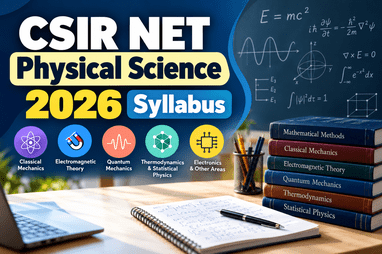
Preparing for the CSIR NET Physical Science examination requires a clear understanding of the syllabus, strong conceptual knowledge, and consistent numerical practice. Candidates can begin by reviewing the CSIR NET Physical Science 2026 Syllabus to identify the prescribed topics and develop a structured preparation plan.
For students aiming to pursue research opportunities or academic careers in physics, an organized approach can make exam preparation more manageable. Instead of covering topics randomly, aspirants should focus on understanding fundamental principles, practising examination-style questions, and revising important concepts regularly.
Explore the syllabus here- https://ifasonline.com/csir-net/physical-science-syllabus/6433b5b36f88433b504b4258/6433ae866f88433b504b4163
Why Understanding the Syllabus Is Important
The syllabus provides a framework for organizing preparation and identifying the subjects that require attention. Without a clear plan, candidates may spend excessive time on familiar topics while overlooking other important areas.
Start by dividing the syllabus into individual subjects and smaller topics. Assess your current understanding of each area and identify which concepts require more time. This simple exercise can help you establish realistic weekly targets.
Keep the latest official CSIR NET notification available while planning your preparation. It provides the relevant examination information, including the applicable syllabus and examination pattern.
Important Subjects to Cover
Physical Science preparation involves several branches of physics and their mathematical applications. Candidates should organize their studies around the topics prescribed in the official syllabus.
Mathematical Methods of Physics
Mathematical methods form the foundation of many advanced physics problems. Candidates should practise relevant areas such as vector calculus, differential equations, linear algebra, and complex analysis.
Focus on understanding the applications of mathematical techniques rather than memorizing formulas without context. Regular problem-solving can improve both calculation accuracy and conceptual understanding.
Classical Mechanics
Classical mechanics deals with motion, forces, conservation principles, and dynamical systems. Begin with fundamental concepts and gradually progress to problems involving multiple principles.
Practise questions regularly and review the reasoning behind each solution. Understanding why a particular method works is more useful than simply memorizing the final answer.
Electromagnetic Theory
Electromagnetic theory covers electric and magnetic fields, Maxwell's equations, electromagnetic waves, and related concepts. Candidates should understand the physical meaning of important equations and learn to apply them to different problem situations.
Prepare concise notes containing key relationships and important concepts for quick revision.
Quantum Mechanics
Quantum mechanics requires a strong foundation in theoretical principles and mathematical reasoning. Study the fundamental concepts, operators, eigenvalues, and other prescribed topics systematically.
Work through basic examples before attempting more challenging questions. This approach helps build confidence and makes complex concepts easier to understand.
Thermodynamics and Statistical Physics
These subjects involve thermodynamic principles, statistical distributions, and the behaviour of physical systems. Focus on conceptual clarity and practise numerical questions to understand how theoretical relationships are applied.
Regular revision is particularly helpful for retaining important equations and recognizing the appropriate methods for different problems.
Electronics and Other Areas
Candidates should also prepare electronics, atomic and molecular physics, nuclear and particle physics, condensed matter physics, and other subjects included in the official syllabus.
The time allocated to each topic should reflect its syllabus coverage, your current level of understanding, and your performance in practice tests.
How to Prepare a Realistic Study Schedule
A good timetable should include theory, numerical practice, revision, and self-assessment. It should also be flexible enough to accommodate difficult topics.
Set weekly targets: Divide large subjects into smaller sections and establish achievable study goals.
Study concepts before solving advanced problems: Build a strong foundation by understanding definitions, principles, equations, and their applications.
Practise every day: Even a short daily problem-solving session can help maintain consistency and strengthen analytical skills.
Revise completed topics: Schedule regular revision instead of waiting until the entire syllabus has been completed.
Track your progress: Maintain a checklist of completed topics and note areas that require additional practice.
Following a realistic schedule can help prevent last-minute pressure and make preparation easier to evaluate.
The Role of Previous-Year Question Papers
Previous-year question papers are useful for understanding examination-style questions and testing your ability to apply theoretical knowledge.
After completing a topic, solve related questions independently. Once you finish, analyse incorrect answers and identify the reason for each mistake. Errors may arise from weak conceptual understanding, incorrect formula selection, calculation problems, or poor time management.
Maintain a record of difficult questions and revisit them during revision. This helps you focus on specific weaknesses rather than repeatedly practising only familiar topics.
As preparation progresses, attempt timed mock tests to evaluate accuracy, question selection, and time management.
Common Mistakes Physics Aspirants Should Avoid
One common mistake is relying on too many study resources. Constantly switching between textbooks, notes, and online materials can make preparation less organized. Select reliable resources and use them consistently.
Another mistake is postponing revision. Concepts studied several weeks earlier may become difficult to recall without regular practice. Short revision sessions can help reinforce learning.
Candidates should also avoid ignoring numerical problems until the end of preparation. Apply concepts soon after studying them so that misunderstandings can be identified early.
Finally, do not leave difficult subjects entirely untouched. Break challenging concepts into smaller parts, revise the fundamentals, and practise progressively more demanding questions.
Final Tips for CSIR NET Physical Science 2026
A focused preparation strategy combines syllabus analysis, conceptual learning, numerical practice, and regular revision. Begin by identifying the prescribed topics, build a realistic timetable, and evaluate your progress through practice questions and mock tests.
Pay attention to recurring mistakes and use them to guide your revision. Maintain consistency instead of depending on occasional long study sessions.
Most importantly, use the latest official examination information to ensure that your preparation follows the applicable syllabus and requirements. With disciplined study and a systematic approach, physics aspirants can make their CSIR NET Physical Science preparation more focused and productive.