How Custom Web Application Development Services Improve Efficiency and Productivity
-

- July 16th, 2026
- 2,620 views


FREE SEO Topical Map Generator: Find Your Next Content Ideas
A business runs better when its software fits the way the team actually works. That is the main advantage of Custom Web Application Development Services: they create tailored digital solutions that remove friction, simplify operations, and support long-term growth. For business owners, professionals, and beginners, this means fewer bottlenecks and better results from daily work.
What Are Custom Web Application Development Services?
Custom web application development services are the process of designing and building web-based software for a specific business need. Unlike off-the-shelf software, a custom web app is created around your workflows, goals, and users.
Common examples
- Internal dashboards.
- Customer portals.
- Inventory management systems.
- Booking platforms.
- CRM and ERP integrations.
- Workflow automation tools.
These applications are usually built to solve a specific problem, such as reducing duplicate work, improving communication, or making data easier to access.
Why Do They Improve Productivity?
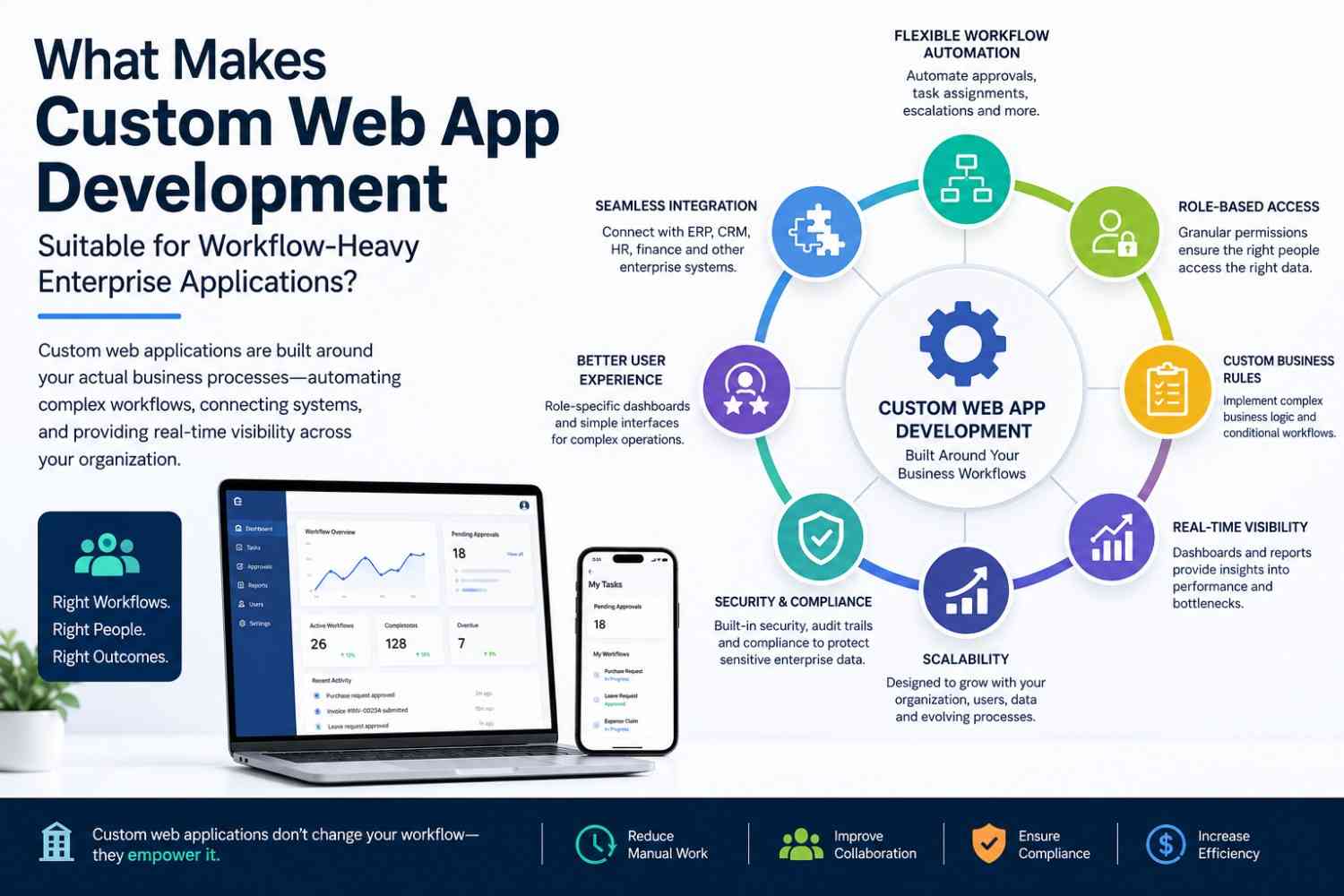
Custom applications improve productivity because they reduce the number of steps employees need to complete a task. They also minimize context switching, cut down on manual data entry, and connect different departments through one system.
Main productivity benefits
- Faster task completion.
- Fewer human errors.
- Better team collaboration.
- Centralized data access.
- Automated workflows.
- Easier reporting and decision-making.
When software matches the business process, employees spend less time adjusting to the tool and more time doing valuable work.
How They Improve Efficiency
1. Automating repetitive tasks
Many businesses waste time on repeated actions such as data entry, approvals, status updates, and report generation. A custom web application can automate these tasks and free employees for higher-value work.
2. Reducing workflow delays
Custom systems can route tasks automatically to the right person. That means fewer handoff delays and faster completion times across teams.
3. Improving data accuracy
Manual processes often lead to mistakes. Custom applications validate input, standardize records, and keep information in one place, which improves accuracy and reduces rework.
4. Connecting systems
Many businesses use multiple tools that do not communicate well with each other. Custom web apps can integrate with APIs, CRMs, payment gateways, and third-party platforms to reduce duplicate work.
5. Supporting better decisions
When data is organized and visible in one dashboard, managers can make faster and more informed decisions.
Step-by-Step Process to Improve Productivity
1. Identify bottlenecks
Start by finding where time is lost. Look for repetitive tasks, manual approvals, slow reporting, and disconnected systems.
2. Define business goals
Decide what productivity improvement means for your company. It could be faster turnaround, lower labor cost, or better team output.
3. Map the workflow
Document how tasks currently move through your business. This helps identify where automation or redesign will have the biggest impact.
4. Choose the right features
Only build features that solve real problems. Common productivity features include dashboards, notifications, approval flows, role-based access, and reporting tools.
5. Test with real users
Before launch, ask employees to test the application. Their feedback helps remove friction before it affects the whole team.
6. Measure results
Track performance after launch using metrics such as task completion time, error rate, customer response time, and employee productivity.
Real-World Example
A logistics company may use spreadsheets and email to manage deliveries. This creates delays, duplicate entries, and missed updates. A custom web application can automate order tracking, assign deliveries, notify drivers, and store all records in one place.
The result is faster coordination, fewer errors, and better productivity across the entire operation.
Custom vs Off-the-Shelf Software
Factor |
Custom Web App |
Off-the-Shelf Software |
Fit for business process |
High |
Limited |
Workflow automation |
Strong |
Basic |
Scalability |
Flexible |
Depends on vendor |
Upfront cost |
Higher |
Lower |
Long-term efficiency |
Better |
May require workarounds |
Custom software is often the better choice when your business has unique workflows or needs strong integration with existing systems.
Pros and Cons
Pros
- Built around your exact workflow.
- Saves time through automation.
- Reduces errors and manual work.
- Supports growth and scalability.
- Improves collaboration and visibility.
Cons
- Higher initial investment.
- Longer development time.
- Needs ongoing maintenance.
- Requires clear planning before development.
E-E-A-T and Business Value
Businesses usually see the best results when custom development is guided by user research, process analysis, and measurable goals. Research from McKinsey has shown that digital transformation can improve productivity when businesses redesign processes instead of simply digitizing old ones. Clear structure, secure architecture, and usability testing are all part of building software that actually improves performance.
For example, a sales team using a custom dashboard can see lead status, follow-up reminders, and customer history in one place. That reduces switching between tools and helps the team respond faster.
Quick Answer
Custom Web Application Development Services improve efficiency by automating tasks, reducing errors, and connecting workflows. They improve productivity by helping teams work faster, collaborate better, and make informed decisions using tools designed for their business needs.
Key Takeaways
- Custom web apps solve specific business problems.
- Automation saves time and reduces manual effort.
- Better data flow improves accuracy and decision-making.
- Integration reduces tool-switching and duplicate work.
- Productivity increases when software matches real workflows.
Frequently Asked Questions
What is custom web application development?
It is the process of building a web app designed for a specific business need, workflow, or audience.
How do custom web applications save time?
They automate repetitive tasks, reduce manual input, and make business processes faster and more organized.
Are custom web apps better than ready-made software?
They are better when your business has unique needs that off-the-shelf tools cannot handle well.
What types of businesses need custom web apps?
Startups, small businesses, and enterprises can all benefit, especially if they rely on complex workflows or integrations.
Do custom web applications improve team productivity?
Yes. They reduce delays, improve communication, and help teams complete tasks more efficiently.
Conclusion
Custom Web Application Development Services are valuable because they turn slow, manual, and fragmented processes into efficient digital workflows. When businesses build software around their real needs, they save time, reduce errors, and create a more productive work environment.