How to Choose a Heavy-Duty Demolition Hammer for Concrete Breaking?
-

- Published Updated
- 146 views
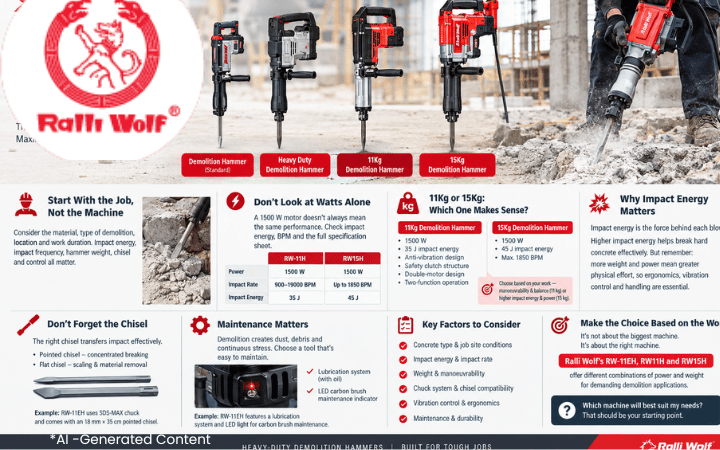
When you're in front of a thick slab with the wrong tool, it might seem easy to break concrete.
An inadequately light machine will slow down the entire task. In the same way, an unnecessarily heavy machine will make the task harder for the operator. This explains why selecting a heavy-duty demolition hammer involves selecting a machine whose weight does not have to be the highest.
The following are some of the attributes that should attract your attention when considering either a demolition hammer, 11Kg demolition hammer, or 15Kg demolition hammer.
Start With the Job, Not the Machine
Before comparing demolition hammers, consider the materials being broken and the type of demolition being done.
Are you breaking up a concrete floor? Demolishing a concrete slab? Masonry chiselling? Demolition and renovation work that requires working continuously throughout the day at the job site?
Why? Because the effectiveness of concrete breaking involves more than motor power. Impact energy, impact frequency, hammer weight, chisel, and control are factors in how a hammer works.
A heavy-duty demolition hammer is designed for chiselling and concrete-breaking work. Different from a rotary hammer that can do both drilling and hammering, a demolition hammer is a hammer that concentrates impact energy through the chisel.
This makes impact energy, measured in joules, one of the most important statistics to consider.
Don't Look at Watts Alone
Here's a common mistake: seeing a 1500 W rating and assuming two machines will perform similarly.
They may not. For example, Ralli Wolf's RW-11H is rated at 1500 W, with a full-load impact rate of 900-19000 BPM and impact energy of 35 J.
The RW15H also uses a 1500 W motor, but it is rated at 45 J impact energy and up to 1850 BPM.
The takeaway? When comparing a demolition hammer, don't judge it by wattage alone. Look at the complete specification sheet.
11Kg or 15Kg: Which One Makes Sense?
This is probably the question most buyers have.
An 11 kg demolition hammer can provide substantial breaking power while remaining lighter than a 15 kg machine. Ralli Wolf offers two 11 kg options with different specifications.
The RW11H 11Kg demolition hammer is rated at 1500 W and 35 J impact energy. It includes an anti-vibration design, safety clutch structure, double-motor design and two-function operation.
Then there is the 15Kg demolition hammer.
The Ralli Wolf RW15H weighs 15 kg and delivers 45 J of stated impact energy from its 1500 W motor, with a maximum impact rate of 1850 BPM.
So, rather than asking which weight is better, ask what your work requires. If manoeuvrability and a balance between weight and impact power matter, an 11 kg model may fit the application. If the work calls for higher stated impact energy and you are comfortable handling a heavier machine, the 15 kg class becomes relevant.
Why Impact Energy Matters in Concrete Breaking
Think of impact energy as the force behind each individual blow.
When you're working on hard concrete, the chisel needs enough impact to fracture the material effectively. A higher impact-energy rating can therefore be particularly relevant to demanding demolition work.
But there is a practical side to this equation.
A heavy-duty demolition hammer is held by an operator, not a machine stand. More weight and impact can mean greater physical demands during extended work. That is why ergonomics, vibration management and control should be considered alongside raw power.
For example, Ralli Wolf's RW11H incorporates anti-vibration design, while the RW-11EH has a design intended to reduce vibration reaching the operator's hands.
Don't Forget the Chisel
Even a powerful demolition hammer needs the right chisel.
The chisel determines how the impact is transferred to the concrete. Pointed chisels are useful where concentrated breaking is required, while flat chisels can be useful for scaling and material removal.
The RW-11EH uses an SDS-MAX chuck system for large chisels and is supplied with an 18 mm × 35 cm pointed chisel.
Before buying an 11Kg Demolition Hammer or 15Kg Demolition Hammer, therefore, check not only the machine but also its compatible accessories.
Maintenance Matters on a Jobsite
Demolition work creates dust, debris and continuous mechanical stress. A tool that is easy to maintain can be more practical for regular professional use.
The RW-11EH also features a lubrication system using oil as well as an LED light to indicate when the carbon brush requires maintenance.
It might seem insignificant at first glance, but it becomes quite relevant once you realise that your powerful demolition hammer will be utilised constantly.
Make the Choice Based on the Work
Choosing a demolition hammer isn't about picking the biggest machine. Look at the concrete, workload, impact energy, weight, chuck system, vibration control and maintenance requirements.
Ralli Wolf's RW-11EH, RW11H and RW15H offer different combinations of power and weight for demanding demolition applications.
When trying to decide between an 11 Kg demolition hammer and a 15 Kg demolition hammer, all you need to ask yourself is this one question: Which machine will best suit my needs?
This should be your starting point in deciding on a suitable heavy-duty demolition hammer.