Children's Day gifts that kids actually use: a practical guide by age
-

- Published Updated
- 26 views
Think back to the last gift your child received from a relative. Is it still in use? For a lot of families, the honest answer is no. The battery toy stopped after a week. The craft kit is half done in a cupboard. Meanwhile, the plain steel water bottle a grandparent gave two years ago still goes to school every single day.
That is the test for a good Children's Day gift. Not how big the box is, or how loud the reaction is when it is opened, but whether it is still being used in January.
Children's Day falls on 14 November, Pandit Jawaharlal Nehru's birth anniversary, and many schools, aunts, uncles and grandparents mark it with a small gift. Here is a practical guide by age and budget, built around one idea: give things children use daily, and make them feel like theirs.
The 4-question test for any gift
Before you buy, ask:
- Will it be used at least once a week? Daily is better.
- Does it fit their life right now? School, tuition, sports, a new sibling, a long commute.
- Will it survive a child? Steel over thin plastic, stitched over glued.
- Will they know it is theirs? A name on it, or something they chose themselves, changes how children treat an object. They look after it, and it comes home from school.
Ages 2 to 4: routine, comfort and nothing small
At this age the best gifts support the daily routine: meals, bath, sleep, the first months of playschool or daycare.
What gets used:
- A sturdy, spill-resistant water bottle for playschool, with their name on it so it does not get mixed up with every other bottle in the basket.
- Thick board books. Children this age will happily read the same book again and again.
- A small backpack they can carry themselves.
- Chunky crayons and a large drawing pad.
What to avoid: anything with small detachable parts, tiny hair clips, bead charms, and toys with button batteries. Children this age still put things in their mouths.
Ages 5 to 7: big school, big feelings, lots of things to lose
This is the age of the first proper school bag, the first tiffin, and the first time a child is fully responsible for their own things. It is also the age when things go missing most.
What gets used:
- A water bottle and lunchbox they love. Stainless steel lasts for years, and a design they chose makes them more likely to bring it home.
- Name labels for books, stationery and tiffin. It sounds dull, but children enjoy seeing their name on everything, and parents stop replacing lost pencil boxes.
- A bag tag or bag charm so they can spot their own bag on a crowded rack.
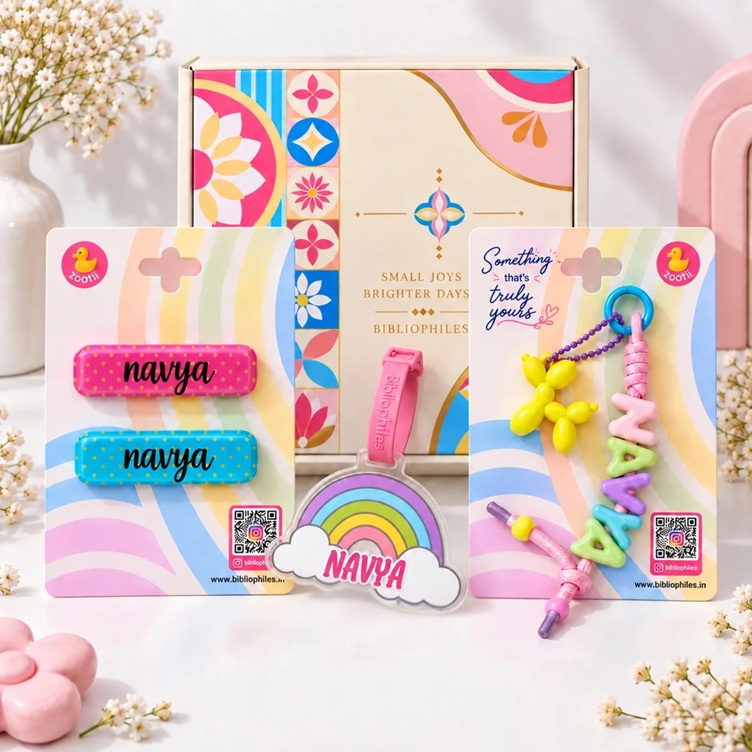
- For children who like accessories, name hair clips, or a set of seven clips, one for each day of the week. Choosing Tuesday's clip on Sunday night turns a morning struggle into a small ritual.
- An alarm clock or a simple watch to start learning time.
Ages 8 to 10: independence and identity
Children this age want to feel grown up and to have things that say something about them.
What gets used:
- A personalised stainless steel bottle for school and sports.
- A journal or diary with a lock, and good pens.
- A library card and their first "proper" chapter book series.
- A bag charm or clicker charm with their initials. Satisfying to fiddle with, and their bag becomes easy to identify.
- A basic sports kit: a skipping rope, a football, a badminton set.
Ages 11 to 13: practical and a little stylish
Pre-teens are hard to buy for, and most of the gifts that miss are the ones that feel childish.
What gets used:
- A good insulated bottle or a bento-style lunchbox with proper compartments.
- A desk organiser and quality stationery for exam season.
- A personalised accessory with initials rather than a full name. Subtle is the point at this age.
- Something for a hobby they already have: a sketchbook, a beginner's coding kit, a cricket bat grip, a set of guitar strings.
Budget guide in rupees
These are typical prices for personalised everyday items from Indian makers in October 2026. Prices vary by shop, so use them as a guide rather than a quote.
| BudgetWhat fitsGood for | ||
| Under ₹400 | A pair of name-printed hair clips (around ₹229 to ₹335), a pack of name stickers for books or tiffins (around ₹329 to ₹399), a writable bag tag set (around ₹399) | Class gifts, return gifts, cousins |
| ₹400 to ₹1,000 | A personalised bag charm (around ₹396 to ₹439), a set of seven day-of-the-week clips or a school label combo (around ₹899), a personalised 350 ml steel bottle (around ₹999) | Nieces, nephews, godchildren |
| ₹1,000 to ₹1,500 | A stainless steel bento lunchbox (around ₹1,299), or a small gift box combining clips, a bag tag and a charm (around ₹799 to ₹1,499) | Your own child, or a grandparent's gift |
A small tip for budgets: personalised items usually take a few days to print and ship. If you are ordering for 14 November, order in the first week of the month.
Gifts for a whole class
If you are a parent buying for a class or a teacher choosing gifts for 30 to 40 children, practical wins again. A set of name stickers, a pencil with each child's name, or a bookmark is used for months and costs far less than a plastic toy. Check with the school first; some schools have rules on what children can bring in, and on food gifts in particular.
Make the gift feel like theirs
The single biggest upgrade to any gift is putting the child's name on it. A plain bottle is a bottle. A bottle with "Aarav" on it is Aarav's bottle, and it is far more likely to come home every day. If you want ideas for name-printed gifts across these ages and budgets, Zootii's gift collection groups them by type and price.
The short version
On Children's Day, buy for the January test. A gift that is used every day, survives school, and has a child's name on it will be remembered far longer than the one that made the loudest noise when it was opened.
Think back to the last novelty toy or plastic gadget a child received. Chances are, the battery died within a week, the pieces vanished under a sofa, or the craft kit was abandoned half-finished in a cupboard. Meanwhile, that plain stainless steel water bottle gifted years ago still goes to school every single morning.
That contrast defines the true test of a good gift: not how loudly it is unwrapped in November, but whether it is still a daily essential when January arrives.
Children’s Day, celebrated on 14 November, often turns into a race to buy oversized boxes that provide fleeting excitement and long-term clutter. Instead of temporary novelties, practical gifting focuses on high-utility items tailored to a child’s specific developmental stage. For toddlers (ages 2 to 4), safety and daily routine take priority: thick board books, chunky non-toxic crayons, and spill-proof bottles free of hazardous button batteries or tiny detachable pieces.
As children transition into primary school (ages 5 to 7), the world expands to classrooms, bus racks, and crowded cubbies. This is the peak age for lost belongings. Here, sturdy lunchboxes, simple time-learning watches, and distinct bag tags transform daily chaos into independence. By ages 8 to 10, children seek identity; locked journals, sport equipment, and chapter books encourage personal growth. Once they reach the pre-teen years (ages 11 to 13), gifts need understated style—like sleek desk organizers, hobby essentials, or insulated tumblers with subtle monograms rather than loud graphics.
Across all age groups, personalization serves as the ultimate practical upgrade. Placing a child’s name or chosen initial on an everyday item transforms ordinary utility into personal pride. A generic water bottle is easily forgotten on the sports field, but a bottle with their name on it comes home safely. It eliminates lost-property piles and helps children take genuine ownership of their gear.
From budget-friendly label sheets and customized bag charms under ₹400 to durable insulated bento boxes above ₹1,000, thoughtful utility consistently outperforms disposable trends. A successful gift does not need to blink, beep, or overwhelm. It simply needs to survive a backpack, fit into a routine, and make a child feel uniquely seen every day.