Digital Currency Payment Gateway: How Payin, Payout, and Conversion Actually Work Together
-

- Published Updated
- 23 views
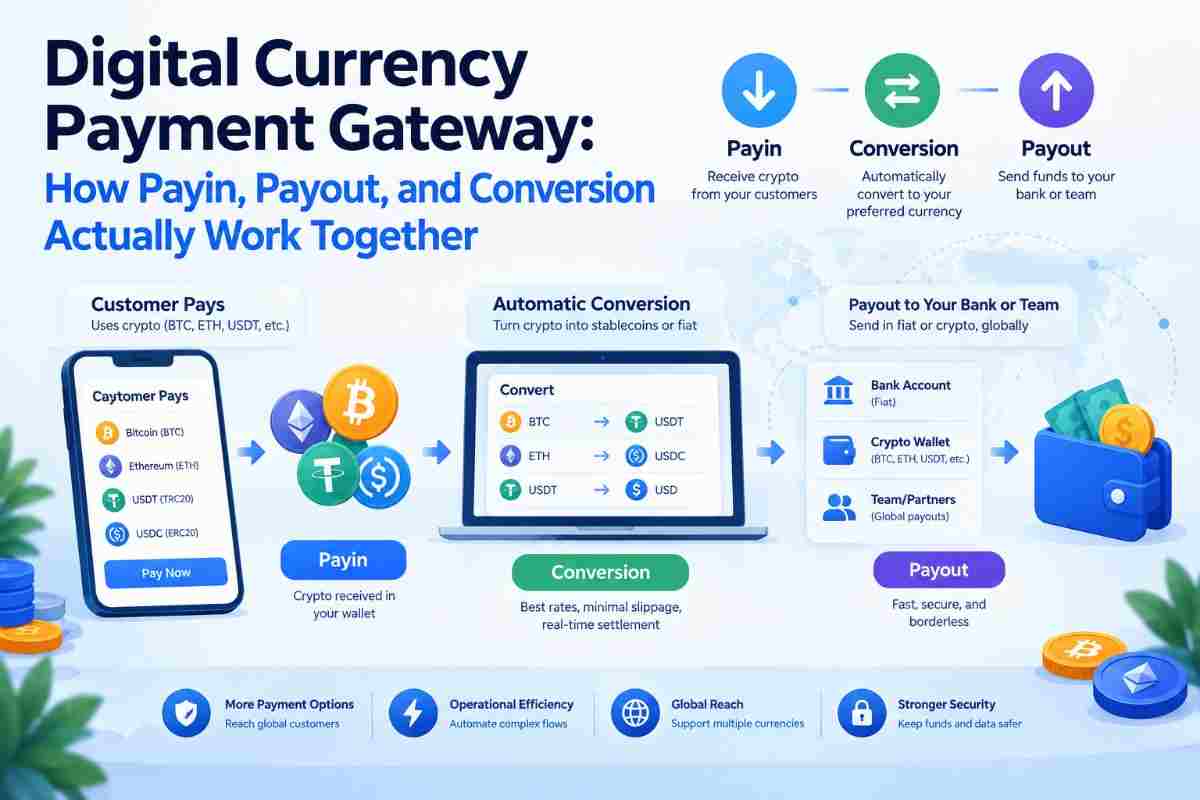
Most explanations of crypto payments focus entirely on the moment a customer pays, and stop there. That's only a third of the picture. Digital Currency Payment Gateway: How Payin, Payout, and Conversion Actually Work Together looks at the full cycle, money coming in, money going out, and assets converting between currencies, as one connected system rather than three separate problems.
The short answer
A Digital Currency Payment Gateway manages three distinct but connected flows, payin when a customer sends payment, payout when funds move out for refunds, payroll, or vendor payments, and conversion when one crypto asset gets swapped for another or for fiat. Digital Currency Payment Gateway: How Payin, Payout, and Conversion Actually Work Together means understanding that these aren't isolated features, they all draw from and feed back into the same underlying ledger, and a gateway that treats them separately tends to create reconciliation headaches down the line.
Why payin is the flow most businesses already understand
Payin is the familiar part, a customer generates an invoice, sends crypto to a specific address, and the gateway waits for blockchain confirmations before marking the order paid. Digital Currency Payment Gateway: How Payin, Payout, and Conversion Actually Work Together starts here because payin is usually the first flow a business sets up, and getting comfortable with invoice expiration, underpayment handling, and webhook-based confirmation lays the groundwork for understanding how the other two flows actually connect to it.
Why payout is where most businesses underestimate the complexity
Payout, sending crypto out for a refund, a payroll run, or a vendor payment, feels conceptually simple but carries meaningfully more risk than payin, since a crypto transfer sent to the wrong address generally can't be reversed. Digital Currency Payment Gateway: How Payin, Payout, and Conversion Actually Work Together should treat payout controls, scoped permissions, address allowlisting, small test transfers to new destinations, and clear audit trails, as seriously as any other financial control in the business, not as an afterthought bolted onto a system designed primarily for receiving payments.
Why conversion is the flow that actually protects the business financially
Conversion, swapping a received crypto asset into a stablecoin or fiat currency, is where a business actually manages its exposure to price volatility. Digital Currency Payment Gateway: How Payin, Payout, and Conversion Actually Work Together depends heavily on this flow, since holding a volatile asset between the moment it's received and the moment it's actually used or settled creates real financial risk that a clear, written conversion policy is specifically designed to limit.
Why these three flows need to share a single ledger, not three separate systems
The real operational insight is that payin, payout, and conversion all need to be visible on one unified record, not tracked across three disconnected systems or spreadsheets. Digital Currency Payment Gateway: How Payin, Payout, and Conversion Actually Work Together works best when every transaction, incoming, outgoing, or converted, carries a consistent order ID, timestamp, and status, so your finance team can actually trace a single customer payment through its entire lifecycle rather than reconstructing it manually across different tools.
Why timing between the three flows actually matters
A payin event, a conversion event, and a potential payout event don't necessarily happen at the same moment, there's often a meaningful time gap between when money comes in and when it needs to go back out or get converted. Digital Currency Payment Gateway: How Payin, Payout, and Conversion Actually Work Together should account for this timing explicitly, since the exchange rate at payin time may differ meaningfully from the rate at conversion or payout time, and a good system tracks this rather than assuming all three happen instantaneously at a single fixed rate.
Why a refund actually touches all three flows at once
A customer refund is a useful example of how these flows interconnect in practice, the original transaction was a payin, the refund itself is technically a payout, and if the original payment was already converted to a stablecoin, the refund may require converting back or sourcing the original asset again. Digital Currency Payment Gateway: How Payin, Payout, and Conversion Actually Work Together becomes very concrete here, a refund isn't just "give the money back," it's a coordinated sequence across all three flows that needs clear policy and tracking.
Why reconciliation depends on clean data from all three flows
Your accounting team needs to match a specific payin to its eventual conversion and any related payout, which only works smoothly if each flow records consistent, linked data, the order ID, the payment ID, the asset and amount involved, and a clear status at every stage. Digital Currency Payment Gateway: How Payin, Payout, and Conversion Actually Work Together should be evaluated specifically on how well it supports this kind of cross-flow reconciliation, rather than just how smoothly each individual flow works in isolation.
Why fee structure looks different once you consider all three flows together
A provider's headline fee often describes payin costs alone, but payout and conversion typically carry their own separate costs, network fees for outgoing transfers, spread costs on conversion, that only become visible once you're actually using all three flows in combination. Digital Currency Payment Gateway: How Payin, Payout, and Conversion Actually Work Together means evaluating total cost across the full cycle a transaction actually goes through, not just the advertised rate for the payin step alone.
Why settlement speed claims should be evaluated across the whole cycle
A provider might advertise fast settlement, but that claim often applies narrowly to how quickly a payin confirms, not necessarily to how quickly a subsequent conversion or payout actually completes. Digital Currency Payment Gateway: How Payin, Payout, and Conversion Actually Work Together should be evaluated end to end, confirming how long the full cycle genuinely takes from customer payment through conversion to final settlement, rather than taking a single speed claim at face value.
A practical checklist for understanding your gateway's full flow cycle
- Confirm how payin, payout, and conversion data link together under a single order ID.
- Understand your gateway's payout security controls, allowlisting, scoped keys, and audit trails.
- Get a written conversion policy covering how and when volatile assets get converted.
- Check how refunds are handled when they touch payin, payout, and conversion simultaneously.
- Evaluate total fees across the full payin-to-settlement cycle, not just the advertised payin rate.
- Confirm settlement speed claims apply end to end, not just to the initial payin confirmation.
Where FaradPay fits
FaradPay is a crypto payment provider, so ask it directly how its payin, payout, and conversion flows connect on a single ledger, what controls exist around payouts, and what its real total cost looks like across the full transaction cycle. Those specific answers are the real test behind Digital Currency Payment Gateway: How Payin, Payout, and Conversion Actually Work Together for any finance team evaluating a provider for actual production use.
FAQ on Digital Currency Payment Gateway: How Payin, Payout, and Conversion Actually Work Together
What's the difference between payin and payout in a crypto payment gateway? Payin is money coming in from a customer payment, while payout is money going out, for a refund, payroll, or vendor payment, and it carries higher risk since crypto transfers generally can't be reversed.
Why does conversion matter if a business just wants to accept crypto? Because holding a volatile asset between receipt and actual use creates real financial exposure, and conversion into a stable asset is how that exposure gets managed deliberately.
Does a refund really involve all three flows at once? Yes. The original payment is a payin, the refund itself is a payout, and if conversion already happened, sourcing funds for the refund may involve converting again.
Why should payin, payout, and conversion share one ledger? Because tracking them separately makes reconciliation much harder, while a single linked record lets your finance team trace a transaction's full lifecycle easily.
Are advertised settlement speeds usually for the full cycle or just payin? Often just the payin confirmation step, so it's worth specifically confirming how long conversion and payout actually take as part of the complete process.
Should I compare total fees across all three flows, not just payin? Yes. Payout and conversion typically carry their own separate costs that only become visible once you're actually using the full cycle in combination.
Final thoughts
Digital Currency Payment Gateway: How Payin, Payout, and Conversion Actually Work Together comes down to understanding these three flows as one connected system sharing a single ledger, not three isolated features evaluated separately. Understand how they interact, especially around refunds, timing, and reconciliation, and you'll choose a gateway built for the full financial cycle your business actually runs, not just the moment a customer hits pay.