How a Company Saved Storage Space by Removing Duplicate MSG Files from Its Email Archive
-

- Published Updated
- 4,850 views
It began with a warning about storage space.
The company’s IT team observed that the storage shared for its email archive was expanding at a far faster rate than anticipated. The business had been archiving Outlook emails as MSG files for a number of years so a large archive was not uncommon.
The team was amazed to discover how much of that storage space was taken up by repeated emails.
The archive held customer conversations, invoices, project discussions, internal messaging, and other vital business correspondence. Many of these emails, however, had been exported multiple times or copied into different backup folders.
The company did not wish to lose valuable emails. It had to remove duplicate MSG files without affecting the original data in the email.
The IT team tried a few cleanup options and chose Softaken MSG Duplicate Remover to find and delete redundant duplicate emails.
The Storage Problem
The company had been building its MSG archive over the years.
Teams followed different email backup practices. Certain employees manually exported emails from Outlook, and the IT department did periodic backups. In addition, department changes and system migrations resulted in the transfer of existing MSG folders to new storage locations.
The same email can be found in several places over time.
A single customer message might be displayed in:
- A project folder
- An employee email archive
- An archive of the department
- A folder to migrate
- Yearly backup
And the files weren’t always the same name.
For example, the archive might contain:
Invoice_Request.msg Invoice_Request_Copy.msg Customer_Invoice_2024.msg
As a stand-alone, the comparison of the filename could not reliably determine whether these were separate emails or duplicate copies of the same message.
Why the Company Could Not Simply Delete Old Files
Initially, the IT team thot to delete older folders to free up storage.
That approach was a serious concern.
The archive was filled with business records that employees might need later. A few of the messages were about customer disputes, invoices, project decisions and vendor communication.
You could delete an entire backup folder, freeing up storage space, but you could also delete unique emails that existed nowhere else.
So the company needed a more controlled approach.
The goal was simple:
Remove unnecessary duplicate MSG emails without removing unique business messages.
The First Attempt: Manual Duplicate Checking
The IT team ran the manual cleanup on a small subset of the archive.
They opened the MSG files and looked at the sender information, subject, date, message content, and flagged duplicate copies for deletion.
This worked for a small folder.
It didn’t scale well.
The archive contained thousands of MSG files and manually checking them one by one would be too time-consuming for the staff.
Human error was also a possibility.
An employee might, perhaps, accidentally delete a one-of-a-kind email simply because it was similar to a different message.
The team needed to automate the repetitive part of the process, but still wanted to retain control over the final deletion.
Introducing MSG Duplicate Remover
The company opted for Softaken MSG Duplicate Remover for the cleanup project.
They used the software as a dedicated tool to find duplicate MSG emails, not basic Windows file searches.
The team then took a full backup of the original archive.
A most necessary precaution this was. Although duplicate detection is automated, business email archives should always have a recovery copy before bulk deletion.
After the backup was done the cleanup started.
Step 1: Organize the Archive
First, the IT team took into account the existing folder structure.
They kept the main archive categories separate instead of putting every MSG file into one folder.
That meant folders for departments, projects and backup times.
The structure was kept so that it was easier to see where duplicate emails had accumulated.
It also helped the team determine whether or not to keep a specific copy.
Step 2: Scan the MSG Files
The team added the relevant MSG folders in Softaken MSG Duplicate Remover.
The software then searched the selected collection for duplicate e-mail messages.
This was more helpful than just searching Windows Explorer for filenames with things like "Copy" or "(1)".
The reason is simple. Duplicate email files may have different filenames.
They needed to find messages that were repeated, not just files that had similar names.
Step 3: Check for Duplicate Results
Once the scan was completed, the IT team went through the duplicates found.
They didn't just throw away every email that looked like it.
This was important because business conversations often include messages such as:
- The same topic
- Same guy
- Related content
- Various dates
- different answers
- Various attachments
For example, ten emails titled “Contract Update” are ten different messages within one conversation.
The team thus verified the duplicate results before proceeding with deletion.
Step 4: Removing Unnecessary Copies
Upon analyzing the results, the team identified the duplicate MSG files that were not needed.
We kept the original email archive and deleted the superfluous copies.
With this approach the company was able to clean the storage without taking the risk of deleting entire backup folders.
The process could be repeated for various parts of the archive.
How Much Storage Did the Company Save?
The amount of storage recovered from duplicate MSG cleanup highly depends on the size and number of emails.
In this case the company discovered that much of its archive consisted of multiple copies of the same email.
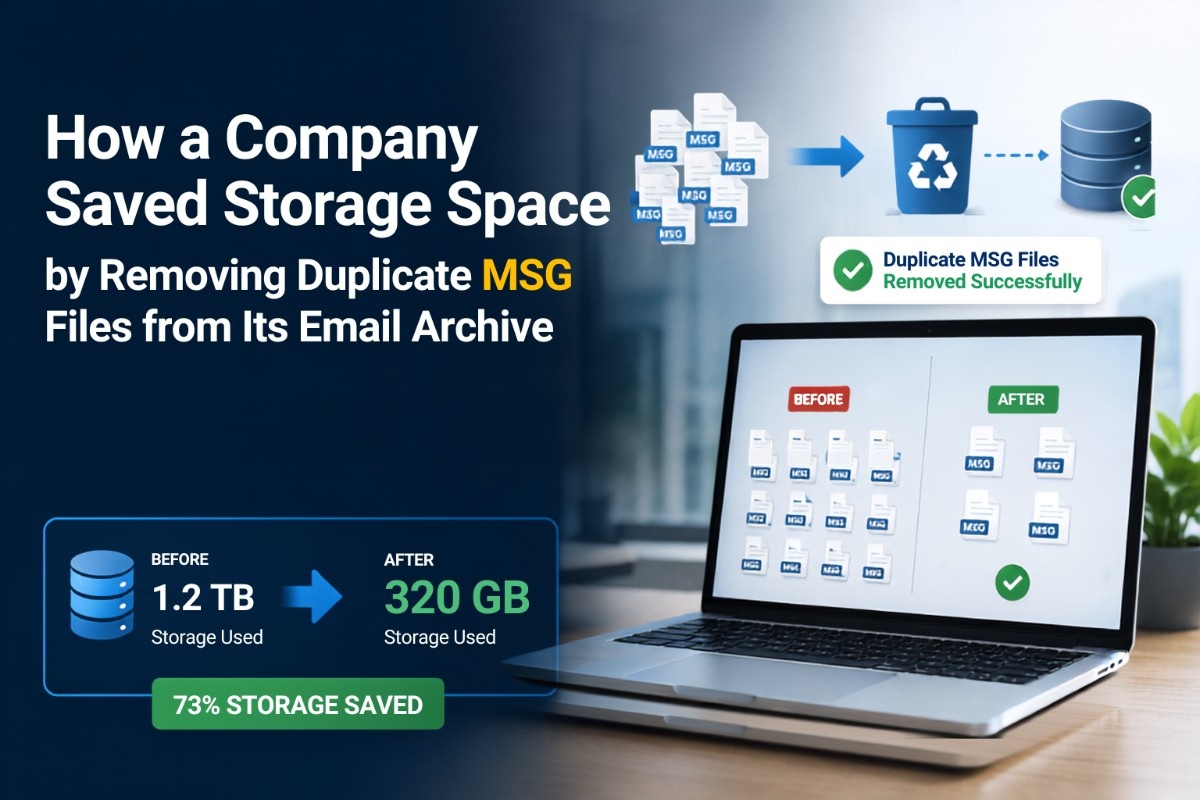
Following the duplicate cleanup, the organization was able to decrease the amount of redundant MSG data stored on its shared storage.
The exact savings varied by archive folder as some departments had far more repeated emails than others.
The important thing was that the company didn’t have to delete valuable historical emails to get space back.
Instead it took out duplicate copies.
What Changed After the Cleanup?
The company now had a more manageable email archive after the duplicate MSG files were removed.
1. Less Storage Waste
And the archive had no more duplicate copies of the same messages.
2. Easier Email Management
A cleaner folder structure made it easier for employees and administrators to find relevant emails.
3. More Efficient Backups
And because there were fewer duplicate files, subsequent backups didn’t have to keep saving the same copies of emails.
4. Better Archive Organization
The IT team could see which folders actually contained unique email data and which ones had been created mostly through repeated backups.
5. Reduced Administrative Work
Large clean-up projects did not require the company to rely on manual MSG file comparison alone.
Why Duplicate MSG Files Become a Problem
This case also shows the impact of duplicate email files on a business beyond the mere consumption of storage.
Having redundant MSG files could cause:
- Increased backup sizes
- Longer backup jobs
- More complex email archive
- Higher costs for storage
- Problem finding the correct mail
- Duplicate data in migrations
- File management - unnecessary work
The problem usually develops gradually.
Having a few duplicate files created in an Outlook export might not be a big deal. But when the same process repeats itself over and over for years, the duplicates can hog an incredible amount of storage.
Final Thoughts
It was not that the company had no important emails. It was because we had too many copies of the same emails.”
Over the years, Outlook exports, backups, folder copies and migrations had slowly built up duplicate MSG files in the email archive.
The archive had valuable business correspondence and it would have been risky to delete whole folders. Meanwhile, comparing manually would have taken too long.
Softaken MSG Duplicate Remover allowed the IT team to find unnecessary duplicate MSG files, examine them and remove redundant copies without discarding the whole archive.
The biggest lesson is simple: when an email archive grows too big, deleting old data isn’t always the answer. We might remove redundant data. It might be a safer and more effective way.
For small collections, manual cleanup may still be sufficient. But for organizations with years of MSG archives to manage, a dedicated duplicate removal solution can accelerate storage cleanup, make it more organized, and far easier to manage.