Top 8 Ecommerce SEO Services Agencies for Modern Search in 2026
-

- Published Updated
- 1,788 views
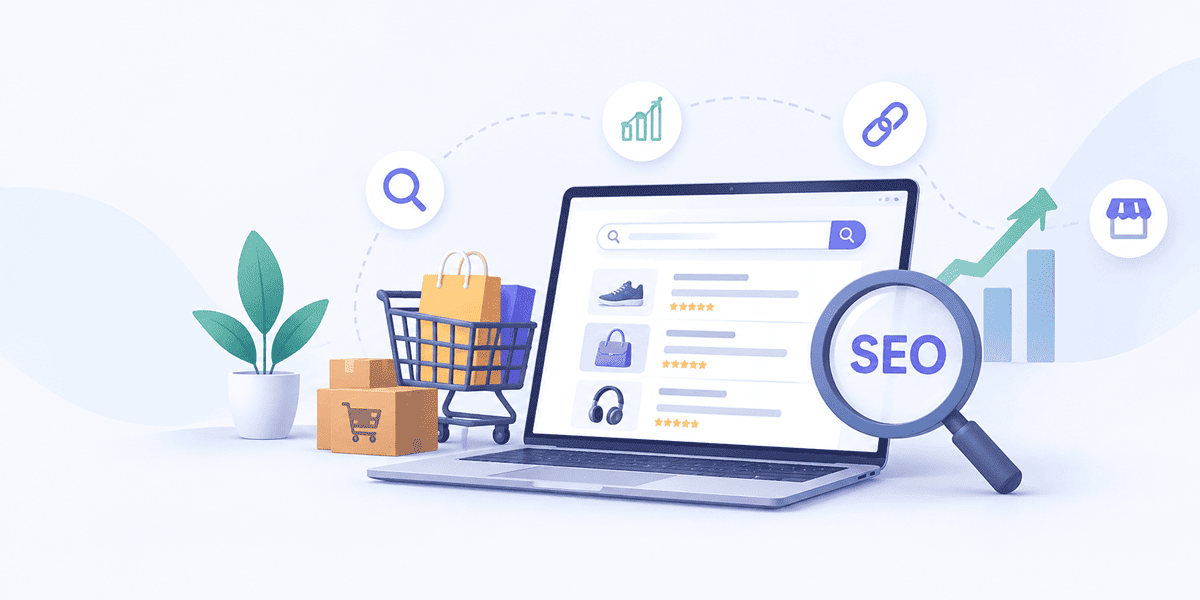
Ecommerce search has become much more complicated than ranking product pages on Google.
Customers can discover products through traditional organic results, Google Shopping, AI Overviews, conversational search, marketplaces, social platforms, and increasingly AI-powered shopping experiences. At the same time, ecommerce websites have their own technical challenges, including large product catalogs, duplicate URLs, faceted navigation, product variants, structured data, internal linking, and frequently changing inventory.
That makes choosing an ecommerce SEO agency different from choosing a general SEO provider. A capable ecommerce partner needs to understand how search visibility connects with products, categories, shopping journeys, technical architecture, and revenue.
The agencies below stand out for different reasons. Some are particularly strong in enterprise ecommerce, some specialize in catalog and technical SEO, while others have built their services around AI search and broader commerce discovery.
What Makes an Ecommerce SEO Agency Ready for Modern Search?
Before comparing agencies, it helps to define what “modern search” actually means.
A strong ecommerce SEO program should cover the fundamentals while adapting to the way product discovery is changing.
Product and category optimization
Product detail pages and category pages need to target the right search intent without creating thousands of thin or overlapping pages.
Technical ecommerce SEO
Large stores can generate enormous numbers of URLs through filters, sorting, pagination, variants, and internal search. Managing crawlability, canonicalization, indexing, and site architecture is therefore essential.
Content that supports product discovery
Informational content, buying guides, comparisons, FAQs, and category resources can introduce shoppers to a brand before they search for a specific product.
Structured product information
Search engines and AI systems need clear information about products, attributes, availability, pricing, reviews, and relationships between products.
AI and conversational search
Modern ecommerce SEO increasingly includes optimization for AI-generated answers and shopping experiences, where product information may be summarized or compared rather than simply displayed as a traditional blue link.
Revenue-focused measurement
Traffic and rankings matter, but ecommerce SEO ultimately needs to contribute to product discovery, transactions, revenue, and customer acquisition.
With those criteria in mind, here are eight agencies worth considering.
1. WebFX
Best for: Full-service ecommerce SEO with strong reporting and technology
WebFX is one of the larger established digital marketing agencies on this list, making it a particularly relevant option for businesses looking for ecommerce SEO alongside broader digital marketing capabilities.
Its ecommerce SEO offering covers technical SEO, keyword research and mapping, on-page optimization, content, marketplace support, and reporting tied to revenue and ROI. WebFX also supports platforms such as Shopify, WordPress, and BigCommerce.
One differentiator is its proprietary RevenueCloudFX technology, which the company uses to connect marketing activity with revenue reporting. Its ecommerce SEO packages also include prompt targeting, reflecting the shift toward AI-driven search experiences.
Why consider WebFX?
- Large in-house digital marketing team
- Ecommerce SEO combined with other marketing channels
- Technical, on-page, content, and marketplace support
- Revenue and ROI reporting
- Experience across major ecommerce platforms
- AI-search considerations incorporated into current offerings
Good fit for: Established ecommerce businesses that want SEO integrated with a larger digital marketing and measurement ecosystem.
2. Coalition Technologies
Best for: Large ecommerce catalogs and revenue-focused SEO
Coalition Technologies has a strong ecommerce orientation and positions its SEO around measurable commercial outcomes rather than rankings alone.
Its ecommerce work addresses issues that become particularly important at scale, including faceted navigation, product and category optimization, platform-specific technical SEO, content, and conversion rate optimization. The agency also explicitly positions its ecommerce SEO services for both traditional and AI search.
Coalition reports more than 34 million ecommerce transactions across its work and more than 500 SEO case studies on its current ecommerce service page. Those figures are company-reported, so prospective clients should still evaluate individual case studies relevant to their own industry and store size.
What stands out?
Coalition's approach is particularly relevant to stores where SEO problems are tied to scale. An ecommerce website with thousands of SKUs needs a different approach from a store with 50 products.
The agency combines:
- Technical ecommerce SEO
- Product and category optimization
- Content strategy
- Conversion optimization
- Link building
- AI-search optimization
- Revenue-focused reporting
Good fit for: Mid-market and enterprise ecommerce brands with complex catalogs and a strong focus on revenue.
3. ResultFirst
Best for: Performance-focused ecommerce SEO and emerging AI search
ResultFirst takes a performance-oriented approach to ecommerce SEO, with services spanning technical audits, keyword research, product and category optimization, content, link building, analytics, and scalable catalog optimization.
What makes ResultFirst particularly relevant to a modern search list is its focus on both traditional ecommerce SEO and AI-driven discovery. Its current ecommerce offering includes optimization for Google AI Overviews and AI platforms, entity-based optimization, and product-feed work through Google Merchant Center.
The agency also highlights programmatic approaches for larger ecommerce websites, including automated metadata frameworks, faceted-navigation control, crawl optimization, and internal linking.
Where ResultFirst has a strong use case
Large ecommerce websites cannot realistically optimize every SKU manually. A scalable approach is needed to identify which pages deserve attention, control indexation, improve templates, and connect product and category pages through a logical internal structure.
ResultFirst's ecommerce offering addresses that challenge while also incorporating AI-search considerations.
Good fit for: Ecommerce brands looking for performance-focused SEO with technical, scalable, and AI-search capabilities.
4. Victorious
Best for: Product discovery and SEO strategies built around modern search
Victorious has developed a dedicated ecommerce SEO offering focused on helping shoppers discover products through search.
Its current approach includes product-page optimization, product schema, conversion optimization, long-tail search, comparison queries, and AI-answer visibility.
One interesting aspect of its methodology is the use of commercial anchor pages supported by networks of related content. Rather than treating every ecommerce page as an isolated SEO task, the agency organizes optimization around commercially important products, categories, and use cases.
That structure makes sense for ecommerce because category-level authority can influence the visibility of many related products.
Why it belongs on the list
Victorious is particularly interesting for brands trying to connect:
Product discovery → informational content → commercial pages → conversion
It also explicitly addresses AI answers and citation-oriented content, which makes its current ecommerce strategy broader than traditional keyword optimization.
Good fit for: Ecommerce brands that want product discovery, content, technical SEO, and AI search considered within one strategy.
5. Searchbloom
Best for: Catalog SEO, technical prioritization, and revenue-focused ecommerce growth
Searchbloom has a particularly strong emphasis on the technical challenges created by large ecommerce catalogs.
Its ecommerce SEO offering focuses on keyword research, URL consolidation, technical audits, product and category optimization, content, and prioritizing pages according to potential business value.
Searchbloom's current methodology also addresses AI search and shopping visibility. Its 2026 agency comparison specifically evaluates firms across ecommerce/catalog SEO, technical SEO, CRO, AI search and shopping visibility, and documented results.
A notable strength
For a large catalog, “optimize everything” is rarely a useful strategy.
There may be thousands of URLs, but only a portion have meaningful commercial potential. Searchbloom's emphasis on prioritizing pages based on demand, ranking opportunity, revenue potential, and implementation effort is therefore particularly relevant to large stores.
Good fit for: Ecommerce brands with large catalogs that need technical SEO and page-level prioritization rather than generic content production.
6. OuterBox
Best for: Complex ecommerce catalogs and technical SEO
OuterBox has specialized in ecommerce SEO for many years and currently positions its offering around complex catalogs rather than generic SEO traffic.
Its ecommerce SEO services focus on connecting strategy and implementation around the catalog, with attention to product discovery, category structures, technical performance, and the path from search to purchase.
This specialization matters because ecommerce SEO problems are often structural.
A store can have excellent product copy and still struggle because:
- Important category pages are poorly linked
- Filters generate excessive URLs
- Product variants create duplication
- Search engines cannot efficiently discover products
- Canonical signals are inconsistent
- Valuable pages lack authority
An agency that understands these relationships can often provide more value than a generalist SEO team.
Good fit for: Ecommerce businesses with technically complicated websites, large catalogs, or substantial product/category architecture challenges.
7. Tinuiti
Best for: Enterprise commerce, omnichannel discovery, and AI search
Tinuiti approaches ecommerce search from a broader commerce perspective.
Its current search offering covers traditional search and AI-powered search, while its wider commerce capabilities extend across paid search, shopping, retail media, marketplaces, and other customer touchpoints.
That broader perspective is increasingly relevant because customers rarely follow a clean:
Google → website → purchase
journey.
A shopper might discover a product on social media, search for it on Google, compare it through an AI assistant, check Amazon, and eventually purchase through another channel.
Tinuiti's current AI SEO offering includes prompt research, AI-answer-ready content, technical optimization, structured data, and measurement of AI visibility.
The agency is also actively publishing research around AI citation trends and agentic commerce, showing that its search strategy is expanding beyond conventional rankings.
Good fit for: Large ecommerce and retail brands that need SEO connected with broader commerce, shopping, marketplace, and AI-search strategies.
8. Inflow
Best for: Ecommerce-focused SEO and conversion optimization
Inflow is another name worth considering for ecommerce brands that want search optimization tied closely to conversion performance.
Its inclusion is particularly relevant for stores where the problem is not simply getting more organic visitors, but improving the path from product discovery to purchase.
For ecommerce, this distinction is important.
A store can increase organic traffic without generating meaningful additional revenue if visitors land on weak category pages, poorly optimized product pages, or pages that do not match the intent behind the search.
A stronger ecommerce SEO program therefore considers:
- Search intent
- Product and category architecture
- On-page optimization
- Technical SEO
- Content
- Conversion behavior
- Internal linking
- Revenue attribution
Good fit for: Ecommerce businesses looking for a specialized SEO partner with a strong connection between organic visibility and conversion performance.
Which Ecommerce SEO Agency Should You Choose?
There is no single “best” ecommerce SEO agency for every store.
The right choice depends heavily on your catalog size, platform, market, technical complexity, internal team, and growth goals.
Here is a practical way to narrow the list:
For large, complex catalogs:
Searchbloom, OuterBox, Coalition Technologies, and ResultFirst are worth evaluating.
For enterprise and broader commerce ecosystems:
WebFX and Tinuiti are strong options to investigate.
For product discovery and AI search:
Victorious, ResultFirst, Tinuiti, and Searchbloom have clearly incorporated modern search considerations into their current offerings.
For a broader full-service marketing setup:
WebFX and Coalition Technologies may make sense when SEO needs to work alongside other digital marketing channels.
For performance-focused ecommerce SEO:
ResultFirst is worth considering if the priority is connecting technical SEO, catalog optimization, organic growth, and measurable business outcomes.
What Should You Ask Before Hiring an Ecommerce SEO Agency?
An agency can have an impressive website and still be the wrong fit for your store.
Before signing a contract, ask specific questions about how the team will actually work on your ecommerce site.
Ask how they handle large catalogs
If you have thousands of products, ask how the agency manages:
- Faceted navigation
- Product variants
- Duplicate URLs
- Canonicals
- Pagination
- Internal search pages
- Out-of-stock products
- Product and category templates
Ask what they measure
Rankings alone are not enough.
A serious ecommerce SEO engagement should connect search performance with metrics such as:
Organic traffic → product engagement → transactions → revenue
Ask about AI search
AI search should not be treated as a buzzword.
Ask:
- Which AI platforms do you monitor?
- How do you identify relevant prompts?
- How do you measure citations or brand mentions?
- How are product pages structured for AI retrieval?
- How do you connect AI visibility with ecommerce performance?
Ask who actually executes the work
There is a major difference between receiving an SEO audit and having an agency that can actually implement recommendations.
Find out whether the agency handles:
- Technical implementation
- Content
- Internal linking
- Structured data
- Product-feed optimization
- Developer coordination
- Reporting
or simply sends recommendations to your internal team.
Modern Ecommerce SEO Is Moving Beyond the SERP
The biggest change in ecommerce search is not simply that AI has entered the picture.
It is that product discovery is becoming more distributed.
Customers can encounter a product through a traditional search result, shopping result, AI-generated recommendation, marketplace, social platform, review site, or conversational assistant.
That means ecommerce SEO increasingly needs to connect several layers:
Technical foundation
↓
Product and category visibility
↓
Helpful content
↓
Structured product information
↓
Brand authority
↓
AI and conversational discovery
↓
Conversion and revenue
The agencies on this list approach that challenge differently. Some have deeper technical ecommerce specialization, while others bring broader commerce, AI search, or performance capabilities.
The best choice is therefore not necessarily the agency with the longest service list. It is the one that understands your catalog, your search environment, and the commercial outcomes you need SEO to influence.
Final List
- WebFX – Best for full-service ecommerce SEO and reporting
- Coalition Technologies – Best for large catalogs and revenue-focused SEO
- ResultFirst – Best for performance-focused ecommerce SEO and AI search
- Victorious – Best for product discovery and modern search
- Searchbloom – Best for catalog SEO and technical prioritization
- OuterBox – Best for complex ecommerce catalogs
- Tinuiti – Best for enterprise commerce and omnichannel search
- Inflow – Best for ecommerce SEO and conversion-focused growth
Note: Agency capabilities, pricing, team structures, and service offerings change. The descriptions above are based on publicly available information reviewed in September 2026, and prospective clients should verify current capabilities directly before making a hiring decision.