EdTech Companies vs Traditional Learning: Which Education Method Is Better?
-

- Published Updated
- 1,823 views
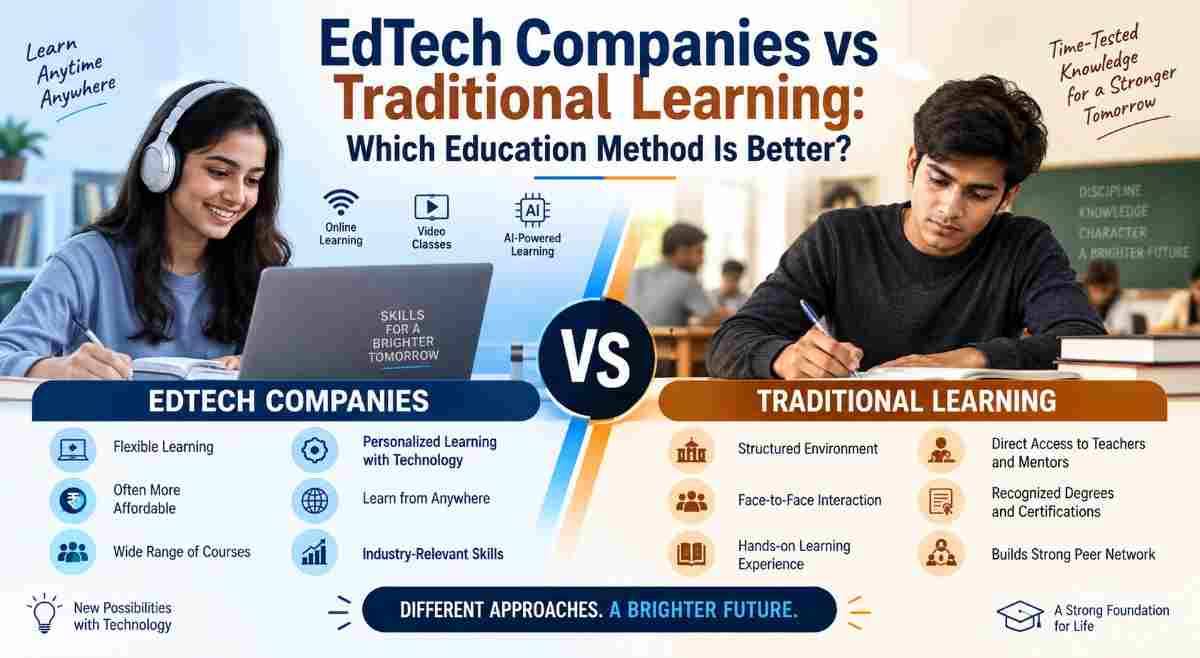
The debate between online, EdTech-delivered education and traditional, in-person learning often gets framed as an either-or choice — but the honest answer is considerably more nuanced. Each approach carries genuine strengths and real limitations, and the "better" choice depends heavily on the specific learner, subject matter, and goals involved. This blog compares the two directly and honestly, without assuming either is universally superior.
Strengths of Traditional, In-Person Learning
Direct, immediate interaction: Face-to-face engagement with instructors and peers supports spontaneous discussion, immediate clarification, and richer interpersonal dynamics that can be harder to fully replicate online.
Structured accountability: Fixed schedules and physical presence requirements can support stronger discipline and consistency for learners who benefit from external structure.
Hands-on and lab-based learning: Certain subjects — particularly those requiring physical equipment, lab work, or hands-on practice — are often better supported by in-person facilities.
Campus community and networking: The shared physical experience of a campus environment fosters organic networking and community-building that online formats need to work harder to replicate.
Established institutional trust: Traditional institutions often carry long-established reputations and trust built over decades, which some learners and employers still weigh heavily.
Strengths of EdTech-Delivered Learning
Flexibility for working professionals: Online learning accommodates work and family commitments in ways full-time, in-person programmes generally cannot.
Geographic accessibility: Learners can access quality education regardless of their physical location, removing barriers tied to living near a specific institution.
Often more cost-effective: Online programmes frequently cost less than equivalent in-person options, partly due to lower infrastructure overhead.
Self-paced options: Many EdTech platforms offer self-paced learning, allowing learners to progress according to their own schedule and learning speed.
Faster content updates: Digital delivery allows for more frequent curriculum updates, keeping pace with rapidly evolving fields more easily than some traditional institutions.
Data-driven personalisation: Many EdTech platforms use learning analytics to personalise content and identify areas where individual learners need additional support.
Genuine Limitations of Each Approach
Traditional learning limitations:
Less flexibility for those balancing work, family, or geographic constraints.
Generally higher cost, particularly when factoring in accommodation and related expenses for non-local students.
Slower curriculum update cycles in many established institutions.
EdTech limitations:
Requires stronger self-discipline, particularly for self-paced formats.
Networking and interpersonal interaction require more deliberate effort compared to organic, in-person community-building.
Quality varies significantly across providers, requiring more careful evaluation from learners.
Hands-on, lab-based learning is harder to fully replicate for subjects requiring physical practice.
Which Approach Suits Different Learner Profiles
Working professionals with limited flexibility: EdTech-delivered learning generally offers the practical flexibility needed to balance ongoing education with existing job and family commitments.
Full-time students early in their academic journey: Traditional, in-person learning may offer richer developmental benefits through immersive campus community and structured accountability, particularly for younger learners still building independent study discipline.
Learners in remote or underserved areas: EdTech-delivered learning often provides meaningfully better access to quality education than what's locally available through traditional institutions.
Fields requiring extensive hands-on practice: Traditional, in-person learning may still hold a practical advantage for subjects genuinely requiring physical lab work or hands-on skill development.
A Note on Personal Learning History
Your own past educational experiences can also meaningfully shape which format feels more natural to you. Learners who thrived in structured, in-person environments during earlier education may find a fully online format requires more deliberate adjustment, while those who've already had positive experiences with independent, self-directed learning often adapt to EdTech-delivered formats more comfortably from the outset.
The Emerging Hybrid Model
Rather than treating this as a strict binary choice, many institutions and learners are increasingly adopting hybrid approaches — combining online flexibility with periodic in-person components, such as occasional campus immersion sessions or blended delivery formats. This hybrid approach often captures meaningful benefits from both models, though it requires institutions to genuinely invest in designing both components well rather than treating either as an afterthought. For those interested in how these frameworks can be applied, explore more in our guide on Understand the Impact of Design Thinking on Business Strategy.
Making the Right Choice for Your Situation
Rather than asking which method is universally "better," it's more useful to ask which method better fits your specific circumstances — your schedule flexibility, learning style, subject matter, budget, and career goals. Both traditional and EdTech-delivered learning can lead to strong outcomes when the format genuinely matches the learner's actual needs and constraints. If you are planning your career growth while evaluating these learning methods, check out our 5 Steps To Creating a Successful Leadership Development Plan.
To explore flexible, accredited education options that combine EdTech delivery with genuine academic rigour, visit Jaro Education.
As both traditional and EdTech-delivered learning models continue to evolve, particularly through growing hybrid approaches, it's worth periodically revisiting your own assumptions about what each format can offer, since the practical differences between them continue to narrow in some respects even as genuine, meaningful distinctions remain in others.
Frequently Asked Questions
Is online, EdTech-delivered education as respected as traditional education by employers?
Increasingly yes, particularly when the programme is delivered through a UGC-entitled university, carrying the same formal academic recognition as traditional, in-person equivalents.
Which is better for networking — traditional or EdTech-delivered learning?
Traditional, in-person learning generally supports more organic networking, though EdTech platforms increasingly offer structured networking opportunities through cohort-based learning and alumni communities.
Are hybrid learning models becoming more common?
Yes, many institutions are increasingly combining online flexibility with periodic in-person components to capture benefits from both approaches.
How do I decide which method is right for me?
Consider your schedule flexibility, learning style, subject matter requirements, and budget, rather than assuming one method is universally superior to the other.