How EHR Telehealth Integration Accelerates Healthcare Interoperability
-

- February 23rd, 2026
- 1,627 views
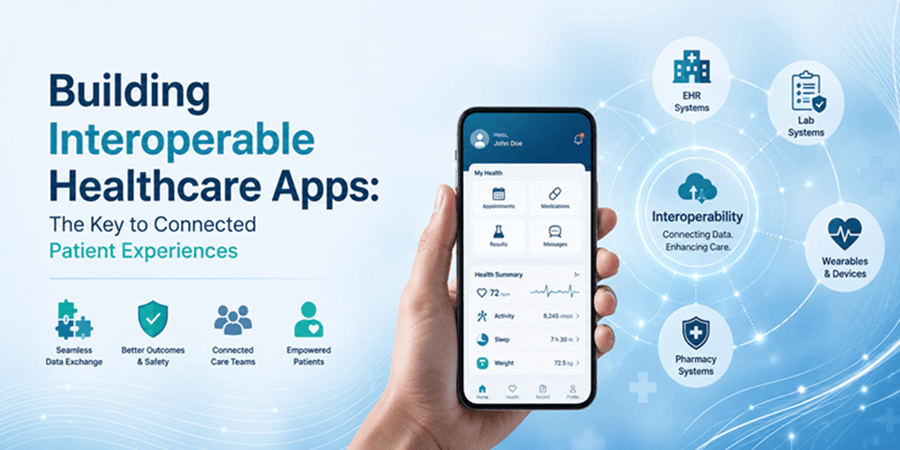
The rise of remote care and virtual visits has made EHR telehealth integration a key driver of healthcare interoperability, enabling clinical teams to share complete patient records across care settings. This integration links telemedicine platforms, remote monitoring devices, and patient portals with electronic health records (EHRs) to support coordinated care, reduce duplication, and improve data continuity.
- EHR telehealth integration connects virtual care tools with EHR systems to improve data flow and clinical decision-making.
- Standards such as FHIR and HL7, secure APIs, and health information exchange (HIE) frameworks are central to interoperability.
- Successful implementation requires attention to clinical workflows, privacy and security (HIPAA/CMS guidance), and patient consent management.
EHR telehealth integration: Benefits and challenges
Integrating telehealth with electronic health record systems offers measurable benefits: unified patient records for virtual and in-person encounters, streamlined documentation, fewer medication and test duplications, and improved chronic disease management through remote patient monitoring (RPM). Interoperability reduces administrative burden and supports population health analytics by enabling data aggregation from distributed sources.
Challenges include technical fragmentation among EHR vendors, inconsistent use of data standards, variations in API maturity, and organizational barriers to change. Privacy, consent management, and secure authentication remain essential concerns, especially where state rules and federal guidance intersect.
Key technologies and data standards
FHIR, HL7, and APIs
The Fast Healthcare Interoperability Resources (FHIR) standard from HL7 provides a modern, web-friendly approach to exchanging clinical data. FHIR-based APIs are increasingly used to enable real-time access to patient records, scheduling, and clinical summaries during telehealth encounters. Legacy HL7 messaging formats and CDA documents may still be used for batch exchange or reporting.
Health Information Exchange and patient portals
Health information exchange (HIE) networks aggregate clinical data across organizations to support continuity of care. Patient portals and mobile health apps that connect to EHRs allow patients to view televisit notes, upload home measurements, and share consent, improving patient engagement and adherence.
Implementation steps for successful integration
Assess workflows and clinical use cases
Begin with mapping clinical workflows to determine which telehealth interactions require full EHR write-back, read access, or simple documentation links. Common use cases include virtual urgent care, behavioral health sessions, chronic care management, and RPM for conditions such as hypertension and diabetes.
Adopt standards-based APIs and testing
Use FHIR APIs for encounter summaries, medication lists, allergies, and observations to reduce semantic gaps. Implement conformance testing and pilot integrations in controlled environments before full deployment to identify data mapping issues.
Change management and training
Train clinicians and support staff on the integrated workflows, documentation expectations, and privacy practices. Define escalation paths for technical issues so telehealth sessions do not disrupt clinical operations.
Privacy, security, and regulatory considerations
Integration must align with applicable privacy laws and regulatory guidance. In the United States, HIPAA provides a baseline for privacy and security safeguards, while the Centers for Medicare & Medicaid Services (CMS) issues telehealth coverage and documentation guidance. Organizations should implement secure authentication, audit logging, encryption in transit and at rest, and robust consent management to meet legal and ethical obligations.
Federal initiatives and standards bodies offer resources and policy direction for interoperability and privacy. For authoritative guidance on interoperability policy and standards, consult the Office of the National Coordinator for Health Information Technology (ONC): ONC interoperability resources.
Outcomes and real-world impacts
Studies and pilot programs have shown that integrated telehealth-EHR systems can reduce emergency department visits for chronic conditions, improve follow-up rates after hospital discharge, and increase clinician access to up-to-date medication and allergy information. Integration enables more complete clinical decision support by supplying telehealth visits with the same context as in-person care.
Future trends
Emerging trends include broader adoption of FHIR Bulk Data for population health analytics, expanded device interoperability for continuous remote monitoring, and increased use of standardized provenance metadata to maintain clinical data lineage. Advances in secure federated learning and privacy-preserving analytics may enable research and quality measurement without centralizing raw patient data.
FAQ
What is EHR telehealth integration and why does it matter?
EHR telehealth integration refers to the technical and workflow-level connection between telemedicine platforms and electronic health records. It matters because it creates a unified patient record that supports safer, more coordinated care and enables interoperability across providers and settings.
Which data standards support telehealth and EHR interoperability?
FHIR (Fast Healthcare Interoperability Resources), HL7 messaging, and secure RESTful APIs are commonly used. Other standards such as DICOM for imaging and Continua/IEEE for device data may apply depending on the use case.
How are privacy and consent handled in integrated telehealth systems?
Privacy and consent are managed through authentication, role-based access controls, explicit patient consent workflows, audit trails, and compliance with applicable regulations such as HIPAA and CMS guidance. Organizations should document consent policies and technical safeguards.
Can integrating telehealth into EHR systems reduce costs?
Integration can reduce duplication of testing and administrative overhead and may lower costs associated with avoidable hospital visits, though outcomes depend on implementation quality and care coordination practices.
How do standards like FHIR improve telehealth integration?
FHIR standardizes data formats and APIs, making it easier for telehealth apps and EHRs to exchange clinical data reliably and in near real-time. This reduces custom integration work and improves scalability across vendors.